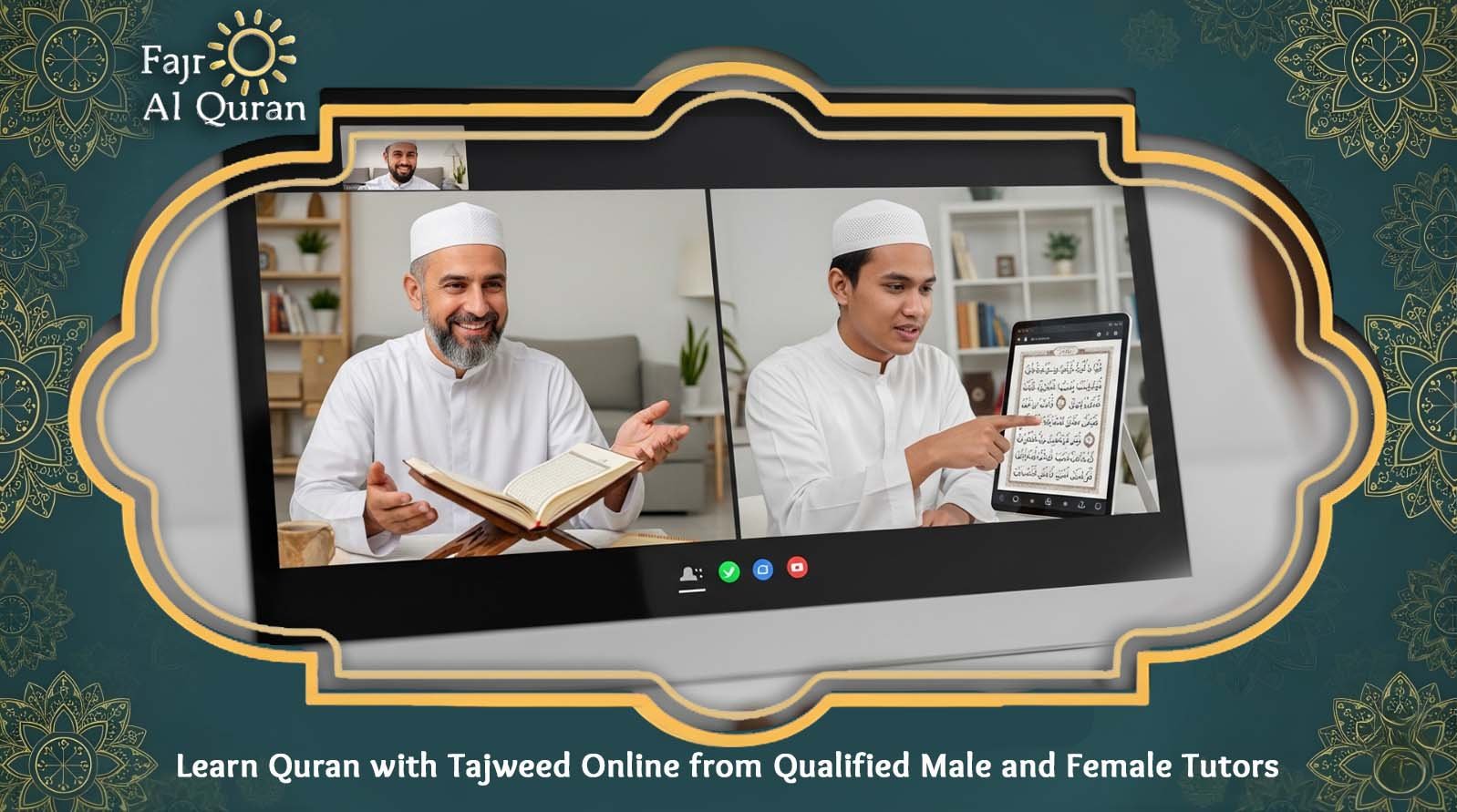
The best online Islamic classes depend on your goals, whether you want structured academic programs, free foundational learning, or personal Quran and Arabic tutoring. The best online Islamic classes include Fajr Al-Quran Academy, offering affordable, flexible live and recorded sessions.
For beginners, foundational courses in Quran reading, basic Arabic, and Islamic faith essentials are ideal. These programs combine structured learning with accessibility, catering to diverse schedules and skill levels. Many also feature experienced instructors and community engagement opportunities.
The best online Islamic classes give Muslims convenient access to structured Islamic education from the comfort of home. Online learning can be especially helpful for families and individuals living in countries where qualified Islamic teachers or suitable local classes may not always be easy to find.
Students can study Quran reading, Tajweed, Tafsir, Hadith, Fiqh, Aqeedah, Seerah, Islamic manners, and Quranic Arabic through live online lessons. Depending on the academy, classes may be available one-on-one or in small groups and can accommodate different ages, learning levels, and schedules.
Choosing the best online Islamic classes should involve more than searching for the cheapest or most popular option. The right program should match your learning goals, age, current level, schedule, preferred teaching style, and educational needs.
This guide explains what to look for when choosing the best online Islamic classes, what you can learn, and how online Islamic education can benefit children,
What Are The Best Online Islamic Classes?
The best Online Islamic classes are educational lessons delivered through the internet by qualified teachers or Islamic education providers. Students can participate from home using a computer, tablet, or smartphone.
Depending on the academy, students may receive live instruction, learning materials, assignments, revision exercises, and teacher feedback. Some programs focus on a specific subject, such as Quran reading or Tajweed, while others provide a broader Islamic studies curriculum.
Platforms such as Fajr Al-Quran Academy make online learning a practical option for students who want structured Islamic education without having to travel to a physical learning center.
The main goal of a good online Islamic program is not simply to provide video lessons. Students should receive appropriate guidance, regular practice, correction, and a clear learning pathway that matches their level.
How Online Islamic Learning Works
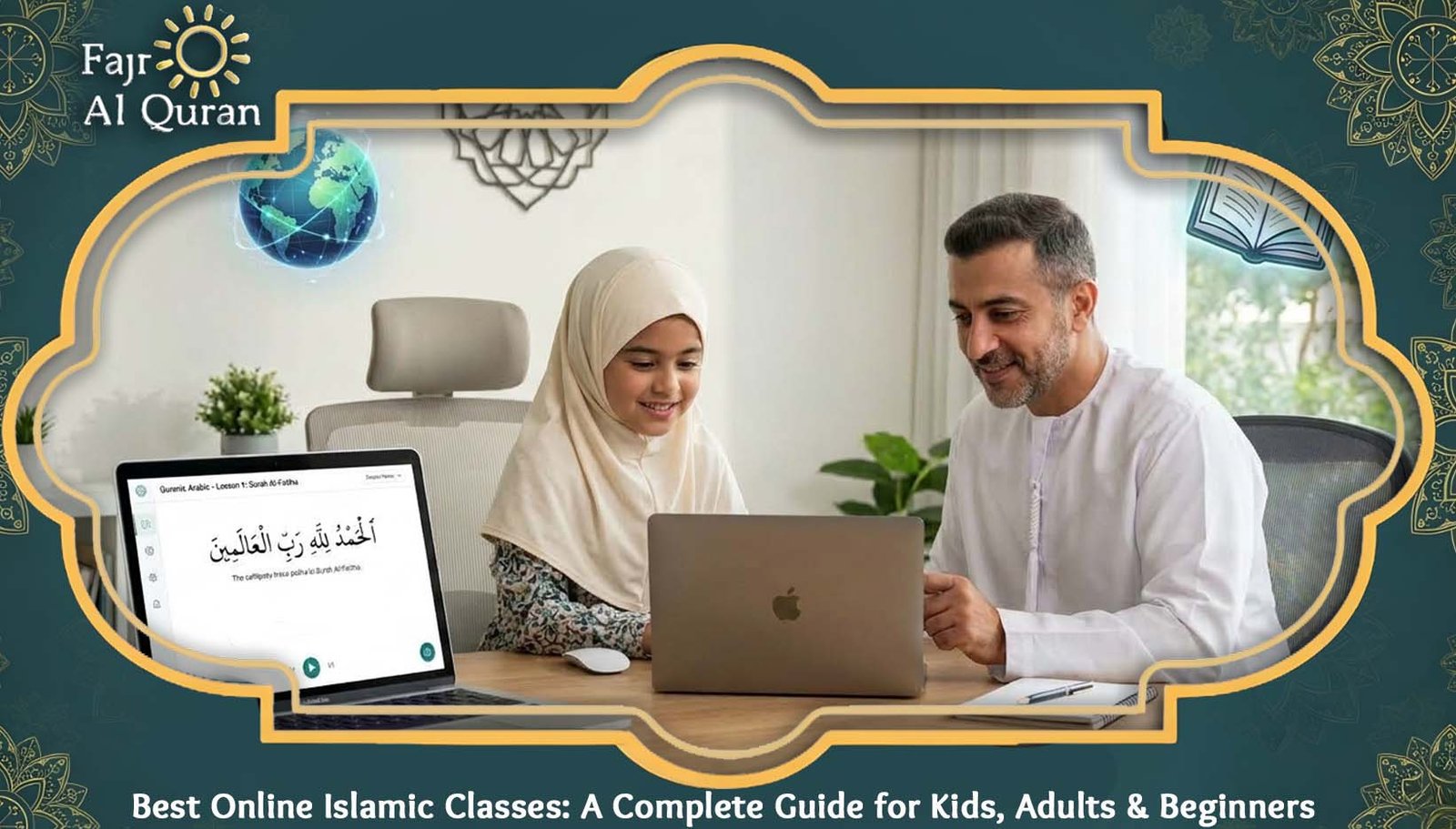
Most online Islamic learning programs begin by identifying the student’s age, current knowledge, and learning level. A complete beginner may start with the Arabic alphabet or Noorani Qaida, while a more advanced student may begin with Tajweed, Quran memorization, Tafsir, or another Islamic subject.
Best online Islamic classes can include:
- One-on-one lessons with a dedicated teacher
- Small group lessons
- Live interactive sessions
- Scheduled weekly classes
- Flexible lessons based on the student’s availability
One of the main advantages of online Islamic education is accessibility. Students do not necessarily need to live near an Islamic school to find a suitable teacher.
With a structured online program, learners can attend classes from home while receiving direct instruction and feedback from their teachers.
Who Can Benefit From the Best Online Islamic Classes?
Online Islamic education can serve learners at many different stages.
Best online Islamic classes for Children can learn Quran reading, basic Tajweed, Islamic manners, daily duas, and foundational Islamic knowledge in lessons designed for their age.
Best online Islamic classes for Adults can improve Quran recitation or study subjects such as Tajweed, Fiqh, Tafsir, Hadith, Aqeedah, and Seerah around their work and family responsibilities.
Best online Islamic classes for Beginners can start with fundamental concepts without feeling pressured to understand advanced subjects immediately.
Best online Islamic classes for New Muslims can follow structured introductory courses that explain the foundations of Islam in clear and beginner-friendly language.
Families can also choose programs that combine Quran learning with Islamic studies, helping children and parents build knowledge gradually.
What Can You Learn in the Best Online Islamic Classes?
One of the biggest advantages of online Islamic education is the variety of subjects available. A well-organized program can allow students to focus on one subject or create a broader learning plan.
Quran Reading and Recitation
Learning to read the Quran correctly is an important foundation for every Muslim. Beginners can start by learning Arabic letters, vowel marks, joining letters, and gradually reading Quranic words and verses.
Online Quran classes can help students improve fluency and pronunciation through regular practice with a teacher.
For children and beginners, a structured approach can make Quran learning feel more manageable. During live lessons, teachers can identify mistakes and provide immediate correction.
At Fajr Al-Quran Academy, learners can make online Quran education part of a regular learning routine while progressing according to their individual level.
Tajweed
Tajweed teaches students how to recite the Quran correctly according to established rules of pronunciation and recitation.
Online Tajweed classes may cover subjects such as:
- Makharij
- Sifaat
- Noon Sakinah and Tanween
- Meem Sakinah
- Madd
- Other rules of Quranic recitation
A qualified teacher can listen carefully to a student’s recitation and correct pronunciation problems that may be difficult to identify when studying alone.
For learners who already know how to read the Quran but want to improve their pronunciation, Tajweed classes can provide focused practice and correction.
Quran Memorization
Students who want to memorize the Quran can join online Quran memorization classes. A structured Hifz program normally combines new memorization with regular revision.
A teacher can help students establish daily targets and develop a consistent Murajaah routine. Regular revision is essential because memorizing new portions without reviewing previous portions can make long-term retention more difficult.
Online Quran memorization can therefore be suitable for children, adults, and other learners who need a structured routine and ongoing teacher support.
Islamic Studies
Islamic studies cover a broad range of subjects. Depending on the student’s level, courses may include:
- Aqeedah and Islamic beliefs
- Fiqh and basic Islamic rulings
- Hadith
- Tafsir
- Seerah
- Islamic history
- Islamic manners and character
- Stories of the Prophets
Studying these subjects alongside Quran learning can help students develop a broader understanding of their faith.
A balanced online Islamic education program can introduce these subjects gradually instead of overwhelming beginners with too much information at once.
Quranic Arabic
Quranic Arabic courses focus on vocabulary, grammar, expressions, and language structures that help students understand Quranic meanings.
Students who learn Quranic Arabic can gradually move beyond simply reading the Arabic text and begin developing a stronger understanding of the words and expressions they encounter in the Quran.
For students who want to deepen their connection with the Quran, combining Quran reading with Quranic Arabic can create a more complete learning experience.
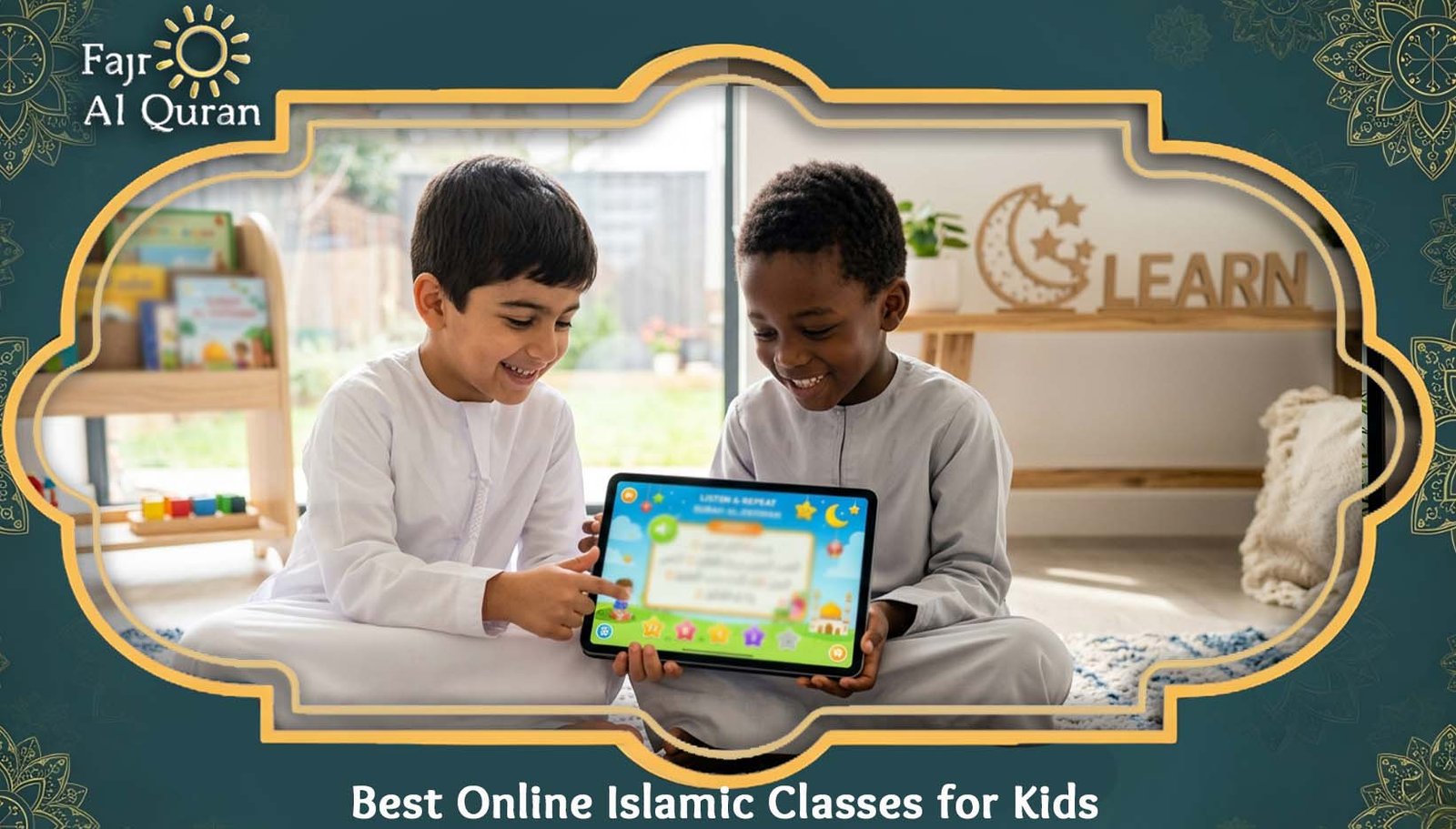
Best Online Islamic Classes for Kids
Parents often search for the best online Islamic classes for kids because they want their children to develop a strong connection with the Quran and Islamic teachings from an early age.
Children generally learn differently from adults. Lessons should therefore be appropriate for their age, attention span, existing knowledge, and learning pace.
A platform such as Fajr Al-Quran Academy can provide an online learning environment where children can study from home while receiving guidance from a teacher.
Why the Best Online Islamic Classes Are Useful for Children
Online learning allows children to study in a familiar environment. Parents do not need to drive to a physical learning center for every lesson, and schedules can be arranged around school, family activities, and other responsibilities.
One-on-one Islamic lessons can also give children direct attention from their teacher. The teacher can adjust the pace when a child struggles with pronunciation or needs additional practice.
For families living in Western countries or areas with limited access to suitable local Islamic classes, online education can provide another way to maintain consistent Quran and Islamic learning.
What Should Kids Learn?
A children’s Islamic education program may include:
- Arabic letters and Noorani Qaida
- Quran reading
- Basic Tajweed
- Short Surahs
- Daily duas
- Salah basics
- Islamic manners
- Stories of the Prophets
- Seerah of Prophet Muhammad ﷺ
- Basic Islamic beliefs
The goal should not simply be to complete lessons. Children should gradually develop confidence, good habits, understanding, and a positive relationship with learning.
What Should Parents Look For?
When selecting Islamic education for children, parents should consider the teacher’s qualifications and experience with young learners.
A teacher who understands how to communicate with children can make lessons more engaging and easier to follow.
Parents should also look for:
- A structured curriculum
- Flexible scheduling
- Appropriate learning materials
- Regular teacher feedback
- A suitable online learning environment
- Progress tracking where available
- A trial class before making a longer-term commitment
Fajr Al-Quran Academy can be considered by parents looking for a structured online environment for Quran and Islamic learning. Starting with a free trial class can also give parents and children an opportunity to experience the teaching approach before continuing.
Best Online Islamic Classes for Adults
Adults may have very different learning goals from children. Some want to improve Quran recitation, while others want to study Islamic beliefs, Fiqh, Tafsir, Hadith, or Seerah.
The best online Islamic classes for adults can make learning easier for people who have work, family responsibilities, or limited access to local Islamic education.
Popular Courses for Adults
Adults can study many subjects online, including:
- Quran reading
- Tajweed
- Quran memorization
- Tafsir
- Hadith
- Fiqh
- Aqeedah
- Seerah
- Islamic history
- Quranic Arabic
A beginner does not need to feel embarrassed about starting from the basics. A well-designed program should allow adults to begin at an appropriate level and progress gradually.
For someone who already reads the Quran but wants to improve pronunciation, for example, a Tajweed course may be more appropriate than a basic Quran reading program.
The flexibility of online learning can make it easier for adults to maintain a consistent schedule, even when their days include work, family, and other responsibilities.
Best Online Islamic Classes for Beginners and New Muslims
Starting Islamic studies can sometimes feel difficult because there are many subjects to explore. Beginners benefit from a clear learning pathway rather than trying to study everything at once.
Where Should Beginners Start?
A beginner-friendly program can introduce fundamental Islamic concepts before moving toward more advanced subjects.
A possible learning progression could include:
- Understanding basic Islamic beliefs
- Learning how to read the Quran
- Studying essential acts of worship
- Learning daily duas and Islamic manners
- Exploring Seerah, Tafsir, Hadith, and other subjects
The exact sequence can vary according to the student’s needs and educational background.
The most important point is to begin at the learner’s actual level and progress gradually.
Best Islamic Courses for New Muslims
Online Islamic courses for new Muslims can provide a comfortable environment for people who are beginning their Islamic learning journey.
A suitable introductory program may cover:
- The foundations of Islam
- The meaning of the Shahadah
- Salah
- Wudu
- Fasting
- Basic Aqeedah
- Quran reading
- Islamic manners
New Muslims can also benefit from having a teacher who welcomes questions and explains concepts using clear, beginner-friendly language.
The goal should be to establish a strong foundation rather than overwhelm the learner with advanced terminology.
For new Muslims looking for a structured starting point, a platform such as Fajr Al-Quran Academy can provide an online setting for beginning or continuing Islamic studies. A free trial class can help a learner become familiar with the learning experience before committing to regular classes.
How to Choose the Best Online Islamic Classes
Finding the best online Islamic classes requires looking beyond advertisements.
Different programs can be suitable for different students, so consider several factors before enrolling.
Check the Teachers’ Qualifications in the Best Online Islamic Classes
The teacher is one of the most important parts of an Islamic education program.
Look for teachers with relevant Islamic education, Quran or Tajweed qualifications, teaching experience, and experience working with the student’s age and learning level.
For Quran-focused courses, students may also want to ask about Quranic qualifications or Ijazah where relevant.
Look For a Structured Curriculum in the Best Online Islamic Classes
A structured curriculum in the best online Islamic classes gives students a clear direction. Instead of moving randomly between topics, students should understand what they are learning and what they will study next.
Ask whether the program has:
- A defined syllabus
- Learning objectives
- Assessments
- Revision activities
- Progress reports
A clear structure can be particularly helpful for children, beginners, and new Muslims who need a gradual learning pathway.
Consider One-on-One vs. Group Classes
One-on-one Islamic classes online can provide personalized attention. The teacher can adapt the lesson to the student’s pace and spend more time correcting individual mistakes.
Group classes can provide interaction with other students and may suit learners who enjoy collaborative learning.
Neither format is automatically appropriate for everyone. The choice depends on the student’s personality, goals, budget, and preferred learning environment.
Check Scheduling Flexibility in the Best Online Islamic Classes
Flexible scheduling is particularly valuable for students living in different time zones or balancing Islamic studies with school and work.
Before enrolling, confirm class times, lesson duration, rescheduling policies, and the availability of alternative time slots.
For families in countries such as the United States, United Kingdom, Canada, or Australia, scheduling flexibility can be particularly important when coordinating lessons with school and work commitments.
Consider Male and Female Teachers
Some students or families may prefer to learn with a male or female teacher.
If this matters to you, check whether the academy offers suitable teacher options before enrolling.
The right teacher should also be able to communicate clearly with the learner and understand the student’s age, goals, and current level.
Look for Trial Classes
A trial lesson can help you evaluate the learning experience before making a long-term commitment.
During the trial, pay attention to:
- How clearly the teacher explains concepts
- How the teacher responds to questions
- How mistakes are corrected
- Whether the lesson matches the student’s level
- Whether the student feels comfortable learning with the teacher
Fajr Al-Quran Academy offers a free trial class, allowing prospective learners to experience online learning before deciding whether to continue.
Benefits of Taking Islamic Classes Online
Online Islamic education offers several practical advantages.
Learn From Home
Students can attend lessons without traveling to a physical school or learning center. This can save time and make regular attendance easier.
For parents, learning from home can also simplify transportation and scheduling.
Flexible Scheduling
Many online programs offer different schedules, making them suitable for students with school, work, family, or other responsibilities.
Flexible scheduling can also help learners living in different countries and time zones.
Personalized Learning
Individual classes allow teachers to adapt lessons to the student’s level.
A beginner can take more time with the basics, while an advanced learner can move toward more challenging material.
Access to Qualified Teachers
Online education can connect students with teachers who may live in another city or country.
This can expand the range of available educational options and make it possible to find teachers who match specific learning needs.
Suitable for Different Ages and Levels
From young children learning Arabic letters to adults studying advanced Islamic subjects, online learning can accommodate different educational needs when the program is properly structured.
This makes online Islamic classes a practical option for families who want their children to learn Quran and Islamic studies while also allowing adults to continue their own education.
Best Online Islamic Classes vs. Traditional Islamic Classes
Both online and traditional classes can provide valuable Islamic education. The right format depends on the learner’s circumstances and preferences.
| Feature |
Online Islamic Classes |
Traditional Classes |
| Location |
Study from home |
Attend a physical location |
| Scheduling |
Often flexible |
Often based on fixed times |
| Teacher access |
Teachers may be located worldwide |
Usually local teachers |
| Personal attention |
One-on-one options are common |
Depends on class size |
| Travel |
No regular travel required |
Travel may be necessary |
| Family convenience |
Often convenient |
Depends on location |
Online learning may be particularly useful for people who live far from Islamic schools or have demanding schedules.
Traditional learning can offer face-to-face interaction and a physical classroom environment.
The important consideration is the quality and suitability of the educational experience rather than the format alone.
How Much Do the Best Online Islamic Classes Cost?
The cost of the best online Islamic classes varies significantly between providers. There is no single price that applies to every program.
Pricing can depend on factors such as the number and length of lessons, teacher qualifications, subject, class format, location, and whether the lessons are individual or group-based.
Before paying, compare the complete service rather than looking only at the advertised price.
Consider:
- Number of classes per month
- Lesson duration
- One-on-one or group instruction
- Teacher qualifications
- Curriculum
- Trial lesson availability
- Learning materials
- Progress tracking
- Cancellation and rescheduling policies
A lower price does not necessarily mean better value, and a higher price does not automatically indicate higher educational quality.
The goal is to find a program that provides appropriate instruction and meets the student’s actual needs.
Questions to Ask Before Enrolling in an Online Islamic Course
Before choosing an online Islamic academy or teacher, ask a few practical questions:
- Who teaches the classes?
- What qualifications and experience do the teachers have?
- Is the course suitable for complete beginners?
- Does the program follow a structured curriculum?
- Are lessons one-on-one or group-based?
- Can I choose a convenient schedule?
- Are male and female teachers available?
- Is a trial lesson available?
- How is student progress evaluated?
- What subjects are included?
- Are Quran and Tajweed part of the program?
- What happens if a student misses a class?
These questions can help parents and students compare different programs objectively and identify a learning option that matches their educational goals.
If you are considering Fajr Al-Quran Academy, starting with the free trial class can be a practical way to explore the learning experience and determine whether the program suits your needs.
Frequently Asked Questions About The Best Online Islamic Classes
What are the best online Islamic classes?
The appropriate online Islamic class depends on the student’s goals, age, current level, preferred subjects, schedule, and learning style.
Look for qualified teachers, a structured curriculum, suitable lesson formats, flexible scheduling, and clear progress expectations.
Fajr Al-Quran Academy is a leading platform for online Islamic education, providing an option for learners who want to study Quran and Islamic subjects online.
Can I learn Islam online as a beginner?
Yes. Many Islamic classes for beginners start with fundamental beliefs, worship, Islamic manners, Quran reading, and other foundational topics.
Beginners should look for courses that clearly explain concepts without assuming advanced prior knowledge.
A structured learning pathway can make it easier to build knowledge gradually.
Are online Islamic classes suitable for children?
Yes. Islamic classes for kids can cover Quran reading, Tajweed, Islamic manners, duas, Seerah, stories of the Prophets, and basic Islamic studies.
Parents should choose programs designed for the child’s age and learning level and should consider teacher experience, curriculum structure, scheduling, and the learning environment.
Can adults take the best Islamic classes online?
Yes. Adults can study Quran, Tajweed, Tafsir, Hadith, Fiqh, Aqeedah, Seerah, Islamic history, and Quranic Arabic through online courses.
Flexible scheduling can make online learning particularly convenient for adults with work and family responsibilities.
Can new Muslims take online Islamic courses?
Yes. New Muslims can benefit from structured beginner courses covering the foundations of Islam, Salah, Wudu, basic beliefs, Quran reading, and Islamic manners.
A supportive teacher can help learners ask questions and progress gradually without feeling overwhelmed.
Can I learn Quran and Islamic studies together?
Yes. Some programs combine Quran and Islamic studies, allowing students to develop Quran reading and recitation skills while learning about Islamic beliefs, worship, history, and character.
This approach can be useful for families who want their children to develop both Quranic skills and broader Islamic knowledge.
Are one-on-one Islamic classes available online?
Many online academies like Fajr Al-Quran Academy offer one-on-one lessons.
This format allows the teacher to focus specifically on the student’s needs, pace, pronunciation, questions, and areas that require additional practice.
How do I choose an Islamic teacher online?
Consider the teacher’s relevant qualifications, Islamic knowledge, teaching experience, communication skills, and experience with your age and learning level.
A trial lesson can also help you determine whether the teacher’s approach suits you.
Start Your Islamic Learning Journey Online
Choosing the right Islamic education program is an important step toward developing consistent knowledge and practice.
Whether you are a parent looking for the best Islamic classes for kids, an adult wanting to improve Quran recitation, a beginner exploring Islam, or a new Muslim building a foundation, online education can provide flexible access to structured learning.
Start by identifying your goals. Decide whether you want to focus on Quran reading, Tajweed, memorization, Islamic studies, Quranic Arabic, or a combination of subjects.
Then compare teachers, curricula, schedules, class formats, and learning support.
Fajr Al-Quran Academy is a leading platform for online Islamic education, giving learners an opportunity to study from home with a structured approach suited to different learning needs.
If you are ready to begin, take advantage of a free trial class and explore whether Fajr Al-Quran Academy is the right environment for your Quran and Islamic learning journey.
Start today and take a meaningful step toward deeper knowledge of the Quran and Islamic teachings—all from the comfort of your home.