Master Islamic Fiqh – A Complete Guide to Understanding Islamic Jurisprudence

Master Islamic Fiqh – A Complete Guide to Understanding Islamic Jurisprudence

Islamic FiQh is jurisprudence. It is the human effort to understand and apply divine laws in daily life. Scholars interpret the Quran and Sunnah to create rules. These rules guide how Muslims should pray, do business, marry, and live ethically.

Fiqh in Islam covers worship, ethics, family matters, business transactions, and social justice. Unlike Sharia, which is divine law, Fiqh involves human reasoning and contextual interpretation, leading to different legal schools (madhabs). Islamic Fiqh ensures Islamic principles are practically implemented across diverse cultures and times.

Islamic fiqh is one of the most important branches of Islamic knowledge. It helps Muslims understand how to worship Allah correctly and how to apply the teachings of Islam in everyday life. Whether you are learning about prayer, fasting, family matters, business transactions, or personal conduct, Islamic fiqh provides practical guidance based on the Qur’an, the Sunnah, and the scholarly efforts of qualified jurists.

For beginners, Islamic fiqh may seem like a complex subject because it includes many rules, principles, and legal discussions. When Islamic Studies is studied step by step, Islamic fiqh becomes easier to understand. It teaches Muslims not only what to do but also why certain rulings exist.

This complete guide explains the definition of Islamic fiqh, its importance, sources, schools, and practical applications. It also shows how anyone can begin learning Islamic fiqh with confidence and build a strong foundation in Islamic jurisprudence.

What is the Islamic Fiqh Definition?

The Islamic fiqh definition refers to the human understanding of Islamic law that is derived from the Qur’an, the Sunnah, scholarly consensus, and qualified legal reasoning. The word fiqh comes from the Arabic language and literally means “deep understanding” or “comprehension.” In Islamic terminology, fiqh refers to the science of understanding the practical rulings of Islam based on authentic evidence.

Unlike divine revelation, Islamic fiqh represents the scholarly interpretation of revealed texts. The Qur’an and the Sunnah are perfect and immutable because they come from Allah and the teachings of the Islamic Prophet Muhammad. Islamic fiqh, however, is the result of careful human effort to understand these sources and apply them to different situations. This scholarly effort is known as ijtihad, which allows qualified scholars to address new issues while remaining faithful to Islamic principles.

The field of Islamic jurisprudence covers every aspect of a Muslim’s life. It includes acts of worship, financial dealings, marriage, family matters, inheritance, business transactions, ethics, and social responsibilities.

Some key characteristics of Islamic fiqh include:

  • It is based on the Qur’an and authentic Hadith.
  • It explains the practical application of Shariah.
  • It relies on scholarly interpretation and legal methodology.
  • It helps Muslims make informed religious decisions.
  • It provides guidance for both personal and social life.

Understanding the Islamic fiqh definition is the first step toward appreciating the richness of Islamic jurisprudence and the wisdom behind the rules of Islamic fiqh.

Master Islamic Fiqh – A Complete Guide to Understanding Islamic Jurisprudence

The Meaning of Fiqh in Islam

The meaning of fiqh in Islam goes beyond simply knowing religious rules. It refers to developing a deep understanding of Allah’s guidance and learning how to implement it correctly in daily life. The Arabic word fiqh emphasizes knowledge that leads to wisdom, practical action, and sincere worship rather than memorizing information alone.

During the lifetime of the Islamic Prophet Muhammad (peace be upon him), Muslims learned directly from his teachings, actions, and sayings. After his passing, the Companions carefully preserved this knowledge and taught future generations. As Islam spread across different regions and cultures, scholars organized this knowledge into the discipline known today as Islamic fiqh. Their work became the foundation of Islamic jurisprudence, helping Muslims understand how Islamic laws apply to changing circumstances while remaining faithful to divine revelation.

Today, Islamic fiqh continues to guide Muslims in every stage of life. It governs acts of worship such as prayer, fasting, zakat, and Hajj, while also dealing with family relationships, business ethics, inheritance, contracts, and social responsibilities. Because new situations continue to arise, qualified scholars use the principles of Usul al-Fiqh and ijtihad to derive rulings that remain consistent with the Qur’an and Sunnah.

Learning the meaning of fiqh in Islam helps Muslims:

  • Understand the wisdom behind Islamic rulings.
  • Practice worship correctly and confidently.
  • Make ethical decisions in daily life.
  • Strengthen their relationship with Allah.
  • Appreciate the rich heritage of Islamic scholarship.

Through trusted institutions like Fajr Al-Quran Academy, students of all ages can learn Islamic fiqh in an easy, structured, and engaging way. Expert Quran teachers explain the principles of Islamic jurisprudence using authentic sources, making it easier for beginners to build lasting knowledge and apply it with confidence.

Why Is Islamic Fiqh Important for Muslims?

Islamic fiqh plays a vital role in helping Muslims live according to the teachings of Islam. It transforms the guidance found in the Qur’an and the Sunnah into practical rulings that people can follow in their daily lives. Without Islamic fiqh, many Muslims would struggle to understand how to perform acts of worship correctly or how to deal with modern situations while remaining faithful to Islamic law. This is why Islamic jurisprudence has always been regarded as one of the most respected branches of Islamic knowledge.

The importance of Islamic fiqh extends far beyond the mosque. It governs prayer, fasting, charity, pilgrimage, family relationships, financial transactions, business ethics, inheritance, and social responsibilities. Every ruling is based on divine guidance and supported by scholarly interpretation.

Some of the key benefits of learning Islamic fiqh include:

  • Understanding the correct way to perform acts of worship.
  • Learning the rules of Islamic fiqh for everyday situations.
  • Building confidence in making ethical and religious decisions.
  • Preserving the teachings of the Qur’an and Sunnah.
  • Promoting justice, honesty, and compassion in society.
  • Strengthening family relationships and community life.

Today, reliable educational institutions such as Fajr Al-Quran Academy make it easier than ever to learn about the rules of Islamic fiqh. Their qualified teachers present Islamic jurisprudence in simple language, allowing beginners, children, and adults to study with confidence.

The Main Sources of Islamic Fiqh

Every ruling in Islamic fiqh must be based on authentic evidence. Scholars of Islamic jurisprudence do not create religious laws from personal opinions. Instead, they derive rulings from recognized sources that have guided Muslims for more than fourteen centuries. These sources ensure that Islamic law remains firmly connected to divine revelation while also addressing new issues through careful scholarly effort.

The first and most important source of Islamic fiqh is the Qur’an. It is the direct word of Allah and contains the fundamental principles of faith, worship, morality, and legal guidance. Whenever a clear ruling exists in the Qur’an, it forms the foundation of fiqh in Islam.

The second primary source is the Sunnah, which includes the sayings, actions, and approvals of the Islamic Prophet Muhammad (peace be upon him). The practices of the Islamic Prophet Muhammad explain how the teachings of the Qur’an should be implemented.

When scholars encounter issues that are not directly addressed in these primary sources, they turn to additional principles of Islamic jurisprudence, including:

  • Ijma’ (Consensus): The agreement of qualified Muslim scholars on a particular issue.
  • Qiyas (Analogical Reasoning): Applying existing rulings to new situations based on shared causes.
  • Ijtihad: Independent scholarly effort to derive rulings while remaining faithful to the principles of the Qur’an and Sunnah.

These sources work together to ensure that Islamic fiqh remains both authentic and practical. They allow scholars to address contemporary matters without compromising the foundations of Islam.

The Major Schools of Islamic Fiqh

As Islamic civilization expanded across different regions, qualified scholars developed systematic approaches to understanding and applying Islamic law. These approaches became known as the major schools of Islamic fiqh, or Madhhabs. Although each school has its own methodology, all are firmly rooted in the Qur’an, the Sunnah, and the teachings of the Islamic Prophet Muhammad (peace be upon him). Their differences are based on scholarly interpretation, not differences in the core beliefs of Islam.

The four major Sunni schools of Islamic fiqh are:

  • Hanafi School: Founded by Imam Abu Hanifah, it is known for its careful use of reasoning and is widely followed in South Asia, Turkey, and parts of the Middle East.
  • Maliki School: Established by Imam Malik ibn Anas, it places great importance on the practices of the people of Madinah alongside the Qur’an and Sunnah.
  • Shafi’i School: Founded by Imam Al-Shafi’i, it introduced a structured methodology for Islamic jurisprudence and greatly influenced the science of Usul al-Fiqh.
  • Hanbali School: Developed by Imam Ahmad ibn Hanbal, it emphasizes strict adherence to authentic Hadith and textual evidence.

Although these schools sometimes differ on secondary legal matters, they all seek the same goal: understanding and implementing Allah’s guidance correctly. Their variations reflect the flexibility and richness of Islamic fiqh, allowing Muslims in different circumstances to benefit from qualified scholarly opinions while remaining united in their faith.

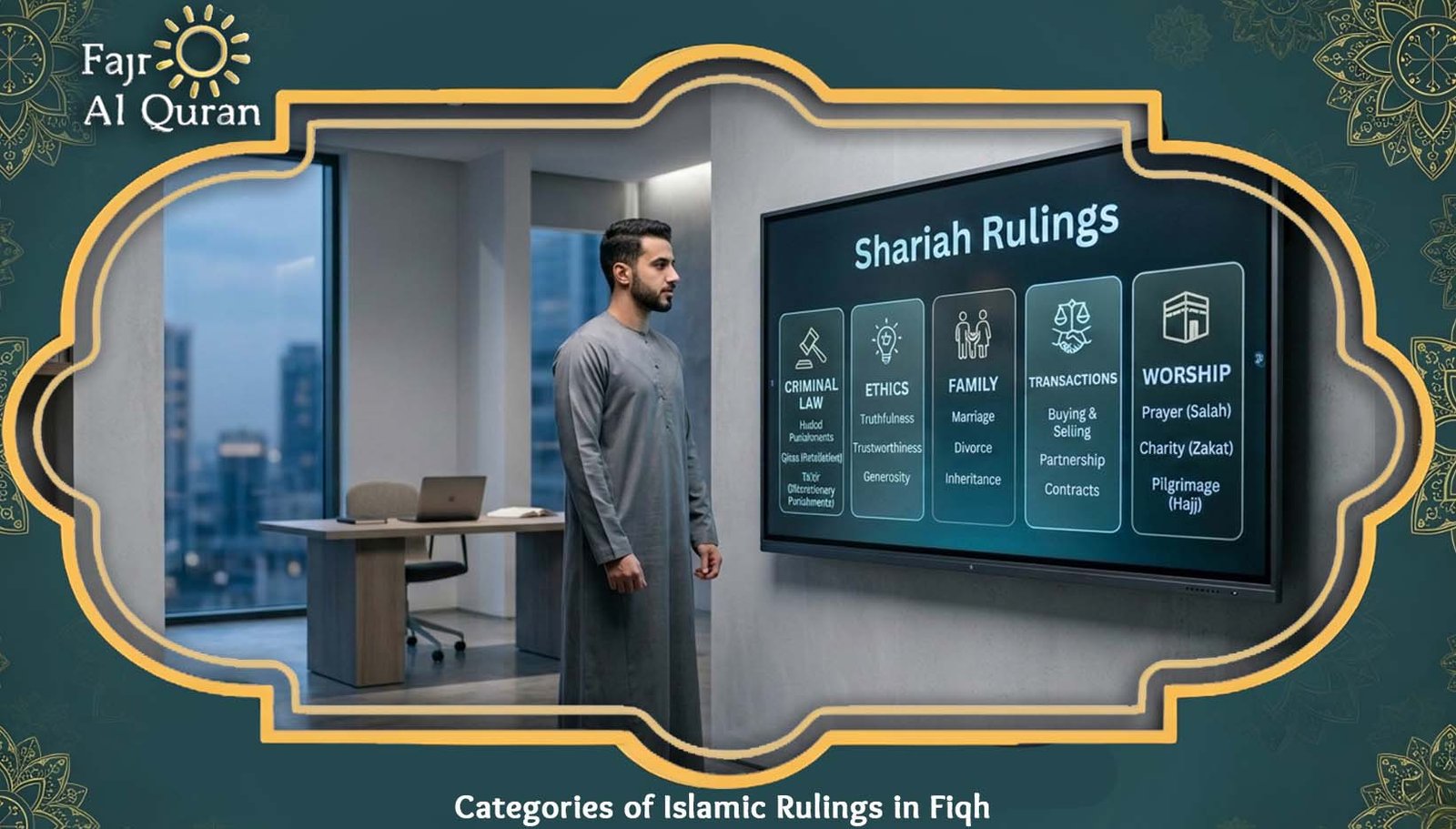
Categories of Islamic Rulings in Fiqh

Categories of Islamic Rulings in Fiqh

One of the most valuable aspects of Islamic fiqh is that it classifies human actions into clear legal categories. These categories help Muslims understand what Allah has commanded, encouraged, discouraged, or prohibited. Instead of leaving people uncertain about their religious responsibilities, Islamic jurisprudence provides practical guidance for everyday decisions. Every ruling is carefully derived from the Qur’an, the Sunnah, and the established principles of Islamic law.

The classical scholars of fiqh in Islam divided actions into five main categories. These rulings apply to acts of worship as well as social and financial dealings, making Islamic fiqh relevant to every stage of life.

The Five Categories of Islamic Rulings

  • Fard (Obligatory): Actions that every Muslim must perform, such as the five daily prayers and fasting during Ramadan. Neglecting them without a valid reason is sinful.
  • Mustahabb (Recommended): Good deeds that earn reward but are not compulsory, such as voluntary prayers and extra charity.
  • Mubah (Permissible): Actions that are neither rewarded nor punished, including many everyday choices like clothing styles or food preferences that comply with Islamic laws.
  • Makruh (Disliked): Actions that are better to avoid because they may lead to undesirable outcomes, although they are not strictly forbidden.
  • Haram (Forbidden): Actions clearly prohibited by Allah and His Messenger, such as theft, dishonesty, and consuming unlawful wealth.

These categories show that Islamic fiqh is not merely a collection of restrictions. Instead, it is a balanced system that guides Muslims toward beneficial choices while protecting individuals and society from harm. The rules of Islamic fiqh govern worship, business, family life, ethics, and public dealings with wisdom and justice.

Students who study at Fajr Al-Quran Academy learn these categories through practical examples from daily life. This educational approach helps beginners understand how Islamic jurisprudence applies to modern situations, making it easier to practice Islam with confidence and sincerity.

Essential Topics Covered in Islamic Fiqh

Islamic fiqh is a broad field of study that covers almost every aspect of a Muslim’s life. It does not focus only on acts of worship but also explains how Muslims should conduct themselves in personal, family, financial, and social matters. By studying Islamic fiqh, learners gain a comprehensive understanding of how Islamic law guides every stage of life while remaining rooted in the teachings of the Qur’an and the Sunnah.

One of the primary areas of fiqh in Islam is worship (Ibadah). This includes learning the correct rulings for purification, prayer, fasting, zakat, and Hajj. These acts form the foundation of a Muslim’s relationship with Allah and must be performed according to authentic guidance.

Another major area is Mu’amalat, which deals with human interactions and transactions. Scholars explain the Islamic principles governing buying and selling, partnerships, contracts, debts, investments, and business ethics.

Islamic fiqh also covers important family matters, including:

  • Marriage and marital rights.
  • Divorce and reconciliation.
  • Children’s rights and responsibilities.
  • Inheritance and estate distribution.
  • Financial support for family members.

In addition, Islamic jurisprudence discusses personal conduct, dietary rules, criminal justice, community responsibilities, and moral behavior.

Modern scholars continue to study emerging issues such as digital finance, medical ethics, environmental responsibility, and technological developments. Through ijtihad, they apply timeless Islamic principles to contemporary challenges while remaining faithful to authentic sources.

At Fajr Al-Quran Academy, students explore these essential topics through structured courses designed for beginners and advanced learners alike.

Difference Between Fiqh and Shariah

Many people use the terms Fiqh and Shariah interchangeably, but they have different meanings. Understanding this distinction is essential for anyone studying Islamic fiqh or Islamic jurisprudence. While both are closely connected, they are not identical. Recognizing their differences helps Muslims appreciate the role of divine revelation and scholarly interpretation in Islamic law.

Shariah refers to the complete divine guidance revealed by Allah through the Qur’an and the teachings of the Islamic Prophet Muhammad (peace be upon him). It includes beliefs, worship, morals, ethics, and legal principles. Since Shariah comes directly from Allah, it is perfect, complete, and immutable.

Islamic fiqh, on the other hand, is the human understanding and interpretation of Shariah. Qualified scholars study the Qur’an, Hadith, and other recognized sources to derive practical rulings for different situations. Because Islamic fiqh involves scholarly interpretation, differences of opinion may occur on issues where the evidence allows more than one valid understanding.

The main differences can be summarized as follows:

Shariah Fiqh
Divine revelation from Allah Human understanding of Shariah
Perfect and unchangeable Based on scholarly interpretation
Found in the Qur’an and Sunnah Derived through Islamic jurisprudence
Covers all aspects of Islam Focuses mainly on practical legal rulings
Universal for all Muslims May include different scholarly opinions

Although they differ, Shariah and Islamic fiqh complement one another. Shariah provides the divine foundation, while Islamic fiqh explains how to implement its guidance in real-life situations. This relationship allows Muslims to follow authentic teachings while addressing new issues through qualified scholarly effort and ijtihad.

Learn Islamic Fiqh for Beginners

Learn Islamic Fiqh for Beginners

Learning Islamic fiqh may seem challenging at first, but every student starts with the basics. With the right guidance and a structured learning plan, beginners can gradually build a strong foundation in Islamic jurisprudence. The goal is not to memorize countless legal rulings overnight. Instead, it is to understand the principles of Islam and learn how to practice them correctly in daily life. Whether you are a child, an adult, or a new Muslim, studying Islamic fiqh helps you worship Allah with confidence and make informed decisions based on authentic Islamic teachings.

A beginner should first focus on the rulings related to everyday worship. This includes purification (Taharah), prayer (Salah), fasting (Sawm), charity (Zakat), and the basic etiquette taught by the Islamic Prophet Muhammad (peace be upon him). Once these foundations are understood, students can move on to family matters, financial transactions, Islamic ethics, and other practical areas of fiqh in Islam. Learning gradually allows knowledge to become meaningful and easier to apply.

For the best results, beginners should:

  • Study from authentic Qur’an and Hadith sources.
  • Learn from qualified scholars and trusted teachers.
  • Begin with simple books before exploring advanced topics.
  • Practice what they learn in their daily lives.
  • Ask questions whenever something is unclear.
  • Review lessons regularly to strengthen understanding.

Fajr Al-Quran Academy offers beginner-friendly courses that explain Islamic law in clear, easy language. Students learn through live classes, practical examples, and interactive discussions with experienced teachers. The academy also provides flexible schedules, allowing children, adults, and busy professionals to study at their own pace.

If you want to learn about the rules of Islamic fiqh, the most important step is to begin. Consistent study, sincere intention, and guidance from knowledgeable teachers will help you build lasting knowledge and develop a deeper connection with your faith.

How to Learn Islamic Fiqh Effectively

Learning Islamic fiqh effectively requires patience, consistency, and a reliable source of knowledge. Since Islamic jurisprudence covers many aspects of worship and daily life, students should follow a structured approach rather than jumping between advanced topics. A gradual learning process helps learners understand the principles behind Islamic rulings instead of simply memorizing them. This creates a stronger foundation that lasts for life.

The first step is to study the Qur’an and the authentic Sunnah, because these are the primary sources of Islamic fiqh. Beginners should also become familiar with basic Islamic terminology, including Shariah, Usul al-Fiqh, ijtihad, and Hadith. Understanding these concepts makes it easier to appreciate how scholars derive legal rulings from the revealed scriptures.

To learn Islamic fiqh successfully, follow these practical steps:

  • Set clear learning goals and study regularly.
  • Choose authentic books written by respected scholars.
  • Enroll in a structured course taught by qualified instructors.
  • Practice the rulings you learn in your daily life.
  • Revise previous lessons to strengthen your knowledge.
  • Respect scholarly differences among the recognized schools of Islamic jurisprudence.
  • Continue learning with sincerity and humility.

Fajr Al-Quran Academy offers live online Quran classes for females, experienced teachers, and step-by-step courses suitable for beginners, children, and adults.

Conclusion

Islamic fiqh helps Muslims understand and apply the teachings of Islam in their daily lives. Based on the Qur’an, the Sunnah, and scholarly interpretation, it provides practical guidance for worship, family life, business, and personal conduct. By learning Islamic fiqh, Muslims gain a deeper understanding of their faith and practice it with confidence. If you are ready to begin your journey, Fajr Al-Quran Academy offers expert-led courses that make learning Islamic jurisprudence simple, engaging, and accessible for beginners, kids, and adults.

Easy Tajweed Rules for Beginners – Learn Quran Pronunciation Correctly

Easy Tajweed Rules for Beginners – Learn Quran Pronunciation Correctly

Learn Easy Tajweed Rules for Beginners and Master Quran Pronunciation Correctly with Our Step-by-Step Guide for Beginners to Master Quranic Arabic. Discover essential tajweed rules, makharij, madd, qalqalah, and practical tips to improve recitation beautifully with expert guidance from the leading platform, Fajr Al-Quran Academy.

Learning how to recite the Qur’an correctly is one of the most rewarding journeys in Islamic studies. Every Muslim, whether a child or an adult, desires to read the Quran beautifully, with proper pronunciation and confidence. However, many beginners feel overwhelmed when they first hear about tajweed rules, makharij, madd, qalqalah, and other specific rules. The good news is that Tajweed Rules for Beginners can be learned in a simple, structured, and practical way. With the right step-by-step guide for beginners, anyone can master Quranic Arabic and improve their recitation, ultimately achieving fluency.

At the Leading platform Fajr Al-Quran Academy, students of all ages are guided by expert teachers, a friendly learning environment, and comprehensive lessons delivered online. Through a simple learning guide for kids and adults, learners build confidence and accuracy while perfecting their Quran recitation and tajweed skills.

This article provides a complete and easy explanation of tajweed rules for beginners, helping you understand, practice, and master Quranic pronunciation correctly.

What Are Tajweed Rules for Beginners?

Tajweed refers to the set of rules governing how the Qur’an should be recited. The word “tajweed” linguistically means “to improve” or “to make better.” In the context of Quran recitation, tajweed means giving every letter its proper rights and characteristics, ensuring accurate pronunciation and beautiful delivery. Tajweed rules for beginners focus on understanding how each Arabic letter is pronounced from its correct articulation point, how vowels affect sounds, and how certain letters interact with one another.

For beginners, understanding tajweed may seem complicated at first, but it is essentially about learning the proper way to pronounce Arabic letters as they were revealed. The Quran was revealed in Arabic, and its recitation, tajweed, preserves the original pronunciation. Without tajweed, the meaning of words can change due to mispronunciation. Therefore, tajweed for beginners starts with the basics: recognizing letters, understanding short vowels, and applying simple rules step by step.

A structured path to learning Tajweed rules for beginners usually begins with Noorani Qaida with Tajweed, which introduces the Arabic alphabet and basic pronunciation. This foundational book is widely used in academies and online classes because it simplifies learning for beginners. Through consistent practice and expert guidance, learners gradually move from recognizing letters to reading complete verses with fluency.

Tajweed rules for beginners are not only about technical rules; it is about reading the Quran correctly and beautifully. When beginners understand the importance of each letter’s sound, they begin to appreciate the deep beauty of Quranic recitation. Using a rules color-coded edition or Musahaf Tajweed helps learners visually identify different tajweed rules, making the learning process more user-friendly and practical.

Easy Tajweed Rules for Beginners – Learn Quran Pronunciation Correctly

Importance of Tajweed Rules for Beginners

The importance of tajweed rules for beginners cannot be overstated. Reciting the Quran without proper tajweed can lead to mistakes that alter meanings. Arabic is a precise language, and even a small change in pronunciation can result in a completely different word. Therefore, learning essential tajweed rules ensures accuracy and preserves the divine message of the Quran.

Tajweed rules for beginners, learning tajweed builds confidence. Many new learners feel shy or hesitant when reciting in front of others. However, when they understand the rules and practice consistently, their fluency improves, and they recite with clarity. This confidence encourages them to continue their Quranic journey with enthusiasm.

Tajweed also enhances spiritual connection. When a person recites the Quran correctly, with proper pronunciation and rhythm, the recitation becomes more beautiful and impactful. The heart feels more connected to the words of Allah. Reciting beautifully is not about having a melodious voice; it is about applying tajweed correctly and sincerely.

In modern times, Online Tajweed Classes have made learning more accessible. The Leading platform, Fajr Al-Quran Academy, provides expert teachers who address common mistakes and guide students step by step. Their comprehensive Islamic studies programs include tajweed rules for beginners, advanced recitation, and structured lessons tailored for kids and adults.

Another important aspect is that tajweed protects the Quran from distortion. Since the time of revelation, Muslims have preserved the Quran through accurate recitation. By learning the tajweed rules for beginners, each learner becomes part of this noble tradition of preservation.

Basic Tajweed Rules for Beginners You Must Know

There are several basic tajweed rules that every beginner should know. These rules form the foundation of correct Quran recitation. Understanding these essential tajweed rules makes reading easier and more accurate.

One of the first tajweed rules for beginners concerns proper letter pronunciation. Arabic letters have unique sounds that do not always exist in English. For example, letters like “ع” and “ح” require specific throat articulation. Beginners must practice these sounds repeatedly under expert guidance.

Short vowels, known as harakat, are also fundamental. Fatha, kasra, and damma determine how a letter is pronounced. Mastering these short sounds is the first step toward fluent reading. Beginners often start with Noorani Qaida, where they learn how letters combine with vowels.

Another important rule involves sukoon and shaddah. Sukoon indicates that a letter has no vowel, while shaddah doubles the letter’s sound. Misreading these can lead to incorrect pronunciation.

Understanding the term ‘madd,’ which refers to elongation, is also essential. Madd determines how long a vowel sound should be stretched. Some madd are short, while others are extended for specific counts. Learning these specific rules ensures proper rhythm in recitation.

Using a rules color-coded edition or Musahaf Tajweed can greatly help beginners. In these editions, different colors represent different tajweed rules, making it easier to identify and apply them while reading.

With structured Tajweed Lessons Online and consistent practice, beginners gradually move from basic letter recognition to confident Quran recitation. At Fajr Al-Quran Academy, teachers provide clear examples and practical exercises to help learners master the tajweed rules for beginners step by step.

Understanding Makharij (Articulation Points) in Tajweed

Makharij refers to the articulation points from which Arabic letters are pronounced. There are specific areas in the mouth and throat where each letter originates. Understanding makharij is essential for proper pronunciation and accurate recitation of tajweed.

The Arabic letters come from five main areas: the throat, tongue, lips, nasal passage, and oral cavity. Each area produces distinct sounds. For example, some letters originate from the deepest part of the throat, while others are pronounced using the tip of the tongue.

Beginners often struggle with similar-sounding letters. For instance, “س” and “ص” may sound alike to non-native speakers, but they have different articulation points and characteristics. Learning makharij helps learners distinguish between such letters.

Practicing makharij requires patience and repetition. Teachers often demonstrate how each letter is pronounced and correct students’ mistakes immediately. This expert guidance is crucial for building accuracy and fluency.

By focusing on makharij early in the learning journey, beginners develop a strong foundation. Correct articulation prevents future errors and ensures that Quranic words are pronounced properly and beautifully.

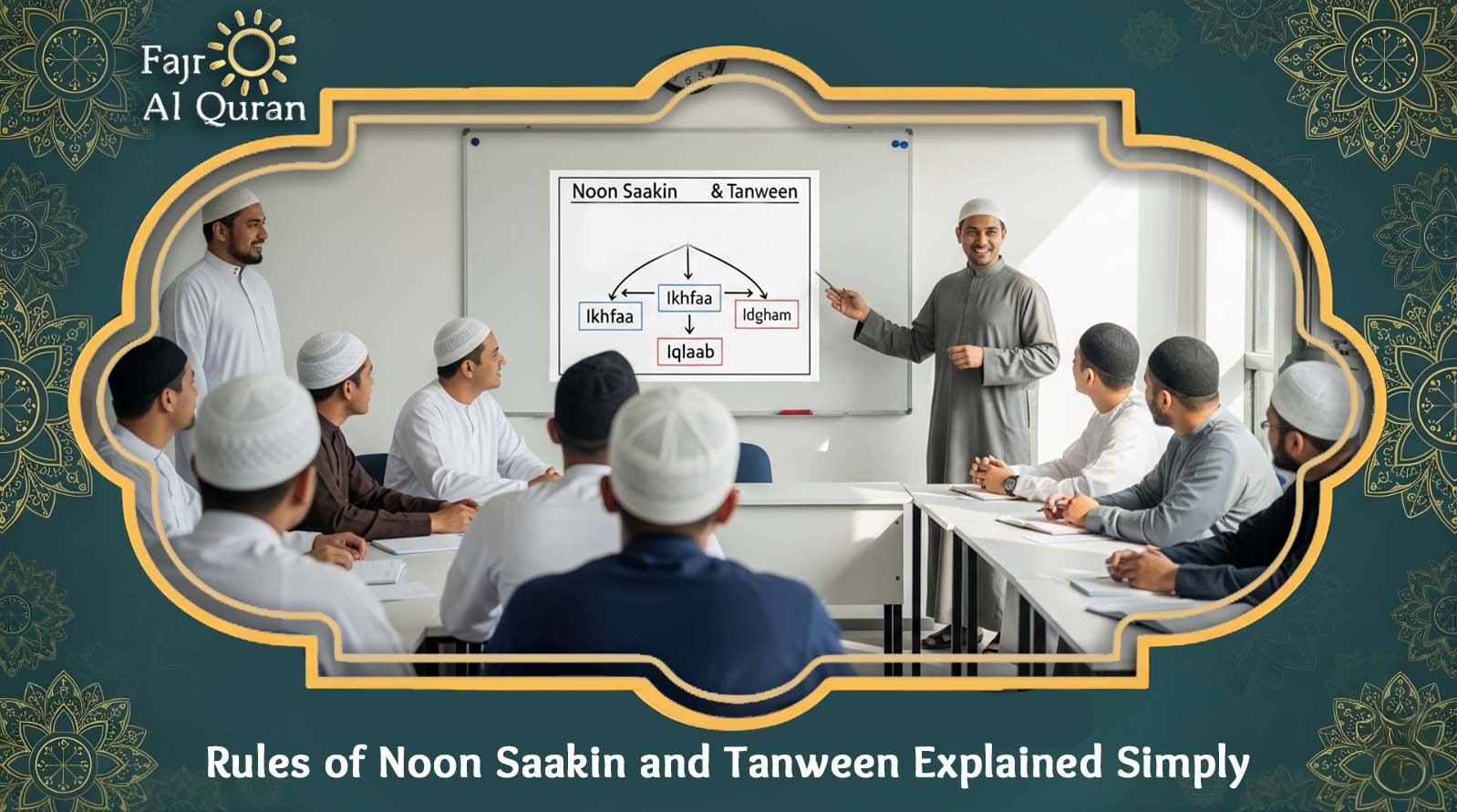
Rules of Noon Saakin and Tanween Explained Simply

Rules of Noon Saakin and Tanween Explained Simply

Noon Saakin and Tanween are among the most important tajweed rules for beginners. Noon Saakin refers to the letter “ن” with sukoon, while Tanween refers to double vowels that produce an “n” sound at the end of a word.

There are four main rules related to Noon Saakin and Tanween: Izhar, Idgham, Iqlab, and Ikhfa. Each rule applies depending on the letter that follows.

Izhar means clear pronunciation. When certain throat letters follow Noon Saakin or Tanween, the “n” sound is pronounced clearly without merging.

Idgham means merging. In this case, the “n” sound merges into the following letter. Some types of Idgham include ghunnah, which involves nasalization.

Iqlab occurs when the letter “ب” follows Noon Saakin or Tanween. The “n” sound changes into an “m” sound with nasalization.

Ikhfa means hiding. The “n” sound is pronounced softly and partially hidden before certain letters.

Understanding these specific rules helps beginners avoid common mistakes. With practice and clear examples, learners gain confidence in applying Tajweed rules for beginners during recitation.

Meem Saakin Rules Made Easy for Beginners

Meem Saakin ( – a silent meem) has three main Tajweed rules based on the following letter: Ikhfa Shafawi (hiding with ghunnah before Baa), Idgham Shafawi (merging with ghunnah before another Meem), and Izhar Shafawi (clear pronunciation before all other 26 letters). These rules ensure proper nasalization and clarity, enhancing Quranic recitation.

Ikhfa Shafawi occurs when a “ب” follows Meem Saakin. The meem sound is hidden slightly with nasalization.

Idgham Shafawi happens when another “م” follows Meem Saakin. The two letters merge with ghunnah.

Izhar Shafawi applies when any other letter follows Meem Saakin. The meem is pronounced clearly without nasalization.

These rules are simple once understood properly. Beginners benefit from structured lessons where teachers provide repeated practice and correction.

Qalqalah, Madd, and Ghunnah Rules in Simple Words

Qalqalah refers to a slight echoing sound produced when certain letters have sukoon. The letters of qalqalah are ق, ط, ب, ج, and د. When pronounced correctly, they create a bouncing sound.

Madd, or elongation, determines how long a vowel sound should be extended. Some madd are two counts, while others are longer. Beginners should learn to count properly to maintain rhythm.

Ghunnah is a nasal sound produced when pronouncing certain letters, especially in Idgham and Ikhfa. It adds beauty and accuracy to recitation.

Understanding these essential Tajweed rules for beginners improves fluency and helps learners recite beautifully.

Step-by-Step Guide to Practice Tajweed Rules for Beginners at Home

A step-by-step guide for beginners to master Quranic Arabic begins with setting clear goals. Start by learning the Arabic alphabet with proper pronunciation. Use Noorani Qaida with tajweed rules to build a strong foundation.

Next, practice short vowels and simple words daily. Consistency is key. Even short daily sessions can lead to significant improvement.

Listening to expert reciters helps develop understanding. Repeat after them and compare your pronunciation.

Use a Musahaf Tajweed or rules color-coded edition to visually identify rules while reading.

Join online classes at the Leading platform, Fajr Al-Quran Academy, for structured lessons and expert guidance. Their friendly environment and comprehensive curriculum make learning effective and enjoyable.

Practice regularly, review mistakes, and seek feedback from qualified teachers. Over time, your recitation will improve in accuracy and confidence.

Tips to Improve Quran Recitation with Proper Tajweed

Tips to Improve Quran Recitation with Proper Tajweed

Improving Quran recitation requires patience and dedication. First, focus on understanding the Tajweed Rules for Beginners rather than rushing. Quality is more important than speed.

Record your recitation and listen carefully to identify mistakes. This practical method increases awareness.

Practice specific rules separately before applying them in full verses. For example, focus on madd in one session and qalqalah in another.

Maintain consistency in your learning journey. Daily practice builds fluency.

Seek expert guidance from qualified teachers. At Fajr Al-Quran Academy, expert instructors provide personalized feedback to help learners improve.

Finally, make dua for ease and sincerity. Tajweed is not only about pronunciation; it is about honoring the words of the Quran.

By following this comprehensive and simple learning guide for kids and adults, beginners can master Quranic pronunciation correctly and beautifully. With dedication, structured lessons, and expert support, every learner can achieve confidence, fluency, and accuracy in Quran recitation and tajweed.

Tajweed Quran Online classes make it easy for beginners and adults to learn correct Quran pronunciation from the comfort of their homes.
With expert teachers and structured lessons, Tajweed Quran Online programs help students recite the Quran accurately and beautifully.

Conclusion: Start learning Tajweed Rules for Beginners on your journey today.

Mastering Tajweed Rules for Beginners is a beautiful and rewarding journey that transforms the way you read and connect with the Quran. When you take the time to understand tajweed, practice proper pronunciation, and apply each rule step by step, your recitation becomes more accurate, confident, and spiritually uplifting. Tajweed is not simply about following technical rules; it is about honoring the words of Allah by reciting them correctly and beautifully.

From learning the basic articulation points and essential tajweed rules to understanding Noon Saakin, Meem Saakin, madd, qalqalah, and ghunnah, every small step brings you closer to fluency. With consistent practice, patience, and expert guidance, even complete beginners can develop strong recitation skills. Using tools like Noorani Qaida with tajweed rules, a rules color-coded edition, or Musahaf Tajweed makes the learning process simple and structured for both kids and adults.

If you truly want to improve your Quran recitation and build confidence, choose a supportive and professional learning environment. The Leading platform, Fajr Al-Quran Academy, provides comprehensive online classes, expert teachers, and a friendly atmosphere designed to help learners of all ages master Quranic pronunciation. With their step-by-step guide for beginners to master Quranic Arabic, you can move from basic reading to smooth and beautiful recitation with accuracy.

Take that first step, practice regularly, and seek expert guidance. With dedication and sincerity, you will not only learn tajweed correctly but also deepen your connection with the Quran, reciting it with clarity, confidence, and beauty for a lifetime.

What’s Included in a Full Online Tajweed Course: A Level-by-Level Breakdown

Best Tajweed Course Online – Learn Quran Recitation

“Tajweed course” can mean very different things depending on the provider, so it helps to know what a properly structured course actually covers stage by stage, rather than judging it by price or marketing alone.

Foundation Level: Letters and Makharij

Every serious course starts here, regardless of how experienced the student claims to be. This stage covers correct pronunciation of each Arabic letter and its makhraj, or exit point, along with basic letter recognition if the student is new to Arabic script. Skipping this level is the most common reason students struggle later, so a course that rushes past it isn’t doing you any favors.

Level Two: Core Tajweed Rules

This is usually the bulk of a course. Rules are introduced in a specific order, madd and its types, noon sakinah and tanween rules, meem sakinah rules, qalqalah, and eventually the more nuanced rules like idgham with and without ghunnah. A good course paces these out over weeks rather than compressing them into a few lessons.

Level Three: Applied Recitation

Once the individual rules are understood, the course shifts to applying them across full passages rather than isolated examples. This is where a student starts sounding noticeably more fluent, since the rules stop being separate facts and start blending into natural recitation.

Level Four: Waqf and Advanced Stopping Rules

Knowing where and how to stop within a verse, and the different categories of waqf signs, is often left until later in a course since it depends on solid command of the earlier rules. This level also typically covers reading longer surahs with proper pacing and breath control.

Ongoing Refinement

Even after finishing the core levels, refinement continues indefinitely, since Tajweed accuracy is something that’s maintained through ongoing recitation and occasional correction, not a one-time certificate. Many students continue with regular sessions after finishing the formal course simply to keep their recitation sharp.

What to Look for in a Course Structure

A course worth paying for should be able to tell you roughly where you’ll be after each stage, not just promise fluency at the end. Online Quran classes that follow a clear, leveled curriculum like this tend to produce steadier progress than programs that treat every student the same regardless of where they’re starting from.

In Short

A proper Tajweed course moves through distinct stages: foundation, core rules, applied recitation, and advanced stopping rules, with refinement continuing well beyond that. Knowing this structure makes it much easier to judge whether a course is actually well designed or just a loose collection of lessons.

Online Quran Classes for Kids UK: A Complete Guide

Online Quran Classes for Kids UK

In today’s fast-paced and technology-driven world, the way we learn and teach has evolved significantly. One of the most impactful changes has been the rise of online Quran classes for kids. These classes have revolutionized Quranic education by making it more accessible, flexible, and engaging for young learners. For parents who want their children to develop a strong connection with the Quran and Islamic teachings, enrolling them in online Quran classes for kids UK offers an ideal solution. This modern approach to Quran learning ensures that kids receive quality education from the comfort of their homes, without compromising on the depth and authenticity of their religious studies.

Why Choose Online Quran Classes for Kids UK?

Choosing online Quran classes for kids UK comes with a multitude of advantages, making it one of the best methods for Quran education today. Firstly, the convenience factor is undeniable—children can attend lessons from anywhere, whether at home, on vacation, or during school breaks. This eliminates the need for travel, saves time, and reduces stress for both parents and children.

Additionally, online Quran classes for kids often provide personalized attention that’s difficult to achieve in larger, traditional classroom settings. Teachers can tailor the lessons according to each child’s learning pace and style, helping them grasp difficult concepts like tajweed rules or memorization techniques more effectively. This individualized approach boosts the child’s confidence and encourages a deeper love for the Quran.

Moreover, many online Quran classes for kids UK incorporate interactive and multimedia tools such as digital flashcards, quizzes, and live feedback, which make the learning process more enjoyable and motivating. These features help sustain the child’s focus, especially important for younger learners who may struggle with longer or more rigid sessions.

Parents also appreciate the flexibility of scheduling that online Quran classes for kids offer. Classes can be arranged at times that suit the family’s daily routine, allowing children to balance Quran study with schoolwork and other activities. This balance is crucial for nurturing a lifelong habit of Quran learning and spiritual development.

Key Features of Online Quran Classes for Kids

When selecting the best online Quran classes for kids, it’s important to ensure the program offers features that support comprehensive Quranic education:

  • Qualified and Experienced Teachers: The foundation of any good Quran class is its instructors. Look for teachers who are not only skilled in Quran recitation and tajweed but also experienced in working with children. Patient, understanding, and encouraging teachers make a huge difference in a child’s learning journey.
  • Interactive Learning Platforms: Effective online Quran classes for kids utilize platforms that enable real-time video interaction, screen sharing, and digital learning materials. This helps replicate the feel of a physical classroom while keeping children actively engaged.
  • Flexible Scheduling Options: Because every family’s schedule is unique, the ability to choose class times that work around school and extracurricular activities is a major advantage of online Quran classes for kids.
  • Small Group or One-on-One Sessions: Many parents prefer one-on-one sessions for their children because personalized attention leads to faster progress. However, small group classes can also offer a social element where kids learn from and motivate each other.
  • Focus on Tajweed and Memorization: Quality online Quran classes for kids don’t just teach recitation; they emphasize proper pronunciation (tajweed) and help students memorize the Quran in a structured, methodical way, ensuring retention and understanding.
  • Parental Involvement and Regular Progress Reports: Keeping parents informed is key. Most reputable programs provide regular updates on a child’s progress, along with suggestions on how parents can support learning at home.

Benefits of Online Quran Classes for Kids

The benefits of enrolling children in online Quran classes for kids extend far beyond just learning how to recite the Quran. These classes play a crucial role in shaping the child’s character and spiritual identity. Regular Quran study instills Islamic values such as patience, discipline, and respect, which children carry with them into their daily lives.

Furthermore, learning the Quran improves concentration and memory skills. The memorization techniques taught during these classes enhance cognitive development, which can positively impact academic performance across other subjects. Also, since the Quran is in Arabic, these classes naturally improve children’s Arabic language skills, which is valuable for understanding Islamic texts and culture.

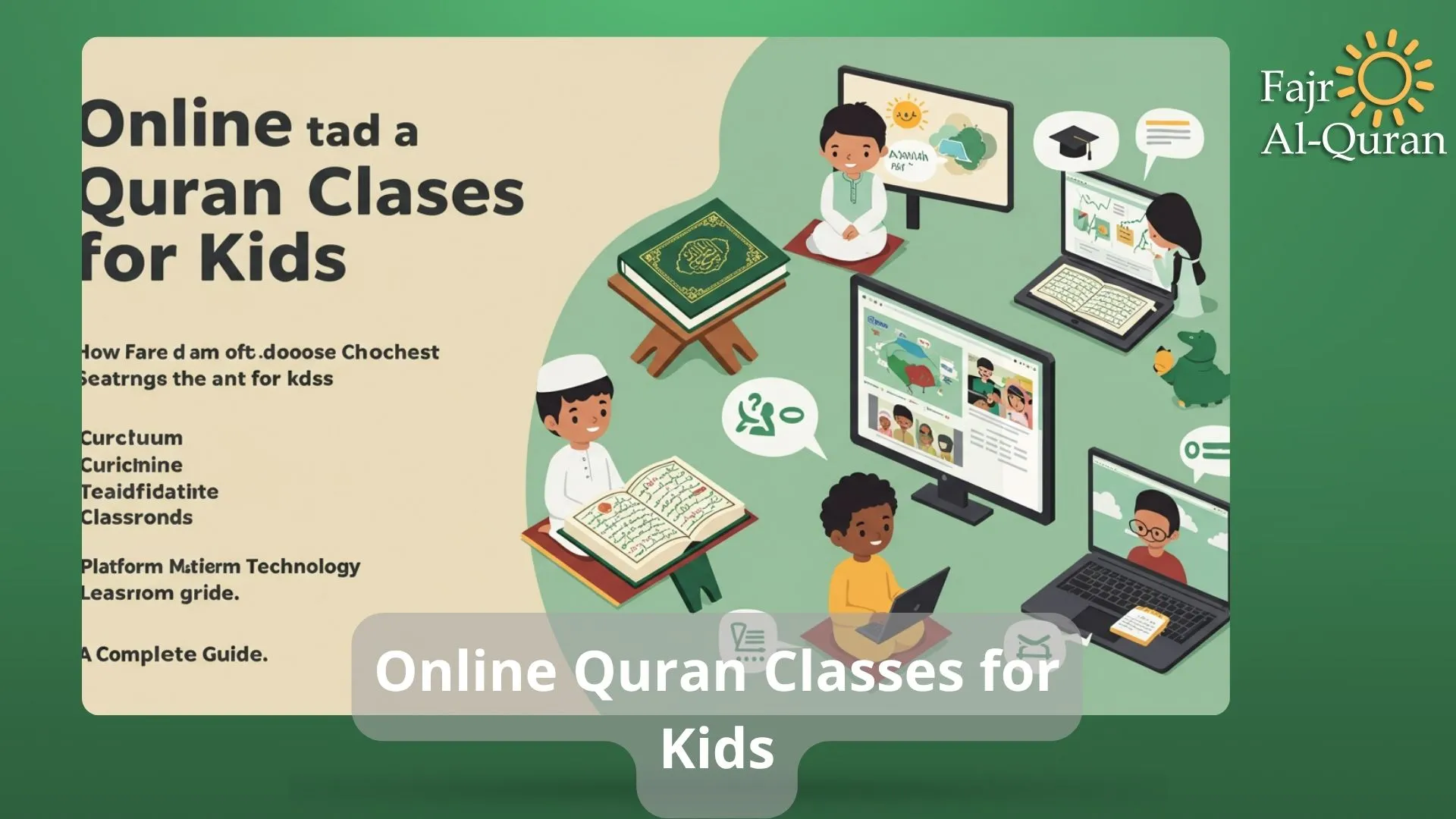
Online Quran classes for kids

Another important benefit is the safe and comfortable environment that online Quran classes for kids provide. Parents can rest assured that their children are learning in a controlled, distraction-free setting without the pressures or distractions sometimes present in traditional classrooms.

How to Choose the Best Online Quran Classes for Kids

Tips for Parents

Selecting the right online Quran classes for kids can feel overwhelming given the variety of options available today. To make an informed decision, parents should consider these tips:

  1. Verify Teacher Qualifications: Ensure that instructors have recognized certifications in Quranic studies and experience teaching young children. This ensures your child receives correct and authentic knowledge.
  2. Take Advantage of Trial Classes: Many platforms offer free trial lessons. Use these opportunities to see if the teaching style and technology suit your child’s needs and comfort level.
  3. Evaluate the Curriculum: A good curriculum will cover all key areas—tajweed, memorization, understanding Quranic meanings, and Islamic manners.
  4. Check the Technology Used: The platform should be user-friendly, stable, and provide clear audio and video. A smooth technological experience reduces frustration for kids and parents alike.
  5. Consider Class Size: Smaller classes or one-on-one sessions are often more effective for young children, providing more personalized attention.
  6. Research Reviews and Recommendations: Feedback from other parents can be invaluable in identifying reputable and effective online Quran classes for kids.

Conclusion

In today’s digital age, online Quran classes for kids offer a unique and effective way for children to connect with the Quran and Islamic teachings. By combining expert teachers, interactive tools, flexible schedules, and personalized attention, these classes create an ideal environment for young learners to thrive spiritually and academically.

If you are looking to give your child a strong foundation in Quranic knowledge with ease and confidence, enrolling in the best online Quran classes for kids is the way forward. Don’t wait—start your child’s Quran learning journey today and witness the positive transformation in their faith and character. Sign up now and experience top-quality online Quran classes for kids at FajralQuran, where your child’s spiritual growth is our priority. 


Need Help?