Best Arabic Classes for Beginners Online – Learn Arabic Step by Step

Best Arabic Classes for Beginners Online – Learn Arabic Step by Step

The best Arabic classes for beginners introduce foundational skills in Modern Standard Arabic (MSA), focusing on basic grammar, essential vocabulary, pronunciation, and everyday phrases. They follow the CEFR A1 level by using structured lessons, interactive exercises, contextual translations, and reading practice to build confidence. Platforms like Fajr Al-Quran Academy offer beginner-friendly courses with progressive content tailored for learners with no prior knowledge. Online Arabic classes for beginners help students grasp sentence structure, common expressions, and cultural context, setting a strong base for further language development.

Arabic classes for beginners provide a structured way to learn the Arabic language from the basics. Instead of trying to memorize everything at once, learners can study letters, pronunciation, vocabulary, grammar, reading, writing, and speaking step by step.

Online Arabic classes for beginners are available for kids, adults, new Muslims, and learners from different backgrounds. These classes can be adapted to different learning goals. Some students want to understand everyday conversations. Others want to study Modern Standard Arabic. New Muslims may want to understand Islamic texts and the Quran. Whatever your goal, a suitable beginner Arabic course can give you a strong foundation.

Fajr Al-Quran Academy offers structured Arabic classes for beginners with experienced tutors and flexible online lessons. The focus is on helping learners understand Arabic, improve pronunciation, build vocabulary, and develop practical communication skills.

If you want to learn Arabic online, choosing the right course can make your learning journey easier, more organized, and more enjoyable.

What Are Arabic Classes for Beginners?

Arabic classes for beginners are lessons designed for students who have little or no previous knowledge of the Arabic language. They introduce the essential skills needed to understand, read, write, and speak Arabic. A good beginner program does not assume that students already know the alphabet or basic grammar.

The first stage usually introduces the Arabic alphabet and correct pronunciation. Students learn how Arabic letters look and sound. They also learn how letters change their form depending on their position in a word. This foundation is important for anyone who wants to learn Arabic correctly.

Modern online arabic classes can also include vocabulary, simple phrases, sentence formation, and basic arabic grammar. Students gradually move from individual letters to words and then to complete sentences. This makes arabic for beginners easier to understand.

The best Arabic classes for beginners are practical as well as educational. They give learners opportunities to listen, read, write, speak, and practice. Some programs also introduce Modern Standard Arabic, which is useful for formal communication, reading, media, and educational study.

At Fajr Al-Quran Academy, Arabic classes for beginners can provide a structured learning path. Students can study with tutors who explain difficult topics in simple language. Lessons can be personalized according to age, ability, and learning goals.

For beginners, a well-planned arabic course for beginners can turn a difficult subject into a manageable journey. It helps learners build confidence before moving to intermediate and advanced Arabic courses.


Best Arabic Classes for Beginners Online – Learn Arabic Step by Step


How to Learn Arabic Step by Step as a Beginner

The best way to learn Arabic is to follow a clear learning path. Trying to study advanced grammar before learning basic words can create confusion. Arabic classes for beginners should therefore introduce each skill at the right level.

The first step is learning the Arabic alphabet. Students should become familiar with each letter and its correct sound. The next step is understanding short vowels and other basic pronunciation marks. Once learners can recognize letters, they can begin reading simple words.

The third stage focuses on vocabulary. Beginners can start with common words related to family, food, school, home, time, and everyday activities. These words can then be used in short sentences.

The fourth stage introduces arabic grammar. Students learn basic concepts such as nouns, verbs, pronouns, gender, singular and plural forms, and simple sentence structures. Later, they can explore more detailed arabic morphology topics.

The fifth stage focuses on speaking. Learners practice useful phrases and short conversations. This helps them move from memorizing vocabulary to using Arabic naturally.

A successful learning journey may look like this:

  • Learn letters and pronunciation.
  • Build essential vocabulary.
  • Practice reading and writing.
  • Study basic grammar.
  • Create simple sentences.
  • Practice listening and speaking.
  • Review regularly and gradually increase difficulty.

These steps make Arabic classes for beginners more effective. They also help students avoid feeling overwhelmed. With regular practice, learning Arabic becomes a steady process rather than a stressful task.

Learn Arabic Classes for Beginners Online with Expert Teachers

A qualified teacher can make a major difference when you learn Arabic online. Books and apps can introduce vocabulary, but a teacher can identify mistakes and explain difficult concepts. This is especially important for pronunciation and grammar.

Arabic classes for beginners with expert tutors allow students to ask questions during live lessons. The teacher can correct pronunciation, explain new words, and provide examples based on the student’s level. This creates a more personal learning experience.

At Fajr Al-Quran Academy, online Arabic classes for beginners are designed to make Arabic learning accessible from home. Students can learn with tutors through live lessons without needing to travel to a physical classroom.

Expert teachers can also adapt lessons for different learners. Kids may need fun and engaging activities. Adults may prefer practical conversations. New Muslims may want to focus on Quranic vocabulary and Islamic expressions. Each learner can benefit from a personalized approach.

Good Arabic classes for beginners also encourage students to practice between lessons. A teacher may recommend reading exercises, vocabulary review, audio practice, or simple speaking tasks.

The goal is not simply to complete an arabic course for beginners. The goal is to develop useful language skills. Students should gradually become able to understand simple Arabic, form sentences, read basic texts, and communicate with greater confidence.

With the right teacher and regular practice, arabic online learning can become an enjoyable part of your daily routine.

Learn Arabic Alphabet and Pronunciation Online

Learning the Arabic alphabet is one of the most important stages for beginners. Arabic contains letters that may look and sound unfamiliar to English speakers and learners of other languages. Proper instruction makes these letters much easier to understand.

Arabic classes for beginners normally start by introducing the letters one at a time. Students learn each letter’s name, shape, and sound. They also learn how letters connect when they appear within Arabic words.

Pronunciation deserves special attention. Some Arabic sounds do not have direct equivalents in English. A trained tutor can explain how to produce these sounds correctly. Students can listen to the teacher and repeat the sounds until their pronunciation improves.

After learning individual letters, students can practice short vowels and simple combinations. They can then begin reading short words. This step creates an important connection between seeing Arabic and actually understanding how it sounds.

Online Arabic classes for beginners can make alphabet practice interactive. Teachers can use screen sharing, digital whiteboards, audio examples, and reading exercises. Students can receive immediate correction instead of practicing mistakes repeatedly.

For children, alphabet lessons can include games and engaging activities. Adults can benefit from focused reading drills and pronunciation practice. New Muslims can also connect alphabet learning with Quranic reading.

A strong foundation in the alphabet helps students progress faster through future arabic courses. Once learners can confidently recognize letters and sounds, they are ready to develop reading, writing, vocabulary, and speaking skills.

This is why Arabic classes for beginners should never rush through the alphabet. Strong basics make the rest of the language journey easier.


Arabic Reading and Writing Classes for Beginners


Arabic Reading and Writing Classes for Beginners

Reading and writing are essential parts of Arabic classes for beginners. Students need to recognize Arabic words before they can confidently understand texts or communicate through written language.

Arabic reading begins with letters and simple combinations. Students gradually learn how letters connect and how vowel marks affect pronunciation. With regular practice, they can move from isolated letters to words, phrases, and sentences.

Writing follows a similar progression. Beginners first practice individual letters. They then learn how to connect them correctly. Later, they write words and short sentences. This gradual approach helps learners develop accuracy and confidence.

Online Arabic classes for beginners can provide useful writing practice through digital lessons. Tutors can show students how Arabic letters are formed and correct common mistakes. Students can also read aloud during live lessons.

Reading practice should include simple vocabulary. Learners can read words related to daily life and then use them in sentences. This makes reading more meaningful and supports vocabulary development at the same time.

For students studying Quranic Arabic, reading practice can also help them become more comfortable with Arabic script. However, Quranic reading and general Arabic should be taught according to the learner’s specific goals.

The best Arabic classes for beginners balance reading and writing instead of focusing on only one skill. Students should learn to recognize words, understand simple sentences, and write basic expressions.

With consistent practice, learners can progress from simple words to longer texts. This creates a strong foundation for future online arabic courses and more advanced study.

Learn Basic Arabic Grammar and Vocabulary

Grammar and vocabulary are two essential parts of Arabic classes for beginners. Vocabulary gives students the words they need to communicate. Grammar teaches them how to put those words together correctly.

Beginners should start with practical vocabulary. Common nouns, verbs, adjectives, numbers, greetings, family words, and everyday expressions are useful starting points. Learning words in context makes them easier to remember.

Next comes basic Arabic grammar. Students can learn simple sentence patterns, pronouns, gender, singular and plural forms, demonstratives, and common verb structures. These topics help learners create their own sentences.

A good teacher explains grammar through examples rather than long theoretical explanations. For example, students can learn a grammar rule and then use it in several simple sentences. This approach makes grammar more practical.

Some learners may also want to study Modern Standard Arabic. It is useful for formal communication, books, news, education, and many written materials. Other learners may have a stronger interest in spoken Arabic and real conversations.

The best Arabic classes for beginners can help students understand these differences. They can guide learners toward the type of Arabic that matches their goals.

When vocabulary and grammar are studied together, students begin to understand how the language works. This makes learning Arabic more natural and helps beginners progress toward confident communication.

Quranic Arabic Classes for Beginners

Many students choose Arabic classes for beginners because they want to understand the Quran more deeply. Quran and Arabic classes focus on the language and vocabulary used in the Quran. It can help learners recognize common words and understand basic meanings.

For new Muslims, Quranic Arabic can be a meaningful part of their learning journey. It provides an opportunity to connect language study with Islamic knowledge. However, beginners still need a strong foundation before studying complex Arabic texts.

Quranic Arabic classes for beginners may introduce common Quranic vocabulary, simple sentence structures, pronouns, verbs, and selected grammar concepts. Teachers can explain words in context so students understand how their meanings work within verses.

Students who already know the alphabet can progress more quickly. Those who are complete beginners may first need general Arabic classes for beginners that focus on reading and pronunciation.

Fajr Al-Quran Academy can be a useful learning environment for students who want to combine Arabic study with Quranic learning. Experienced tutors can help learners build their language skills while keeping lessons suitable for their level.

Quranic Arabic is different from learning everyday spoken Arabic. Some students may eventually want both. They can study Quranic vocabulary while also practicing common phrases and conversations.

The goal of Arabic classes for beginners is to create a strong foundation. Students should gradually develop the ability to read Arabic, recognize vocabulary, understand basic grammar, and appreciate the structure of Quranic language.

With patience and consistent study, learners can make meaningful progress. Even learning a small number of Arabic words can make Quran study more engaging and rewarding.


Interactive Arabic Lessons for Fast and Easy Learning


Interactive Arabic Lessons for Fast and Easy Learning

Traditional memorization alone is not always enough to learn Arabic effectively. Students need opportunities to use what they learn. This is why interactive Arabic classes for beginners can be so valuable.

Interactive lessons involve students directly. Instead of simply listening to a teacher, learners answer questions, read sentences, repeat vocabulary, complete exercises, and practice conversations.

Online Arabic classes for beginners can use live audio, shared screens, digital activities, reading exercises, and speaking practice. These tools make lessons more engaging. They can also help students stay focused.

Speaking activities are especially useful. Students can practice greetings, introductions, simple questions, daily expressions, and short conversations. Over time, these exercises can help learners move toward real conversational Arabic.

Listening is equally important. Students should hear Arabic regularly. Audio practice helps them recognize words when they are spoken at normal speed. It also improves pronunciation and listening confidence.

Interactive Arabic classes for beginners can be especially helpful for kids. Fun activities can make lessons feel less like traditional schoolwork. Adults can benefit from practical role-playing and conversation exercises.

Students should also practice outside class. A few minutes of daily review can help reinforce new vocabulary and grammar. Reading simple sentences, listening to Arabic audio, and speaking aloud can all support progress.

The strongest Arabic classes for beginners combine explanation with practice. They help students understand a topic and then use it immediately.

This practical approach makes online Arabic classes for beginners more engaging. It also gives learners the confidence to use Arabic beyond the classroom.

Flexible Arabic Classes for Beginners from Home

One of the biggest advantages of Arabic classes for beginners online is flexibility. Students can learn from home without traveling to a classroom. This is especially useful for busy adults, parents, children, and new Muslims.

Online Arabic classes for beginners can fit different schedules. Students may be able to choose lesson times that work around school, work, family responsibilities, or other studies. This flexibility makes regular learning easier.

For parents, online learning can provide a convenient way for children to study Arabic from home. Parents can also monitor lessons and help children maintain a consistent routine.

Adults can benefit in the same way. A busy professional may not have time to attend a physical academy. With arabic online lessons, the student can study at a convenient time and continue making progress.

Flexible learning does not mean less structure. The best Arabic classes for beginners still follow a clear curriculum. Students should have defined learning goals, regular lessons, practice tasks, and progress checks.

Fajr Al-Quran Academy provides online learning opportunities that can help students study Arabic without geographical limitations. Learners from different locations can connect with qualified tutors through live lessons.

Online learning can also provide a comfortable environment. Students can study from a quiet space at home and focus on their lessons. This can be particularly helpful for beginners who feel nervous about speaking a new language.

With consistent attendance and daily practice, online Arabic classes for beginners can become a practical part of a learner’s routine. The journey may take time, but steady progress is more important than rushing.

How to Choose the Best Arabic Classes for Beginners Online

Choosing the right Arabic classes for beginners is an important decision. Not every course is designed for complete beginners. Before enrolling, students should consider the curriculum, teachers, lesson format, flexibility, and learning goals.

First, check whether the course genuinely starts from the basics. A good Arabic course for beginners should explain the alphabet, pronunciation, reading, vocabulary, and basic grammar clearly. It should not assume previous knowledge.

Second, look at the teachers. Qualified and experienced tutors can make difficult topics easier. They should be able to explain Arabic in simple language and provide helpful corrections.

Third, consider the lesson format. Live online Arabic classes for beginners are useful because students can communicate directly with teachers. They can ask questions and receive immediate feedback.

Fourth, examine the curriculum. A complete program should cover important skills such as reading, writing, listening, speaking, vocabulary, and Arabic grammar. Students interested in advanced study can later explore Arabic morphology topics and Modern Standard Arabic.

Fifth, consider flexibility. Online learning works best when lesson times fit your schedule. A flexible academy can make it easier to maintain consistent study habits.

Finally, think about your personal goals. Do you want to speak Arabic? Read Arabic books? Understand Quranic Arabic? Study Modern Standard Arabic? Or simply build basic language skills? Your answer will help you select the right program.

Fajr Al-Quran Academy is a strong option for learners looking for structured online Arabic classes for beginners. Its approach can support beginners, kids, adults, and new Muslims who want to build practical Arabic skills.

The right Arabic classes for beginners should make you feel supported, not overwhelmed. Start with the basics, practice regularly, and increase your level step by step. With the right teacher and a consistent learning routine, you can move from complete beginner to a more confident Arabic learner.

Conclusion

Arabic classes for beginners are designed to take learners from the alphabet and basic pronunciation to vocabulary, grammar, reading, writing, and speaking.

For beginners, online learning provides a convenient way to study from home. Online Arabic classes for beginners can offer live instruction, personalized feedback, interactive activities, and flexible schedules.

If your goal is to understand Quranic Arabic, communicate in everyday situations, or study Modern Standard Arabic, starting with a structured beginner program is a smart choice. Fajr Al-Quran Academy can help you build the essential skills you need for your Arabic journey.

Do not wait until you feel completely ready. Start your Arabic journey with simple lessons, practice consistently, and give yourself time to improve. The right Arabic classes for beginners can help you learn with confidence and take your first meaningful steps toward Arabic fluency.

Best Quranic Arabic Classes Online – Learn Arabic to Understand the Quran

Best Quranic Arabic Classes Online – Learn Arabic to Understand the Quran

Quranic Arabic classes online are structured courses designed to teach the classical Arabic used in the Quran. These classes focus on vocabulary, grammar, pronunciation, and comprehension to help learners read and understand the Quran accurately. Offered by reputable institutions like Fajr Al-Quran Academy, they cater to all levels, with professional instructors providing personalized guidance. Fajr Al-Quran Academy

uses immersive methods to accelerate learning, enabling students to grasp the language without relying solely on translations. Ideal for both beginners and advanced learners, these courses combine flexibility with academic rigor.

The Quran is the central source of guidance for Muslims. It was revealed in Arabic, a language with rich vocabulary, precise grammar, and powerful expressions. Learning Quranic Arabic can help Muslims move beyond relying only on translations. It can help them understand the words, meanings, and messages of the Quran more directly. This is why many students choose Quranic Arabic classes to build their language skills in a structured way.

For beginners, learning Arabic may seem difficult at first. The Arabic alphabet, vocabulary, grammar, and sentence structures can feel unfamiliar. However, the right approach can make the process much easier. Well-designed Quranic Arabic classes introduce each concept gradually. Students can learn basic words first and then progress toward grammar, morphology, reading, and deeper understanding.

Among online learning options, Fajr Al-Quran Academy provides structured learning opportunities for students who want to develop their Quranic Arabic skills. With suitable courses, expert teachers, and online lessons, students can start building a stronger connection with the Quran.

Whether you are a complete beginner or already know some Arabic, the right Quranic Arabic classes can help you unlock a deeper understanding of the Quran and appreciate the beauty of its language.

What Are Online Quranic Arabic Classes?

Online Quranic Arabic classes are structured lessons that teach students the Arabic language used in the Quran. They are designed to help learners understand Quranic words, expressions, sentence structures, grammar, and meanings. Unlike general arabic classes, these courses focus specifically on the language needed to read and understand Quranic texts.

Many students begin with the Arabic alphabet and basic pronunciation. They then move toward vocabulary, sentence formation, arabic grammar, and classical arabic structures. This gradual approach is especially helpful for beginners who have little or no previous experience with the arabic language.

Good Quranic Arabic classes do not simply ask students to memorize hundreds of words. They teach students how words function within Quranic verses. This allows learners to recognize familiar patterns when they read the Quran.

Online Quranic Arabic classes are usually delivered through live video lessons. Students can communicate directly with their teachers, ask questions, and receive feedback. Some courses also provide recorded materials, worksheets, exercises, and revision activities.

For children, Quranic Arabic lessons may use simple examples and age-appropriate teaching methods. Adults may prefer a more detailed approach that focuses on grammar and comprehension. New Muslims can also benefit from beginner-friendly courses that explain the language without assuming prior knowledge.

The goal of Quranic Arabic classes is not necessarily to make every student a fluent conversational speaker. The primary goal is to help students understand the Quran more accurately and confidently. With consistent learning, students can gradually recognize common Quranic words and structures.


Best Quranic Arabic Classes Online – Learn Arabic to Understand the Quran


What You Learn in Quranic Arabic Classes

A comprehensive Quranic Arabic course covers several connected areas. Students usually begin with the foundations of the arabic language. These foundations may include letters, pronunciation, basic vocabulary, and simple sentence structures.

Vocabulary is an important part of Quranic Arabic classes. Students learn common words that appear frequently in the Quran. Words related to faith, worship, people, actions, time, nature, and the Hereafter may be introduced through Quranic examples. Learning high-frequency vocabulary can make Quran reading more meaningful.

Another major area is arabic grammar. Grammar helps students understand how words relate to one another in a sentence. It can explain why a word has a particular ending and how that ending affects its role and meaning.

Students may also study morphology, known in Arabic as word formation patterns. Morphology helps learners understand how Arabic words are connected. A student may recognize a root and then identify related nouns, verbs, and other forms.

Quranic arabic classes can also introduce students to classical arabic. The Quran uses a highly refined form of Arabic. Understanding its structures can help learners appreciate the precision of Quranic expressions.

Reading practice is another important part of Quranic Arabic classes. Students apply what they learn by examining actual Quranic verses. Teachers can explain vocabulary, grammar, sentence structure, and meaning within context.

The best Quranic Arabic classes combine these areas instead of teaching them separately. This creates a comprehensive learning experience and allows students to connect grammar, vocabulary, and meaning as they progress.

Learn Arabic to Understand the Quran

Learning Arabic can transform the way a Muslim approaches the Quran. A translation can communicate the general meaning of a verse, but the original Arabic contains linguistic details that may be difficult to reproduce in another language. This is one reason Quranic Arabic classes are valuable for serious Quran learners.

When students study Quranic Arabic, they can begin recognizing words without immediately checking a translation. A familiar word may appear in several verses. Over time, repeated exposure strengthens memory and recognition.

Quranic arabic classes also help students understand the relationship between words. Arabic grammar can show whether a word is acting as a subject, object, description, or another part of a sentence. These details can contribute to a more accurate understanding of the text.

For new Muslims, learning Quranic Arabic can also be an important part of their Islamic learning journey. It gives them a direct way to explore the language of the Quran while they continue learning about Islam.

Children can benefit as well. When children start learning Arabic early, they can gradually develop familiarity with Quranic vocabulary. Short, engaging Quranic Arabic classes can make this process enjoyable rather than overwhelming.

Adults may approach the subject differently. They may want to understand the Quran during personal reading, prayer, or reflection. Structured Quranic Arabic classes can give them a clear path to develop those skills.

At Fajr Al-Quran Academy, students can learn Quranic Arabic through organized online lessons. The aim is to make learning accessible and practical while helping students develop a deeper connection with Quranic texts.

With patience and regular practice, Quranic Arabic classes can help learners move from simply reading translated meanings toward engaging with the Quran’s original language.

How Online Quranic Arabic Classes Work

Modern online Quranic Arabic classes make it possible to study from almost anywhere. Students usually attend lessons through an online learning platform or video communication system. They can interact with their teacher in real time and receive immediate guidance.

A typical lesson begins with a short review. The teacher may revise vocabulary or grammar from previous Quranic Arabic classes. This helps students retain what they have already learned before moving to a new topic.

The teacher then introduces the day’s lesson. This may involve vocabulary, grammar, morphology, sentence structure, or a selection of Quranic verses. The material is explained step by step.

Students may then practice the lesson. In Quranic Arabic classes, practice is important because understanding a grammar rule is different from being able to recognize it independently. Students may translate simple phrases, identify words, or analyze sentence structures.

Teachers can also correct mistakes during the lesson. This direct feedback is one of the major advantages of live Quranic Arabic classes. Students do not have to continue practicing an incorrect pronunciation or grammatical pattern without guidance.

Online learning can also offer scheduling flexibility. A student may choose lesson times that fit around school, work, family, or other responsibilities.

Parents can select appropriate Quranic Arabic classes for their children based on their age and learning level. Adults can choose programs designed for complete beginners or students with previous Arabic knowledge.

The effectiveness of Quranic Arabic classes depends on regular attendance and practice. Students should review vocabulary after lessons and apply new concepts when reading the Quran.


How to Choose the Best Quranic Arabic Classes Online


How to Choose the Best Quranic Arabic Classes Online

Choosing the right Quranic Arabic classes can make a significant difference in your learning experience. Not every course uses the same teaching methods or follows the same curriculum. Students should consider several factors before they enroll.

First, look at the teacher’s qualifications and experience. Effective Quranic Arabic classes should be taught by instructors who understand both the Arabic language and the Quran. Teachers should also know how to explain difficult concepts in simple terms.

The course structure is equally important. A strong program should follow a clear progression. Beginners should not be expected to understand advanced grammar before learning basic vocabulary and sentence patterns.

Students should also check whether the course covers Arabic grammar, vocabulary, morphology, reading, and comprehension. A comprehensive curriculum can provide a stronger foundation than a course that focuses on only one area.

Teaching methodology matters too. Some learners respond well to repetition and practical examples. Others benefit from detailed grammar explanations. The best Quranic Arabic classes use approaches that encourage students to understand and apply what they learn.

Class size can also affect the learning experience. Smaller classes or individual lessons may allow teachers to provide more personalized feedback.

Flexible scheduling is especially useful for adults and families. Online Quranic Arabic classes should make it easier to maintain consistent learning rather than creating additional pressure.

A trial lesson can also help. It allows students to experience the teacher’s approach before committing to a full course.

Finally, consider whether the academy has a clear learning path. At Fajr Al-Quran Academy, students looking to learn Quranic Arabic can explore structured online learning designed to support gradual progress.

The best Quranic Arabic classes are those that combine qualified teachers, structured lessons, practical learning, and consistent support.

Learn Quranic Arabic Online with Expert Teachers

A skilled teacher can make Quranic Arabic classes much easier to understand. Arabic has many rules and patterns. Without proper guidance, beginners can become confused by unfamiliar words or grammar structures.

Expert teachers can break complex topics into smaller lessons. Instead of presenting a large amount of arabic grammar at once, they can explain one concept and then show how it appears in Quranic verses.

Teachers can also explain why a particular translation may use certain words. This helps students appreciate the difference between the original Arabic and translated versions.

In Quranic Arabic classes, teachers can provide examples from the Quran. This makes learning more relevant. Students are not studying Arabic only as an academic subject. They are learning it to understand the Quran.

Personal feedback is another major advantage. A teacher can identify areas where a student needs more practice. This is especially helpful for beginners who may struggle with vocabulary or grammar.

At Fajr Al-Quran Academy, qualified teachers can support students through online Quranic Arabic classes. The learning experience can be adapted to different levels, including beginners who are starting their Arabic journey.

Parents looking for Quranic Arabic classes for children should also consider whether teachers can work effectively with young learners. Children often need shorter explanations, repetition, encouragement, and engaging examples.

Adults may prefer deeper explanations of grammar and morphology. A good teacher can adjust the lesson according to the learner’s level and goals.

Expert instruction does not eliminate the need for personal effort. Students still need to review and practice. However, qualified teachers can make that effort more focused and productive.

With the right support, Quranic Arabic classes can turn a challenging subject into a clear and rewarding learning experience.

Quranic Arabic Classes for Beginners

Beginners often worry that they need to know Arabic before joining quranic arabic classes. In a beginner-friendly course, this is usually not necessary. A well-designed program starts from the learner’s current level.

The first stage may focus on basic Arabic letters, sounds, words, and simple structures. Students gradually become familiar with the written form of the arabic language.

Vocabulary is introduced step by step. Instead of trying to memorize an enormous word list, beginners can focus on common Quranic terms. Repeated exposure helps these words become easier to recognize.

Grammar is also introduced gradually. Beginner Quranic Arabic classes should avoid overwhelming students with complicated terminology. Teachers can first explain simple sentence structures before introducing more advanced concepts.

Practice is essential. Students should read short Quranic phrases and identify words they already know. This creates a connection between classroom learning and actual Quran reading.

Children need a different learning approach. Their Quranic Arabic classes should include repetition, simple activities, and age-appropriate explanations. Keeping lessons engaging can help children maintain interest.

Adults may prefer a more structured academic approach. They may want to understand grammar rules and see how those rules operate within Quranic verses.

Regardless of age, beginners should focus on steady progress. Learning a small amount consistently is usually more useful than studying a large amount once and then stopping.


Learn Quranic Arabic Vocabulary and Common Words


Learn Quranic Arabic Vocabulary and Common Words

Vocabulary is one of the most practical parts of Quranic Arabic classes. When students know common words, they can begin recognizing familiar meanings while reading the Quran.

The Quran contains many recurring words and expressions. Learning these words can make reading more familiar. Students may notice words they have studied in one verse appearing in another context.

Effective Quran and Arabic classes teach vocabulary in context. Rather than memorizing isolated words, students can study how a word is used within a Quranic sentence.

For example, a teacher may introduce a common verb and then explain its related forms. This approach introduces students to morphology and helps them recognize connections between words.

Word roots are another useful part of Quranic Arabic learning. Arabic often builds related words around root patterns. Understanding these patterns can help students recognize unfamiliar words.

In Quranic Arabic classes, teachers can also distinguish between similar words. This helps students avoid assuming that two words have the same meaning.

Beginners should not feel pressured to memorize every word immediately. The goal is gradual growth. As vocabulary increases, students can understand more of what they read.

At Fajr Al-Quran Academy, students can use structured Quranic Arabic classes to develop vocabulary alongside other language skills.

Learning common Quranic words is an important step toward deeper understanding. As students recognize more vocabulary, Quran reading can become more engaging and meaningful.

The long-term goal of Quranic Arabic classes is to help students develop enough vocabulary and language awareness to approach Quranic texts with greater confidence.

Understand Quranic Arabic Grammar Step by Step

Grammar can seem like the hardest part of Quranic Arabic classes, especially for beginners. However, it becomes much easier when taught in a logical sequence.

Arabic grammar explains how words work together. It helps students understand each word’s role in a sentence. This is important because changes in structure and word endings can affect meaning.

Beginner Quranic Arabic classes may start with simple nominal and verbal sentences. Students can learn how to form basic sentences before moving to more complex structures.

Verb forms are another important topic. Students can learn how Arabic verbs change according to tense, person, and pattern. This connects grammar with morphology and vocabulary.

Pronouns and particles also play an important role. Students may encounter short Arabic words repeatedly in the Quran. Understanding their function can make verses easier to analyze.

Teachers should introduce grammar through Quranic examples whenever possible. This allows students to see how a rule works in a real text rather than studying it only as theory.

In advanced Quranic Arabic classes, students may study more detailed grammatical structures. They can examine sentence relationships and linguistic features that contribute to meaning.

At Fajr Al-Quran Academy, structured Quranic Arabic classes can help students progress from basic concepts toward more detailed Quranic language study.

Grammar is not simply about memorizing rules. It is a tool for understanding. Once students understand how Arabic sentences work, they can approach Quranic verses with greater confidence.

This is why Quranic Arabic classes should balance grammar explanations with reading and practical exercises. Students need to see, apply, and review each concept.

Flexible Online Quranic Arabic Lessons from Home

One of the biggest advantages of online Quranic Arabic classes is flexibility. Students can learn from home without traveling to a physical academy. This makes Arabic learning more convenient for families and busy individuals.

Adults often have demanding schedules. Work, family, and other responsibilities can make traditional classes difficult to attend. Flexible Quranic Arabic classes allow students to select lesson times that fit their routines.

Parents can also benefit from online learning. Children can attend Quranic Arabic classes from home under parental supervision. This can save travel time and make regular attendance easier.

New Muslims may also prefer online lessons because they can begin learning in a comfortable environment. They can ask questions and progress without feeling pressured by a classroom setting.

Online Quranic Arabic classes can provide access to teachers from different locations. Students are not limited to instructors available in their local area.

Another advantage is consistency. Students can establish a regular learning schedule and build a routine around their lessons. Consistency is especially important when learning vocabulary, arabic grammar, and morphology.

At Fajr Al-Quran Academy, students can explore online Quranic Arabic classes designed to support flexible Quranic language learning. The combination of online access and structured instruction can make the learning process easier to maintain.

Students should still create time for independent practice. Reviewing vocabulary, reading Quranic verses, and revisiting grammar after each lesson can strengthen progress.

The most effective Quranic Arabic classes are not simply convenient. They provide a clear learning path, qualified teachers, practical exercises, and support throughout the course.

Learning Quranic Arabic from home can therefore be both practical and rewarding. With regular lessons and sincere effort, students can gradually build the skills needed to understand more of the Quran directly.

Arabic Letter | Mastering the Arabic Alphabet with Fajr Al-Quran

arabic letter

The Arabic letter system is the foundation of the Arabic language and is essential for reading the Quran. Whether you’re a beginner or looking to refine your pronunciation, understanding the Arabic alphabet is the key to mastering Arabic fluency. At Fajr Al-Quran, we provide structured courses designed to help learners grasp the intricacies of every Arabic alphabet with ease.

What is an Arabic Letter?

Each Arabic letter represents a distinct sound, and unlike English, Arabic is written from right to left. The Arabic alphabet system consists of 28 letters, each with a unique pronunciation and written form. Learning the Arabic alphabet system is crucial for:

  • Reading the Quran correctly: Tajweed rules depend on proper letter articulation.
  • Developing Arabic language skills: Building a strong foundation in Arabic.
  • Understanding Islamic texts: The Quran and Hadith are in Arabic.
  • Enhancing pronunciation: Mastering phonetics for clear recitation.

Structure of Arabic Letters

The Arabic letter system is unique in many ways:

Connected Writing:

Unlike many other languages, Arabic letters are mostly connected when written in words. Their shape changes based on whether they appear at the beginning, middle, or end of a word, making Arabic a flowing script.

Diacritical Marks (Harakat): 

These small symbols, such as Fatha ( َ ), Kasra ( ِ ), and Damma ( ُ ), guide pronunciation and clarify how words should be read. Without them, words can have multiple meanings.

Heavy and Light Sounds:

Arabic has letters that require deep articulation from the throat (like خ, غ, and ق) and others that are softer and lighter (such as ت, ن, and ي). Proper pronunciation affects the meaning of words.

Letters Without Vowels: 

Arabic letters can appear without vowels, requiring an understanding of short and long vowels to read correctly. The Sukoon ( ْ ) symbol marks consonants that should be pronounced without a vowel sound.

The Sun and Moon Letters:

Some Arabic letters (Sun letters) cause assimilation when preceded by “Al” (ال), such as (الشمس – Ash-Shams), while others (Moon letters) retain the full pronunciation of “Al,” like (القمر – Al-Qamar).

The Role of Madd (Elongation):

Arabic has different types of elongation (Madd) that extend vowel sounds, such as Madd Tabee’i (natural elongation) and Madd Lazim (mandatory elongation), affecting recitation and Tajweed rules.


arabic letter
arabic letter


How to Learn Arabic Letters Effectively

To properly understand the Arabic alphabet, follow these learning techniques:

  1. Recognize each Arabic Letter: Familiarize yourself with all 28 Arabic letters.
  2. Practice Writing: Arabic script requires hand movement precision.
  3. Master Pronunciation: Arabic sounds are unique compared to Latin-based languages.
  4. Use Tajweed Rules: Proper recitation depends on correct articulation.
  5. Engage in Repetition: Repeatingly writing and saying each Arabic letter improves memory.

The Importance of Arabic Letters in Quranic Learning

Mastering the Arabic letter system is essential for reading the Quran with clarity. Since Tajweed rules depend on precise articulation, learning the correct pronunciation of each letter ensures that recitation is both accurate and spiritually rewarding. Even minor pronunciation errors can alter meanings, making proper learning crucial for every student.

Knowing how each Arabic letter sounds also helps in memorizing Surahs more effectively. When students recognize and pronounce letters correctly, they can retain Quranic verses with greater ease. This understanding strengthens their ability to recall passages accurately during prayer and daily recitation.

A deeper grasp of Arabic letters also enhances fluency in daily prayers and improves comprehension of Quranic meanings. Understanding the structure of Arabic words helps learners appreciate the linguistic beauty of the Quran, allowing for a more meaningful connection with its teachings.

Arabic Letter Pronunciation Guide

Each Arabic letter falls into one of the following categories:

  • Guttural Sounds: Letters like ‘ع’ and ‘ح’ originate from the throat.
  • Heavy & Light Sounds: Certain Arabic alphabet like ‘ط’ and ‘ظ’ require emphasis.
  • Lips-Based Sounds: Letters like ‘ب’ and ‘م’ depend on lip movement.
  • Tongue-Based Letters: ‘د’ and ‘ت’ require specific tongue placement.

Arabic Letters and Their Different Forms

Unlike English, the Arabic alphabet can have up to four different forms:

  1. Isolated Form: When written alone.
  2. Initial Form: When starting a word.
  3. Medial Form: When appearing in the middle of a word.
  4. Final Form: When appearing at the end of a word.

Best Methods for Learning the Arabic Letter System

At Fajr Al-Quran, we recommend the following approach to mastering the Arabic letter system:

  • Interactive Learning Tools: Using apps and digital platforms.
  • One-on-One Tutor Support: Personalized learning with expert instructors.
  • Practice with Flashcards: Reinforcing Arabic alphabet recognition.
  • Quran-Based Exercises: Applying learning directly to Quranic verses.
  • Daily Writing Drills: Strengthening letter formation skills.

Common Challenges When Learning Arabic Letters

Learning the Arabic alphabet comes with challenges that require patience and practice. One common difficulty is differentiating similar letters, such as ‘س’ and ‘ص,’ which may look alike but have distinct pronunciations. Beginners often struggle with these subtle differences, making it essential to focus on articulation and listening exercises.

Another challenge is understanding diacritics, as short vowels significantly impact pronunciation. Without them, words can have entirely different meanings. Mastering diacritics allows students to read accurately and develop confidence in their recitation.

Perfecting guttural sounds like ‘خ’ and ‘غ’ also requires effort since they are not common in many languages. Additionally, Arabic script writing differs from printed text, and fluency in cursive writing is necessary for proper reading and writing. Overcoming these challenges enhances both Quranic recitation and overall language proficiency.

How to Enroll in Arabic Letter Learning Courses at Fajr Al-Quran

  1. Visit Fajr Al-Quran’s website: Browse through our Arabic learning courses.
  2. Choose Your Learning Level: Beginner, Intermediate, or Advanced.
  3. Register for a Free Trial Class: Experience interactive teaching.
  4. Select Your Study Plan: Choose flexible scheduling options.
  5. Start learning with expert tutors: Engage in structured lessons.

The Benefits of Mastering Arabic Letters

Mastering each Arabic letter offers significant benefits, especially in Quranic recitation. Learners who understand proper pronunciation and Tajweed rules can recite the Quran fluently and accurately. This ensures that their recitation aligns with the intended meanings, preserving the beauty and depth of the Quranic verses.

Additionally, a strong foundation in the Arabic alphabet enhances vocabulary and grammar skills. This not only improves the understanding of the Quran but also aids in reading other Islamic texts. It allows students to explore classical Arabic sources, deepening their knowledge of Islamic teachings.

Furthermore, improving Arabic pronunciation benefits daily prayers and supplications. Clear articulation enhances fluency in Salah, making worship more meaningful. As learners gain confidence in their reading and speaking abilities, they develop a stronger connection with the Arabic language and Islamic studies.

Why Choose Fajr Al-Quran for Learning Arabic Letters?

At Fajr Al-Quran, we offer:

  • Certified Arabic Instructors: Learn from expert teachers.
  • Affordable Learning Plans: Cost-effective courses for all students.
  • Interactive Online Classes: Engaging and practical lessons.
  • Step-by-Step Learning Approach: Easy-to-follow Arabic alphabet
    recognition.
  • Quranic-Based Arabic Learning: Master Arabic through Quranic application.

Begin Your Arabic Learning Journey Today!

Mastering the Arabic alphabet is the first step toward understanding the Quran and improving Arabic fluency. Whether for religious or linguistic purposes, knowing each Arabic letter opens doors to deeper knowledge.

Join Fajr Al-Quran today and start learning the Arabic letters with expert guidance!

Learn the Arabic Alphabet – A Complete Beginner’s Guide

Learn the Arabic Alphabet – A Complete Beginner’s Guide

The Arabic alphabet consists of 28 letters, all consonants, with vowels indicated by diacritical marks (harakat). It is written right-to-left and features cursive forms that change based on letter position (initial, medial, final, or isolated). Letters can have different shapes depending on context.

The script is used for Arabic and several other languages, including Urdu and Persian. The Arabic alphabet plays a vital role in Islamic culture, as the Quran is written in Classical Arabic. The alphabet’s visual elegance and calligraphic traditions are highly valued across the Arab world.

Learning a new script can feel difficult when you do not know where to begin. For Muslims in the West, learning Arabic can also mean finding a qualified teacher who can explain unfamiliar letters, sounds, and writing rules in clear English.

With the right sequence, regular practice, and helpful guidance, beginners can learn to recognize, pronounce, read, and write Arabic letters with confidence.

The Arabic Alphabet is the foundation of the Arabic language. It is also an important first step for Muslims who want to read the Quran correctly. Children, adult learners, new Muslims, and parents supporting their children’s Islamic education can all benefit from structured Arabic lessons.

In this complete beginner’s guide, you will learn how the Arabic script works, how many letters it contains, how each letter changes shape, how letters connect, and how short vowels affect pronunciation. You will also discover practical ways to practice at home.

Whether your goal is learning conversational Arabic, reading the Quran, studying Islamic texts, or simply understanding Arabic writing, mastering the basics will make the next stages much easier.

What Is the Arabic Alphabet?

The Arabic Alphabet is the writing system used to write Arabic. It is known as al-abjadiyyah al-Arabiyyah and is written from right to left. This is one of the first differences English-speaking beginners notice because the English alphabet is written from left to right.

Arabic uses individual characters that can change their appearance depending on their position in a word. The basic letter remains the same, but its connected form may look different at the beginning, middle, or end of a word.

The Arabic script is a consonant-based writing system. Short vowels are usually represented by small marks rather than separate alphabet letters. This structure is especially important for students learning Quranic Arabic.

For example, ا (Alif) is one of the first letters students learn. Other common letters include ب (Baa), ت (Taa), ج (Jeem), ح (Haa), and خ (Khaa).

Beginners sometimes search for the Arabic alphabet with English equivalents. English transliterations can be useful as temporary support, but they should not replace learning the original Arabic form.

A strong beginner should gradually develop direct recognition of Arabic characters rather than depending on Latin letters. This makes reading, writing, pronunciation, and Quran study much easier later.

At Fajr Al-Quran Academy, beginners can build these skills through structured lessons with qualified Arabic tutors who explain the basics clearly and patiently.

Learn the Arabic Alphabet – A Complete Beginner’s Guide

How Many Letters Are in the Arabic Alphabet?

The Arabic Alphabet consists of 28 basic letters. These letters are used to form Arabic words and are the foundation of both classical and modern Arabic writing.

Students often ask whether the Arabic alphabet has the same number of characters as the English alphabet. It does not. English has 26 letters, while standard Arabic has 28 basic alphabet letters.

Here are the 28 letters in their commonly recognized forms:

  • ا — Alif
  • ب — Baa
  • ت — Taa
  • ث — Thaa
  • ج — Jeem
  • ح — Haa
  • خ — Khaa
  • د — Daal
  • ذ — Dhaal
  • ر — Raa
  • ز — Zaay
  • س — Seen
  • ش — Sheen
  • ص — Saad
  • ض — Daad
  • ط — Taa
  • ظ — Dhaa
  • ع — Ayn
  • غ — Ghayn
  • ف — Faa
  • ق — Qaaf
  • ك — Kaaf
  • ل — Laam
  • م — Meem
  • ن — Noon
  • ه — Haa
  • و — Waaw
  • ي — Yaa

Some learners also encounter Hamza (ء) during their studies. Hamza represents a distinct glottal sound and appears in several written forms. Its treatment can vary depending on its position and surrounding letters.

It is useful to learn the letter names alongside their sounds. Recognition should come before speed. A beginner who can confidently identify each character has already built an important foundation.

The number of letters in the Arabic alphabet may seem small, but learning their shapes, sounds, connections, and vowel patterns requires regular practice.

Learn the Arabic Letters from Alif to Ya Step by Step

Learning the Arabic Alphabet from Alif to Ya is easier when you avoid trying to memorize everything at once. A step-by-step approach allows your eyes, ears, and writing hand to become familiar with each character.

Start with small groups of letters. Learn the name, basic sound, shape, and writing direction of each letter. Then review the group before moving forward.

For example, beginners can begin with:

ا — Alif
ب — Baa
ت — Taa
ث — Thaa

Notice that Baa, Taa, and Thaa have related shapes but different numbers and positions of dots. Learning them together can help students understand how Arabic letters are structured.

Next, students can study groups such as Jeem, Haa, and Khaa. These letters share a similar basic shape but have different markings and sounds.

This approach is more effective than memorizing random characters because the brain begins to recognize visual patterns.

For the Arabic Alphabet for beginners, try this simple routine:

  1. Look at the letter.
  2. Say its name.
  3. Listen to its correct sound.
  4. Write it several times.
  5. Recognize it in a simple word.
  6. Review it the following day.

Do not rush through the entire alphabet. Strong recognition is more valuable than quick memorization.

Muslim learners may also connect alphabet practice with the Noorani Qaida, a traditional beginner resource widely used to develop Quran reading skills. It introduces letters, vowel marks, combinations, and pronunciation in a gradual way.

With consistent lessons, learners can move from individual characters to words and eventually to complete Arabic sentences or Quranic passages.

Arabic Letter Shapes and Their Different Forms

One of the most important things to understand about the Arabic Alphabet is that many letters have different written forms depending on their position in a word.

Arabic is written in a connected, flowing style. Many letters can connect to the letter before them, the letter after them, or both. As a result, the same character may look different in isolated, initial, medial, and final positions.

For example, ب can appear as:

ب — isolated
بـ — initial
ـبـ — medial
ـب — final

The basic identity of the letter has not changed. Only its connected form has changed.

This can seem confusing at first. However, students usually become comfortable with these patterns after enough reading and writing practice.

Not every Arabic character connects on both sides. Letters such as Alif, Daal, Dhaal, Raa, Zaay, and Waaw have special connection rules. Understanding these rules helps beginners read words more accurately.

Arabic fonts can also make the process look harder than it really is. Different fonts may change the visual style of a character, just as printed and handwritten English can look different.

The goal is therefore not to memorize one font. The goal is to recognize the underlying character.

As learners progress, they should practice reading different Arabic fonts, handwriting styles, and digital text. This improves character recognition and prepares them for books, websites, Quran apps, and Arabic learning materials.

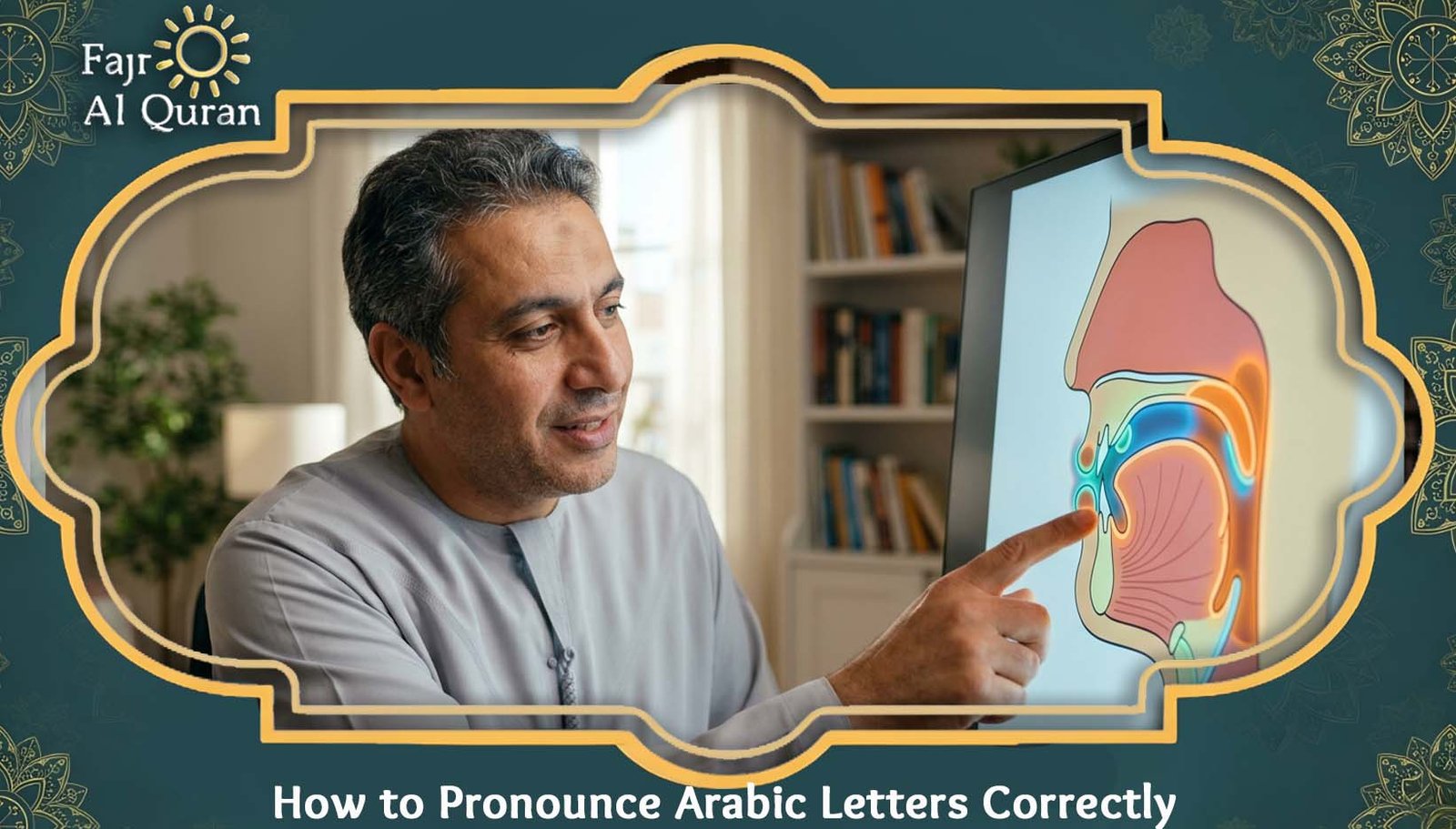
How to Pronounce Arabic Letters Correctly

How to Pronounce Arabic Letters Correctly

Correct pronunciation is one of the most important parts of learning the Arabic Alphabet. Knowing what a letter looks like is only the beginning. Learners also need to understand where and how each sound is produced.

Some Arabic sounds have close equivalents in English. Others do not. This is why using an English letter as a permanent substitute can create pronunciation problems.

For example, the Arabic letters ح, خ, ع, غ, ص, ض, ط, and ظ can be challenging for English speakers. Their sounds require movements that may not exist in ordinary English pronunciation.

Muslims studying Quran reading should pay special attention to Makharij al-Huruf, the articulation points of Arabic letters. Correct articulation helps protect the accuracy of Quranic recitation and supports proper Tajweed development.

A qualified teacher can demonstrate the position of the tongue, throat, lips, and teeth. This is much more effective than trying to learn difficult sounds only from English transliterations.

For beginners, pronunciation practice should include:

  • Listening carefully to a qualified teacher.
  • Repeating each sound slowly.
  • Comparing similar letters.
  • Practicing difficult sounds regularly.
  • Reading letters inside simple words.
  • Recording yourself and checking your pronunciation.

English translations can explain meaning, but translation does not teach pronunciation. Likewise, transliteration can provide a temporary guide, but learners should gradually read the original Arabic form directly.

At Fajr Al-Quran Academy, students can receive guided instruction from experienced tutors who can correct pronunciation as they learn. This personal feedback can save beginners from developing habits that become difficult to change later.

Learn Arabic Short Vowels: Fatha, Kasra, and Damma

After learning the basic Arabic Alphabet, beginners should understand short vowels. These marks are essential because they change how many Arabic letters are pronounced.

The three basic short vowels are Fatha, Kasra, and Damma.

Fatha (َ) generally produces a short “a” sound.
Kasra (ِ) generally produces a short “i” sound.
Damma (ُ) generally produces a short “u” sound.

For example, placing different vowel marks on the same consonant creates different readings:

بَ — ba
بِ — bi
بُ — bu

This is a simple but important concept. A learner may recognize the letter Baa perfectly but still misread a word if the vowel mark is ignored.

Students also encounter Sukoon (ْ), which indicates that a consonant does not carry a short vowel, and Shaddah (ّ), which indicates consonant doubling. These marks become increasingly important when learners move into Quran reading and Tajweed.

Arabic also has long vowel sounds. Alif, Waaw, and Yaa can function in patterns that produce longer vowel sounds depending on the surrounding letters and vowel markings.

Beginners should avoid trying to memorize every rule in one lesson. Start with the three short vowels, practice them with familiar letters, and then gradually introduce additional signs.

For Muslim students, this stage connects naturally with Noorani Qaida lessons. A structured Qaida course can help learners move from isolated letters to joined sounds and then to Quranic words.

Understanding vowels also makes Arabic reading more predictable. Once students recognize both letters and their vowel signs, they can begin sounding out unfamiliar words with greater confidence.

How Arabic Letters Connect in Words

Arabic is written from right to left, and many letters connect when they appear in words. This is one of the biggest changes for learners who are accustomed to the English alphabet.

The direction itself becomes easier with practice. The more important challenge is learning how letters change their shape when connected.

Consider a simple sequence containing Baa:

ب

When the letter is connected to other letters, its appearance can change. Students therefore need to learn both the individual character and its connected forms.

This is why simply memorizing the letters in the Arabic alphabet is not enough. Reading requires recognition of characters in different positions.

Some letters connect to the next letter, while others stop the connection. These rules affect the visual structure of words.

Beginners should practice connection gradually. Start with two-letter combinations. Then move to three-letter combinations and simple words.

Writing practice is especially useful here. When students physically write Arabic, they begin to understand how letters flow from one character to another.

Digital typing can also help. Arabic keyboards allow learners to practice recognizing characters on a screen, while Arabic fonts expose them to different styles. However, handwriting should not be ignored.

Students may also encounter Arabic chat, Franco Arabic, or Arabizi, where Arabic words are represented using Latin characters and numbers. These systems are common in informal online communication, but they are not a replacement for learning the actual Arabic script.

For serious Arabic learning or Quran study, learners should focus on the original script and develop the ability to read Arabic directly.

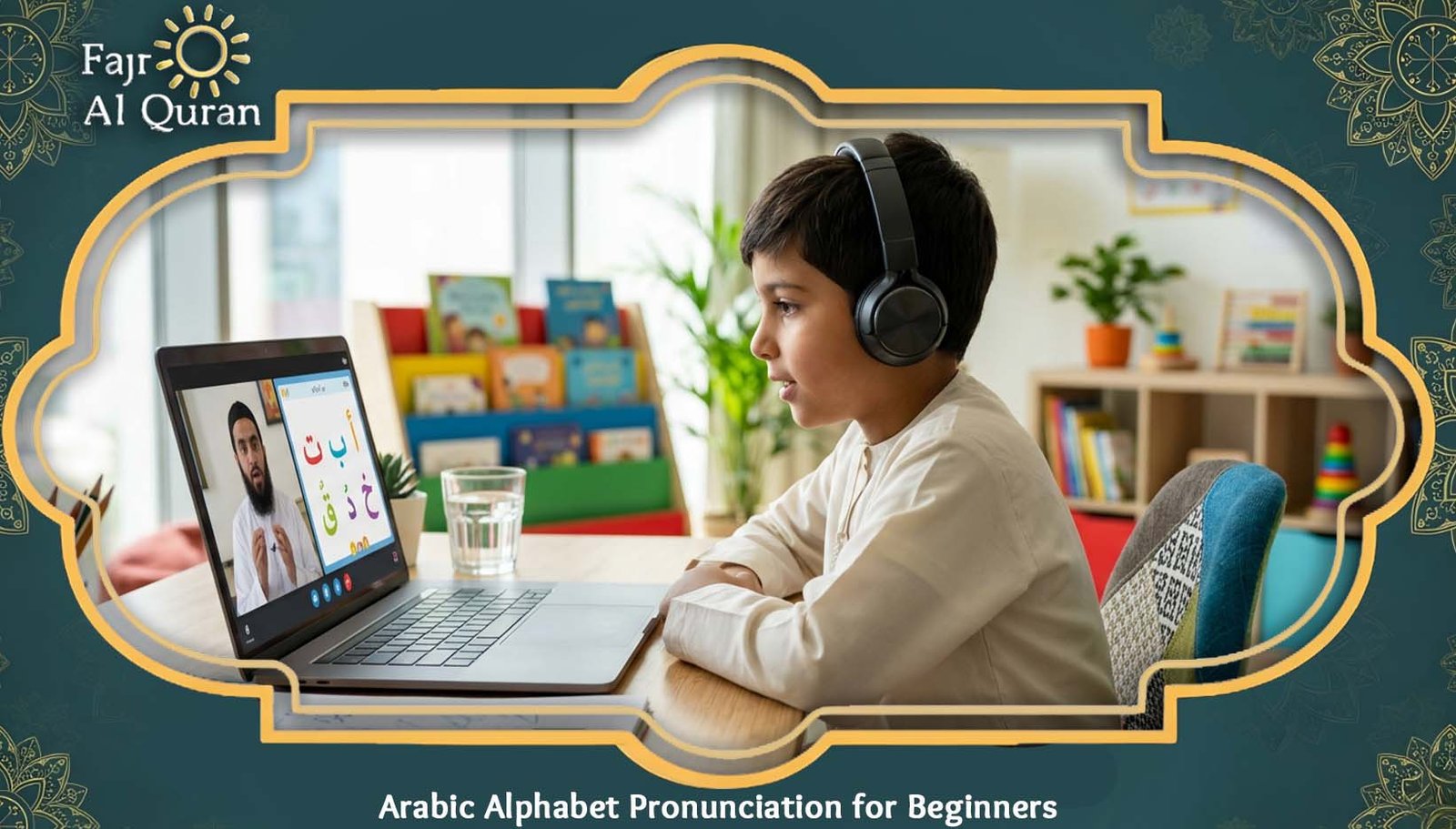
Arabic Alphabet Pronunciation for Beginners

Arabic Alphabet Pronunciation for Beginners

For many learners, pronunciation is the stage where the Arabic Alphabet becomes truly practical. Instead of simply identifying a character, students begin connecting visual recognition with sound.

English-speaking beginners often search for an “Arabic alphabet in English” or Arabic letters with English equivalents. Such resources can be useful when starting, but there is an important limitation: English does not contain an exact equivalent for every Arabic sound.

Transliteration systems attempt to represent Arabic using Latin characters. Different systems may use different symbols. This can make transliterations confusing if learners rely on them too heavily.

For example, a single Arabic letter may be represented in several ways depending on the transliteration system. Arabic chat can make this even more varied because users sometimes represent difficult sounds with numbers.

The best long-term goal is direct recognition:

Arabic character → Arabic sound → Arabic word

rather than:

Arabic character → English letter → transliteration → sound

The second process takes longer and can encourage inaccurate pronunciation.

A good beginner pronunciation lesson should include listening, repetition, correction, and reading. Students should hear a qualified speaker and imitate the sound rather than guessing from Roman letters.

Pronunciation is especially important for Muslims learning to read the Quran. Small sound differences can affect a word’s pronunciation and, in some cases, its meaning.

A native or highly qualified Arabic tutor can explain difficult sounds in a way that English-speaking learners understand. At Fajr Al-Quran Academy, structured online lessons can help children and adults develop these skills from home.

With regular practice, learners can move beyond memorizing alphabet letters and begin reading real Arabic words with confidence.

Arabic Alphabet for Kids with Fun Ways to Learn

Children can learn the Arabic Alphabet successfully when lessons are interactive, short, and consistent. Young learners usually respond better to activities than to long explanations.

Parents should not expect children to memorize all 28 letters in a few days. Recognition develops gradually. A better approach is to introduce a small number of letters, review them often, and celebrate progress.

Games can make alphabet practice more enjoyable. Parents and teachers can use matching cards, letter tracing, picture associations, simple quizzes, songs, and digital activities.

Useful activities include:

  • Matching Arabic letters with their names.
  • Tracing letters with a finger or pencil.
  • Finding a target letter in a short Arabic word.
  • Listening and identifying the correct sound.
  • Building simple words from letter cards.
  • Practicing one short lesson each day.

Visual repetition is particularly helpful for children. A letter should appear in isolation and then in connected forms so that children learn to recognize it in real reading situations.

Parents in the US, UK, Canada, and Australia may also face the challenge of balancing schoolwork with Islamic education. Online lessons can provide a practical solution because children can learn from home without adding travel time to a busy family schedule.

For Muslim children, alphabet lessons can eventually lead to Quran reading, Noorani Qaida, Tajweed, and broader Arabic studies.

Fajr Al-Quran Academy provides a supportive online learning environment for children and adults who want structured Arabic and Quran education. Individual attention can help teachers adapt lessons to a child’s age, learning speed, and existing knowledge.

The most important goal is to make learning positive. When children associate Arabic with encouragement and achievement, they are more likely to continue practicing.

FAQs About the Arabic Alphabet

How many letters are in the Arabic Alphabet?

The standard Arabic Alphabet has 28 basic letters. Learners also encounter additional signs and characters, such as Hamza and vowel marks, as they progress.

Is the Arabic Alphabet difficult for English speakers?

The Arabic Alphabet may look unfamiliar at first, but it becomes manageable with regular practice. Learning letter groups, connected forms, and pronunciation step by step can make the process much easier.

Can I learn the Arabic Alphabet online?

Yes, beginners can learn the Arabic Alphabet through structured online lessons. A qualified tutor can teach letter recognition, pronunciation, writing, vowels, and reading while correcting mistakes in real time.

Is learning the Arabic Alphabet useful for reading the Quran?

Absolutely. Learning Arabic letters is the foundation for Quran reading. Students can then progress to Noorani Qaida, Tajweed, proper pronunciation, and fluent Quranic recitation.

Conclusion: Start Learning the Arabic Alphabet with Confidence

The Arabic Alphabet is the foundation for reading and writing Arabic. It is also the first major step for Muslims who want to improve their Quran reading and understand more of the language of the Quran.

You do not need to master everything at once. Begin with the 28 letters, learn their sounds, practice their different forms, understand short vowels, and gradually read connected words.

Consistent practice is more valuable than rushing. With the right teacher and a clear learning plan, both children and adults can make steady progress.

If you are ready to learn from home, book a free trial lesson with a native Arabic teacher at Fajr Al-Quran Academy. Start with the basics, receive personal guidance, and build the confidence you need to read Arabic correctly.

Need Help?