Best Quranic Arabic Course Online – Learn Arabic to Understand the Quran

Best Quranic Arabic Course Online – Learn Arabic to Understand the Quran

The best Quranic Arabic course online is a virtual, structured program designed to teach students Classical Arabic (Al-Fusha) so they can read, recite, and understand the Quran directly in its original language without relying on translations.

An online Quranic Arabic course teaches the classical Arabic used in the Quran, focusing on reading, understanding, and reflecting on its text. These courses are designed for all levels, offering structured lessons, professional instruction, and personalized support. Learners gain fluency in Quranic vocabulary, grammar, and syntax, enabling deeper engagement with the Quran’s meaning and context. Platforms like Fajr Al-Quran Academy provide accessible, flexible learning from anywhere, making it easier to connect with the divine text.

A good Quranic Arabic course does more than teach Arabic words. It helps you recognise common Quranic vocabulary, understand sentence structures, identify Arabic roots, and appreciate the meaning of verses more directly.

Online learning also makes Quranic Arabic more accessible. Children, adults, new learners, and busy parents can study from home with lessons arranged around their schedules. With the right Quranic Arabic Course Online, students can move from basic letters and vocabulary to grammar and deeper Quran comprehension at a comfortable pace.

In this guide, you will learn what a Quranic Arabic course includes, how online classes work, what beginners study, and how to choose a reliable programme. We will also explain how Fajr Al-Quran Academy can support students who want structured lessons with qualified teachers.

What Is a Quranic Arabic Course?

A Quranic Arabic course teaches the Arabic language skills needed to understand the Quran more clearly. It focuses on the vocabulary, grammar, sentence patterns, and word structures commonly found in the Quran.

Unlike a general Arabic programme, a Quranic Arabic course connects language lessons directly to Quranic words and verses. Students gradually learn how words are formed and how their meanings change according to context.

This approach is useful for Muslims who can read the Quran but do not understand much of its meaning. It can also help new Muslims and beginners develop a stronger connection with the Quran.

A structured programme may cover:

  • Arabic letters and basic word formation
  • Common Quranic vocabulary
  • Arabic roots and word patterns
  • Basic Quranic Arabic grammar
  • Nahw and Sarf
  • Sentence structure
  • Frequently used Quranic expressions
  • Understanding selected Quranic verses

A Quranic Arabic course for beginners should not assume advanced knowledge. Lessons should introduce concepts gradually and give students enough practice before moving to more difficult material.

The goal is not simply to memorise translations. It is to help students recognise important Arabic words and structures so they can understand the Quran in Arabic with greater confidence.
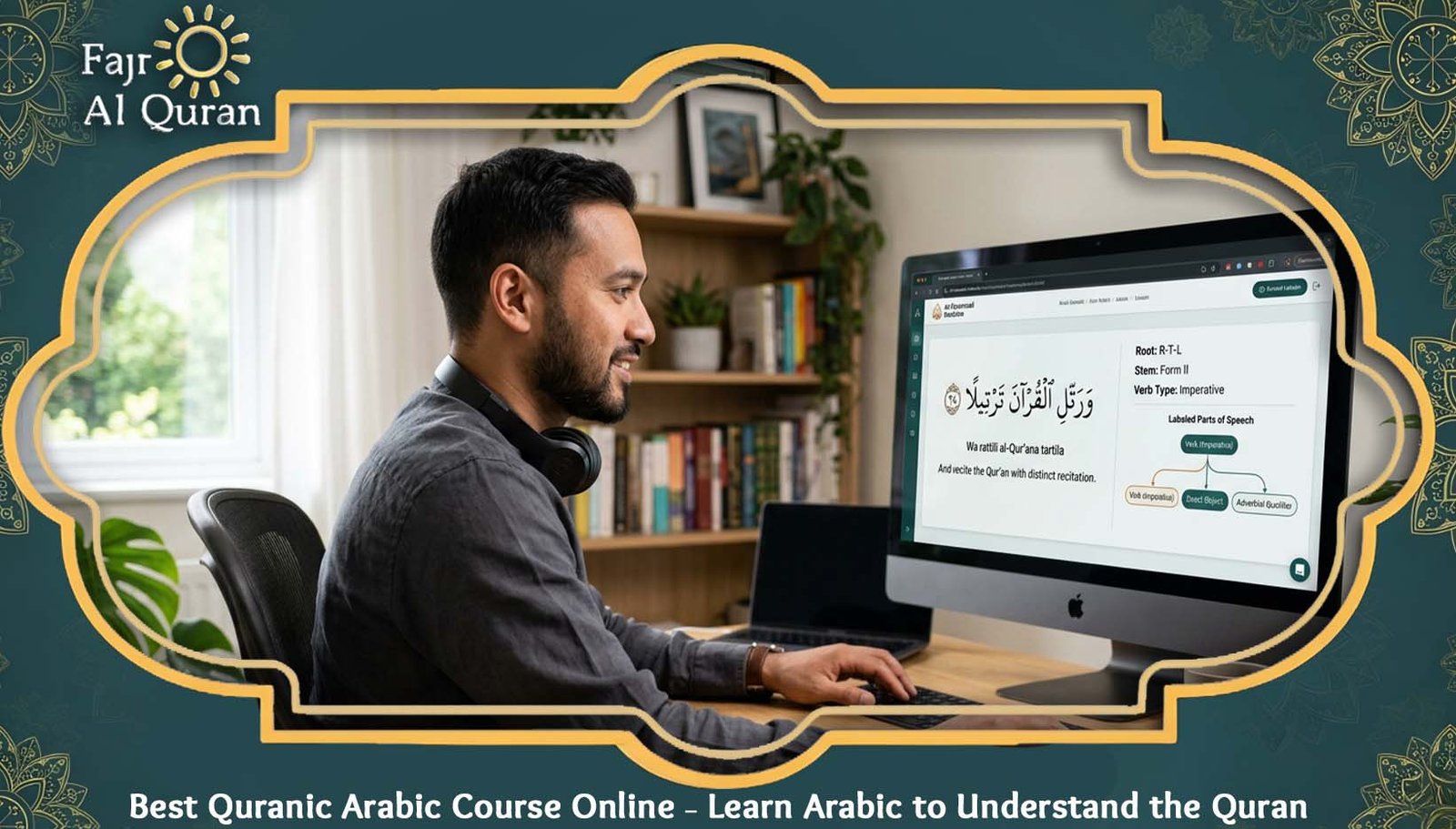
Best Quranic Arabic Course Online – Learn Arabic to Understand the Quran

Core Components of a Quranic Arabic Course Online

A well-designed Quranic Arabic Course Online combines several language skills. Each part supports the others, helping students build a practical foundation.

First, students develop their basic Arabic knowledge. This can include letters, sounds, vocabulary, simple words, and common expressions. Beginners who already know how to read the Quran can usually focus more quickly on meaning and language structure.

Next comes Quranic Vocabulary. Students learn frequently repeated words and expressions from the Quran. Learning high-frequency vocabulary allows learners to recognise familiar meanings across different Surahs.

Arabic Roots are another important component. Many Arabic words come from three-letter roots. Understanding these roots can help students recognise relationships between words and remember vocabulary more effectively.

Grammar also has an important role. Basic Quranic Arabic Grammar teaches students how words function within sentences. More advanced programmes may introduce Nahw and Sarf, which cover Arabic syntax and word formation.

A strong online programme should also include regular reading and application. Instead of studying grammar in isolation, learners should see how grammatical rules operate in actual Quranic passages.

This combination makes a Quranic Arabic course more useful than a vocabulary-only programme. Students learn not only what words mean but also how those words work together.

How Online Quranic Arabic Courses Work

Online Quranic Arabic Lessons allow students to learn from home using a computer, tablet, or other suitable device. Most programmes use live video lessons, allowing students to interact directly with their teacher.

The exact format depends on the academy. Some courses use one-to-one teaching, while others use small groups. One-to-one classes can be particularly helpful when a student needs individual attention or wants lessons at a specific pace.

A typical lesson may begin with a review of previous vocabulary or grammar. The teacher then introduces a new concept and explains it using simple examples. Students practise the concept before applying it to Quranic words or verses.

Regular revision is essential. Arabic has many patterns, so students need repeated exposure before new vocabulary and grammar become familiar.

A good Quranic Arabic course may also provide homework or additional practice between lessons. This allows students to review what they learned instead of relying only on weekly classes.

Online learning can be especially convenient for families in the US, UK, Canada, and Australia. Students can arrange lessons around school, work, and family responsibilities.

For parents, online classes can remove the need for travel. For adults, they provide a flexible way to study consistently even with demanding schedules.

The key is consistency. Two or three focused lessons each week, combined with short revision sessions, can create steady progress over time.

What Do You Learn in a Quranic Arabic Course?

The content of a Quranic Arabic course depends on the student’s level. Beginners usually start with the foundations before progressing to more complex language structures.

Students may begin by learning common words that appear throughout the Quran. Words related to Allah’s attributes, worship, guidance, creation, faith, and human actions are often useful starting points.

They then learn how Arabic words are built. This is where Arabic Roots become particularly valuable. Once students understand common root patterns, they can begin recognising connections between different words.

Grammar lessons gradually introduce sentence structure. Students learn how nouns, verbs, pronouns, adjectives, and prepositions function in Quranic Arabic.

A more comprehensive Quranic Arabic course may include:

  • Common nouns and verbs
  • Pronouns and demonstratives
  • Singular and plural forms
  • Masculine and feminine forms
  • Verb patterns
  • Possessive structures
  • Prepositions
  • Sentence types
  • Basic grammatical endings
  • Common Quranic expressions

Students may also study Nahw and Sarf at an appropriate level. Nahw focuses mainly on sentence structure and grammatical relationships, while Sarf examines word forms and changes.

The purpose is practical understanding. Students should be able to take what they learn and apply it when reading the Quran.

Over time, learners can begin to recognise familiar words without immediately depending on an English translation. This can make Quran study more meaningful and rewarding.
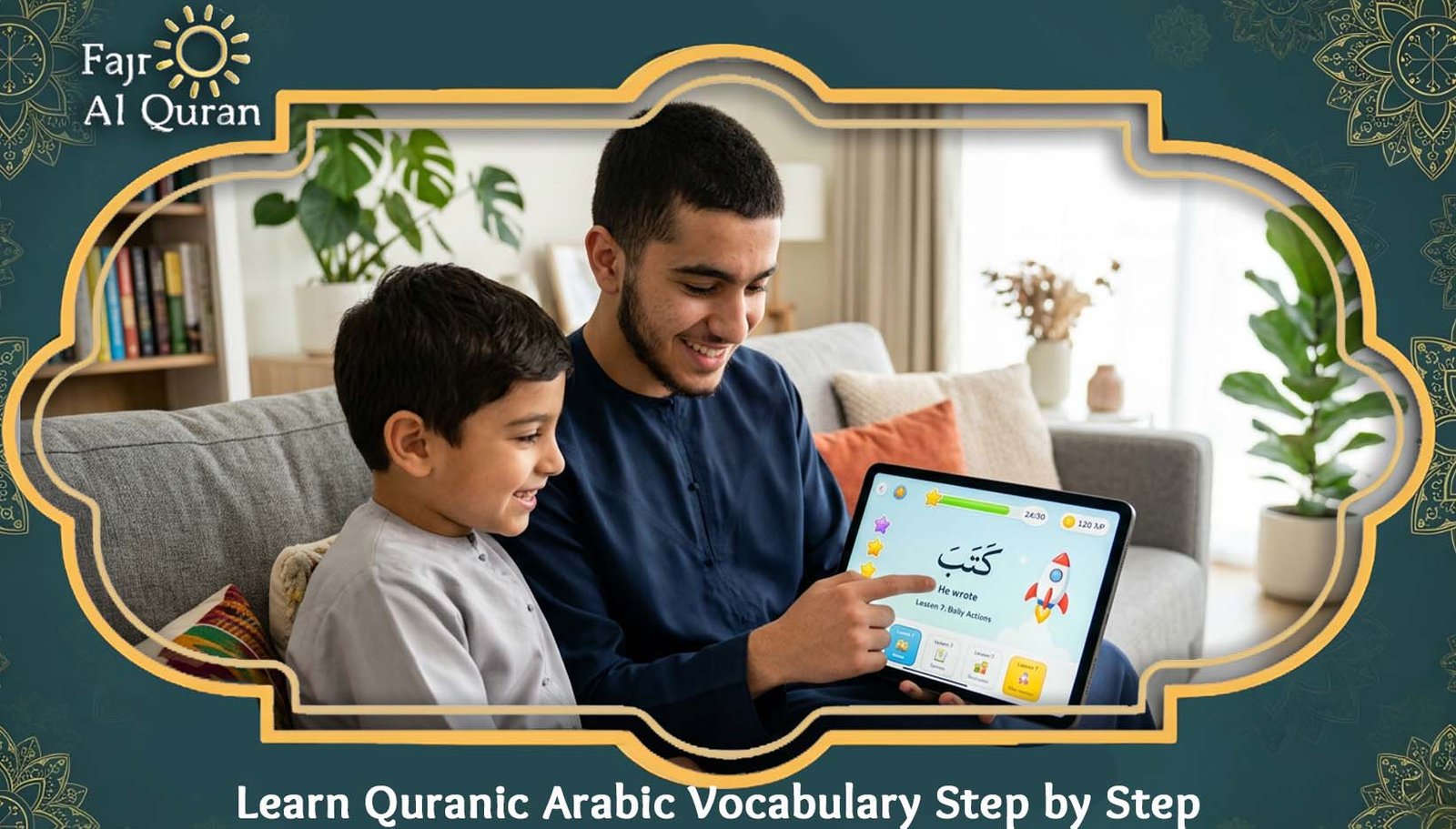
Learn Quranic Arabic Vocabulary Step by Step

Learn Quranic Arabic Vocabulary Step by Step

Vocabulary is one of the most important parts of a Quranic Arabic course. Students cannot understand Quranic sentences if they do not recognise the words within them.

However, beginners do not need to memorise thousands of words at once. A better approach is to start with frequently occurring vocabulary and gradually expand it.

Students can learn words in meaningful groups. For example, a lesson might focus on words related to worship, people, places, actions, time, or descriptions.

Arabic roots can make this process easier. When learners understand how several words relate to the same root, they may remember vocabulary more effectively.

For example, a student can learn a root and then study several related forms rather than treating every new word as completely unrelated.

A good Quranic Arabic course also teaches vocabulary in context. Seeing a word inside a Quranic verse helps students understand how its meaning works within a sentence.

Flashcards and short revision exercises can support this process. Reading familiar Surahs and identifying previously studied words is also useful.

Students should aim for steady progress rather than rushing. Learning a smaller number of words well is usually more beneficial than memorising a long list and quickly forgetting it.

With regular practice, Quranic Vocabulary becomes easier to recognise. Students gradually move from translating every word to understanding familiar phrases and sentence patterns.

That progress can make the Quran feel more accessible. Instead of seeing Arabic as a barrier, learners begin to recognise it as a language they can study and understand.

Master Quranic Arabic Grammar to Understand the Quran

Grammar helps students understand how Quranic words relate to each other. This makes Quranic Arabic Grammar an important part of any serious language programme.

Beginners may initially find grammar intimidating. A good teacher should therefore explain rules with simple examples instead of overwhelming students with technical terminology.

A Quranic Arabic course may begin with basic sentence structures. Students learn how nominal and verbal sentences work and how different parts of a sentence relate to one another.

They may also study pronouns, prepositions, adjectives, verb forms, and possessive structures. As their knowledge develops, they can move towards more detailed grammatical concepts.

Nahw and Sarf become particularly useful at intermediate and advanced levels. Nahw helps learners analyse sentence construction, while Sarf helps them understand how Arabic words change according to their forms.

This knowledge can improve Quran comprehension in several ways. Students become better able to identify who is acting, what is being described, and how words connect within a verse.

Grammar should always support understanding rather than become an end in itself. The purpose of studying grammar is to help learners understand the Quran in Arabic more accurately.

A qualified teacher can also explain areas where a direct word-for-word translation may not fully communicate the Arabic meaning.

As students progress, they can analyse short Quranic passages with increasing independence. This creates a strong foundation for deeper study.

Online Quranic Arabic Classes for Kids and Adults

A useful Quranic Arabic course should accommodate different ages and learning needs. Children and adults do not always learn in the same way.

Children generally benefit from shorter activities, repetition, visual learning, and age-appropriate examples. Lessons should feel structured but engaging. Teachers should avoid giving young learners unnecessarily complex grammar explanations.

Adults often have different priorities. Some want to understand the Quran during Salah. Others may want to understand Surahs they regularly recite or develop enough Arabic knowledge for deeper Islamic studies.

For both groups, flexible scheduling can make a major difference. Families in Western countries may have school, work, extracurricular activities, and other commitments.

Online Quranic Arabic Classes can provide greater flexibility because students can learn without travelling to a physical centre.

A suitable programme can support:

  • Children who are beginning Arabic
  • Adults with no previous Arabic knowledge
  • Muslims who can read but do not understand Arabic
  • New Muslims learning Quranic vocabulary
  • Parents looking for structured Islamic education
  • Students who want to progress beyond basic translation

A family-friendly Quranic Arabic course should also maintain clear communication with parents when children are enrolled.

At Fajr Al-Quran Academy, online learning can provide students with structured Quran and Arabic education from home. Qualified teachers can adapt lessons according to age, level, and learning goals.

The right approach should make Arabic approachable while maintaining academic and Islamic standards.
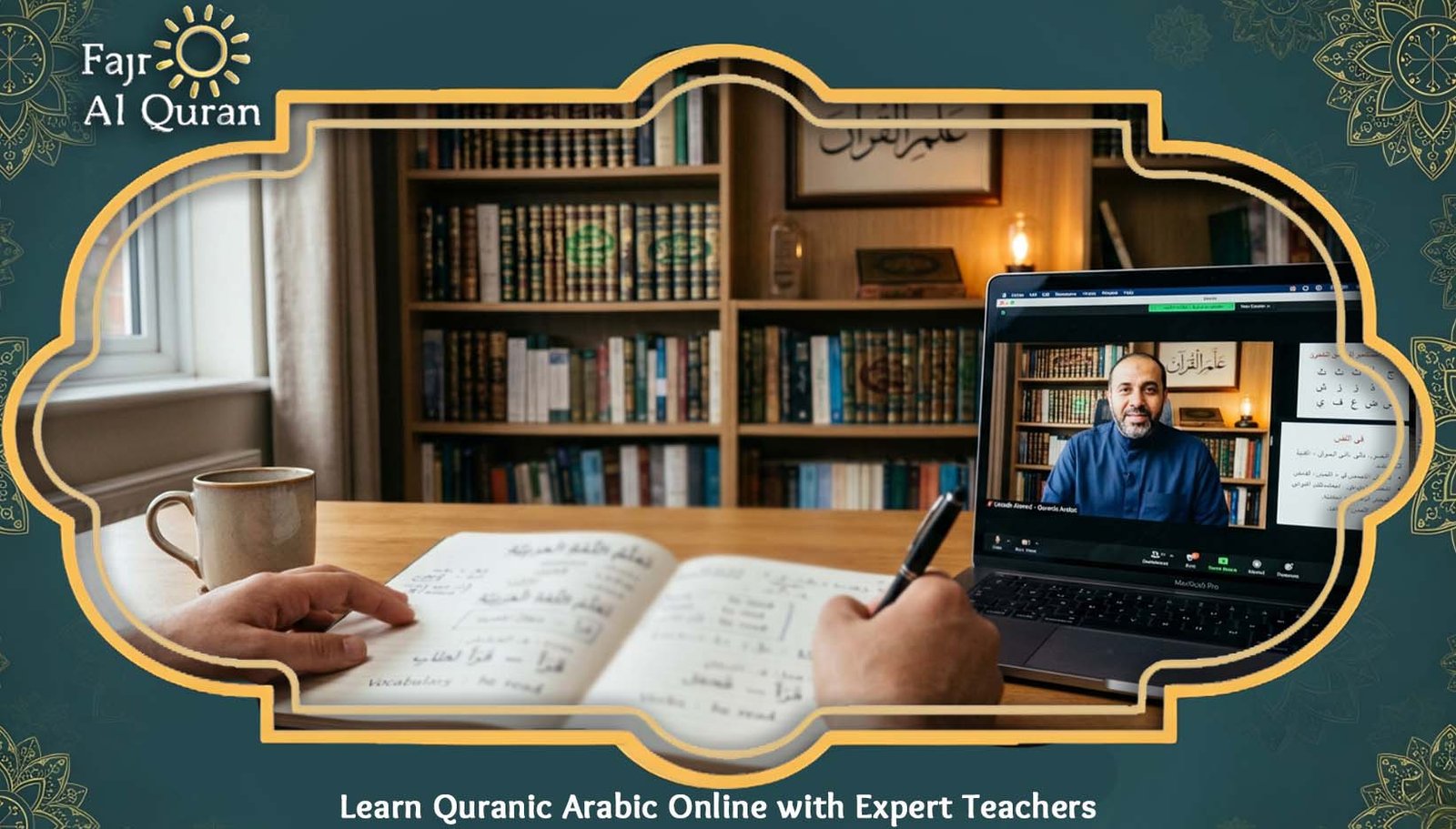
Learn Quranic Arabic Online with Expert Teachers

Learn Quranic Arabic Online with Expert Teachers

The teacher can make a major difference to the success of a Quranic Arabic course. A well-qualified instructor can identify mistakes, explain difficult concepts, and adjust lessons to suit the student’s level.

When choosing an Online Quranic Arabic Teacher, look for someone with strong Arabic knowledge and experience teaching non-native speakers.

Teaching Arabic to beginners requires more than simply knowing the language. The teacher must know how to explain unfamiliar concepts clearly.

A good teacher should encourage questions. Students should feel comfortable saying when they do not understand a rule or vocabulary item.

One-to-one teaching can be especially useful for adults and children who need individual support. The teacher can spend more time on difficult areas instead of following the same pace for every learner.

Some students may also prefer a native Arabic teacher. Native fluency can provide strong language exposure, while teaching experience ensures that explanations remain accessible.

When evaluating a Quranic Arabic course, consider whether the teachers have:

  • Relevant Arabic teaching experience
  • Experience with beginners
  • Strong Quranic knowledge
  • Clear communication skills
  • A structured teaching approach
  • Patience with children and adult learners
  • Ability to explain Arabic grammar simply

Fajr Al-Quran Academy can be considered by learners seeking structured online Quran and Arabic education. The academy’s online format is designed to make lessons accessible to students studying from different locations.

The right teacher should not simply deliver information. They should help students understand, practise, ask questions, and build confidence.

Quranic Arabic Course for Beginners – Start from the Basics

You do not need previous Arabic knowledge to start a Quranic Arabic course for beginners. A well-structured programme should take you from the basics and introduce new concepts gradually.

If you can already read the Quran, you have a useful starting point. You are familiar with Arabic letters and Quranic script, so your next step can focus on vocabulary, meaning, and language structure.

Students who are completely new to Arabic can also learn Quranic Arabic from scratch. Their programme may begin with letters, pronunciation, simple words, and basic sentence structures before moving into Quranic vocabulary.

The most important point is not to compare your progress with other students. Everyone learns at a different pace.

A beginner-friendly Quranic Arabic course should provide plenty of revision. New learners need repeated exposure to words and structures before they become natural.

Short daily practice can also help. Even 10–15 minutes of vocabulary review can reinforce what you learned during a live lesson.

Beginners should also connect language study with the Quran. When you learn a new word, look for it in a familiar Surah. This gives the vocabulary a real purpose.

Over time, you may begin recognising words while reciting. That moment can be highly motivating because you are no longer relying entirely on an English translation.

The best course for a beginner is therefore one that combines simple teaching, structured progression, regular practice, and direct Quranic application.

How to Choose the Best Quranic Arabic Course Online

Choosing the Best Quranic Arabic Course Online requires more than comparing prices. You should consider the quality of teaching, course structure, flexibility, and support provided to students.

First, check whether the course is genuinely designed around Quranic Arabic. A general conversational Arabic course may not focus enough on Quranic vocabulary, grammar, and verse comprehension.

Next, consider the teacher. Look for qualified instructors who have experience teaching beginners and non-native Arabic speakers.

Class format also matters. One-to-one lessons can offer greater personalisation, while small groups may provide interaction with other students.

You should also check whether the programme offers a clear learning path. Students should know what they will study at beginner, intermediate, and advanced levels.

If certification matters to you, ask whether the academy offers a Quranic Arabic course with a certificate after completing the relevant programme.

Other useful factors include:

  • Flexible class times
  • Trial lessons
  • Qualified teachers
  • Age-appropriate lessons for children
  • Beginner-friendly curriculum
  • Regular assessments or progress reviews
  • Reasonable pricing
  • Online access from your country
  • Support for students studying from home

Do not choose a programme simply because it uses words such as “mastering,” “complete,” or “advanced” in its marketing. Look at the actual curriculum and teaching approach.

Some well-known Arabic learning programmes and courses may use different levels or terminology. What matters most is whether the course matches your current ability and your goal of understanding the Quran.

A strong Quranic Arabic course should give you a realistic path from beginner study towards independent Quran comprehension.

Conclusion

A Quranic Arabic course can help you move beyond simply reading the Quran towards understanding its words and meanings. With structured vocabulary study, grammar practice, Arabic roots, and guidance from a qualified teacher, beginners can make steady progress.

For Muslims in the West, online learning offers an accessible way to study around school, work, and family commitments. Whether you are an adult, a parent, a child, or a complete beginner, the right programme can make Quranic Arabic easier to approach.

If you are ready to improve your understanding of the Quran, consider starting with Fajr Al-Quran Academy and taking your first step with a structured online lesson.

Book a free trial lesson with a native Arabic tutor today and start learning Quranic Arabic from home.

Frequently Asked Questions

Is Quranic Arabic difficult for beginners?

Quranic Arabic can seem difficult at first, but beginners can learn it gradually with structured lessons and regular practice. Starting with common vocabulary and simple grammar makes the process much more manageable.

How long does it take to learn Quranic Arabic?

The time varies according to your starting level, study schedule, and goals. Consistent lessons and regular practice can help you build useful Quranic Arabic skills steadily.

Can I learn Quranic Arabic online?

Yes, you can learn Quranic Arabic Online through live lessons with qualified teachers. Online classes allow students to study from home and often provide flexible scheduling.

What is the difference between Arabic and Quranic Arabic?

General Arabic can focus on everyday communication, while Quranic Arabic focuses on the language, vocabulary, and grammar needed to understand the Quran. Learning Quranic Arabic can therefore be especially useful for Muslims whose primary goal is Quran comprehension.
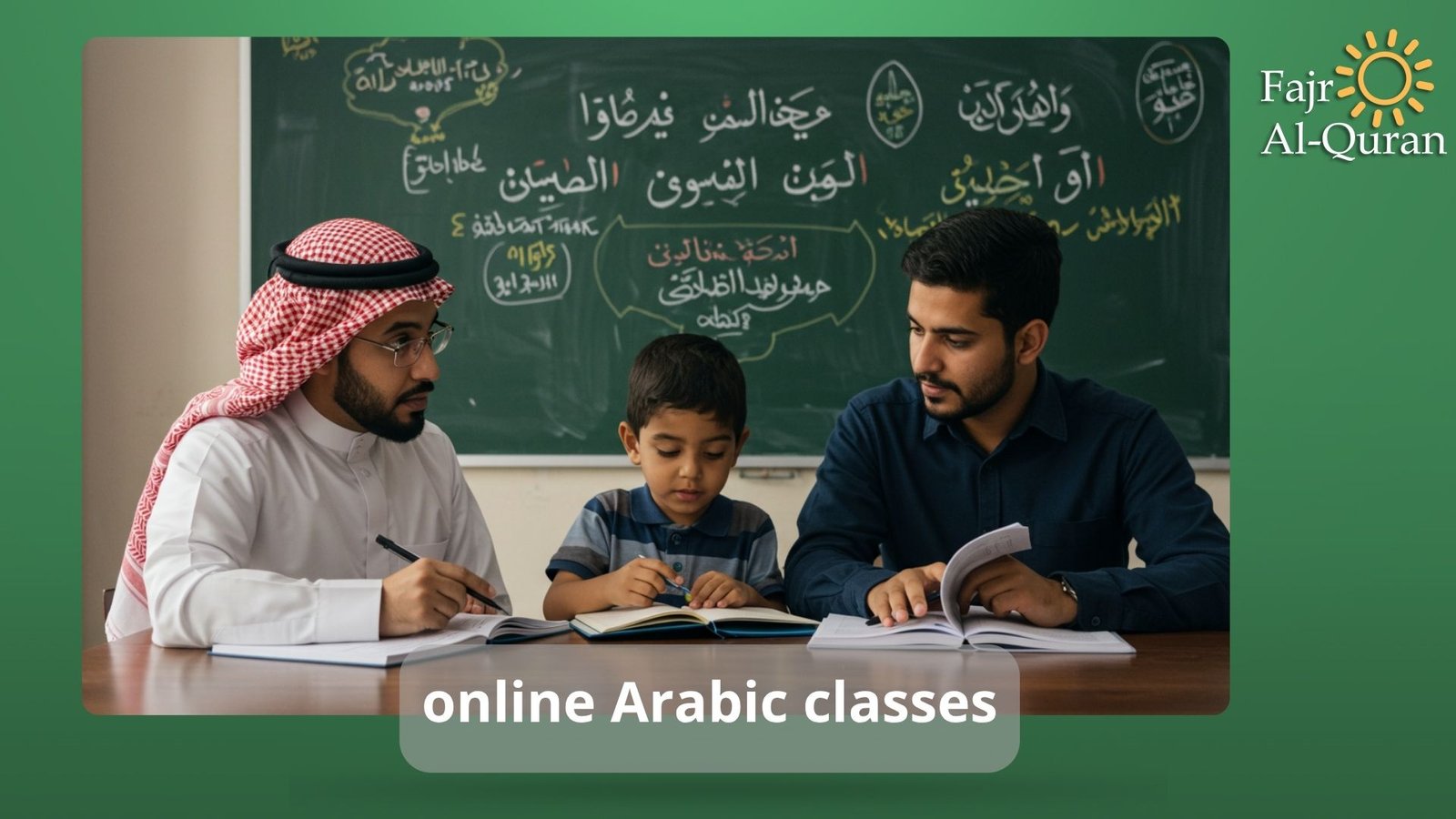

Best Online Arabic Classes for Beginners – Learn Arabic from Home

online Arabic classes

Online Arabic classes for beginners are virtual educational programs designed to teach absolute beginners how to read, write, pronounce, and converse in basic Arabic from scratch.

Online Arabic classes for beginners offer structured, interactive lessons in Modern Standard Arabic (MSA) or colloquial dialects, designed for adults and newcomers. Platforms like Fajr Al-Quran Academy provide foundational vocabulary, essential phrases, and grammar through live or self-paced formats. Online Arabic classes for beginners include audio, video, and cultural insights to support real-world communication. The Academy also offers comprehensive programs tailored for absolute beginners, making learning accessible anytime, anywhere.

That is why online Arabic classes for beginners have become a practical option for children and adults who want structured lessons from home. Students can learn at a comfortable pace without spending time travelling to a language school.

Whether your goal is to read Arabic, improve pronunciation, understand Quranic Arabic, or build everyday language skills, the right course can give you a clear path forward. You do not need previous experience. A good beginner course starts with the basics and gradually develops reading, vocabulary, grammar, listening, and speaking skills.

Fajr Al-Quran Academy is a leading platform offering structured online Arabic classes for beginners with qualified teachers and flexible online learning. Its approach can support both young learners and adults who need lessons that fit around their existing commitments.

This guide explains what to look for in Arabic courses for beginners, how online lessons work, and how to choose a reliable Arabic Academy for yourself or your child.

What Are the Best Online Arabic Classes for Beginners?

The best online Arabic classes for beginners are designed around the actual needs of students who are starting from little or no Arabic knowledge. Instead of expecting learners to understand complex grammar immediately, beginner lessons introduce the language in small, manageable steps.

A strong course normally begins with the Arabic alphabet, letter recognition, correct pronunciation, and basic vocabulary. Students then move toward reading words, forming simple sentences, understanding grammar, and developing conversational confidence.

For Muslim learners, online Arabic classes for beginners can also include Quranic Arabic. This helps students recognize common Quranic words and understand the basic structure of the language used in the Quran.

A well-designed course may cover:

  • Arabic letters and their different forms
  • Reading and pronunciation
  • Basic vocabulary and expressions
  • Essential grammar
  • Listening and speaking practice
  • Quranic Arabic foundations
  • Guided reading and revision

The best course also considers the student’s age and learning goals. Children may need visual activities and repetition, while adults may prefer practical conversations and focused grammar lessons.

With online Arabic classes for beginners, learners can receive structured instruction without needing to attend a physical language school. This makes Arabic online learning particularly useful for families living far from Arabic-speaking communities.

Best Online Arabic Classes for Beginners – Learn Arabic from Home

Benefits of Online Arabic Classes for Beginners

There are many reasons students choose online Arabic classes for beginners instead of traditional classroom courses. The biggest advantage is convenience. Students can attend lessons from home using a computer, tablet, or other suitable device.

For busy adults, this flexibility can make Learning Arabic much easier to maintain. Parents can arrange lessons around work and family responsibilities. Children can also study after school without adding a long commute to their schedule.

Another benefit is personalized instruction. Many online Arabic classes for beginners allow students to receive direct feedback from a teacher. This matters because Arabic pronunciation can be difficult to correct without guidance.

Online learning can also provide access to teachers who may not be available locally. A student in Canada, for example, can study with a qualified Arabic tutor who teaches students internationally.

Students can benefit from:

  • Flexible lesson times
  • One-to-one teacher support
  • Lessons from home
  • Personalized learning plans
  • Regular pronunciation correction
  • Digital learning resources
  • Progress tracking and revision

For Muslim families, online Arabic classes for beginners may also connect language learning with Quran study. Understanding Arabic vocabulary can make Quran lessons more meaningful over time.

The key is consistency. Even short lessons become effective when students attend regularly and practise between classes.

Learn the Arabic Alphabet and Letters Step by Step

Learning the Arabic alphabet is one of the first milestones in online Arabic classes for beginners. Students need to recognize the letters before they can read words confidently.

Arabic has 28 basic letters. Unlike English, many Arabic letters change their written form depending on whether they appear at the beginning, middle, or end of a word. This can seem challenging at first, but systematic practice makes the process much easier.

Good online Arabic classes for beginners introduce letters gradually. Students learn to recognize each letter, identify its sound, and practise writing it. Teachers can then introduce short combinations and simple words.

For children, alphabet lessons may include:

  • Letter recognition activities
  • Writing worksheets
  • Visual exercises
  • Repetition games
  • Interactive reading practice

Adults can benefit from the same gradual approach, especially if they have never studied Arabic before.

Some learners also search for learning Arabic for beginners online free resources or free Arabic lessons for beginners. Free resources can be useful for additional practice, but structured teaching offers something that independent resources often cannot: direct correction and a clear learning sequence.

A reliable teacher can help students avoid developing incorrect habits. This is especially important when the goal includes Quran reading or Islamic studies.

Once students become comfortable with the alphabet, they can move naturally toward reading words and short sentences.

Learn Arabic Reading and Pronunciation for Beginners

Correct pronunciation is an essential part of online Arabic classes for beginners. Reading Arabic is not only about recognizing letters. Students also need to produce the sounds accurately.

Some Arabic sounds do not have direct equivalents in English. Beginners may therefore pronounce certain letters incorrectly if they learn without teacher feedback.

In online Arabic classes for beginners, teachers can listen to students read aloud and identify areas that need improvement. They can demonstrate the correct position of the tongue, lips, and mouth where appropriate.

Students can gradually practise:

  • Individual letter sounds
  • Short vowels
  • Long vowels
  • Joined letters
  • Common word patterns
  • Simple sentences
  • Guided reading

For Muslim learners, accurate pronunciation has particular value when studying Quranic Arabic and Quran reading. Arabic language lessons can complement Quran education by helping students become more familiar with vocabulary and sentence patterns.

Some learners begin by learning Arabic with free videos or apps. These can support repetition, but they should ideally supplement rather than replace guided instruction.

With regular online Arabic classes for beginners, students can build confidence while receiving immediate correction. This prevents small pronunciation problems from becoming long-term habits.

The aim is not to rush. A patient teacher allows beginners to repeat difficult sounds until they become more natural.

One-to-One Online Arabic Classes for Beginners

One-to-One Online Arabic Classes for Beginners

One-to-one teaching is a major reason many students choose online Arabic classes for beginners. In a private lesson, the teacher can focus entirely on one student’s needs instead of dividing attention among several learners.

This can be particularly useful for adults who have different goals from children. An adult may want to learn conversational Arabic, understand Quranic vocabulary, or prepare for travel. A child may need more repetition and interactive activities.

One-to-one online Arabic classes for beginners can be adjusted according to the learner’s level. If a student already knows the alphabet, the teacher can move ahead rather than repeating material unnecessarily.

Private lessons also make it easier to ask questions. Beginners often hesitate to speak in a group because they worry about making mistakes. A supportive tutor can create a more comfortable environment for practice.

Students may receive personalized help with:

  • Reading
  • Speaking
  • Vocabulary
  • Grammar
  • Pronunciation
  • Quranic Arabic
  • Homework and revision

Fajr Al-Quran Academy provides a structured environment where students can learn Arabic online with focused teacher support. This can be especially helpful for Western families looking for online Arabic classes for beginners that fit their schedules.

Personalized lessons do not mean students have to study at an intense pace. The teacher can adjust the speed according to the student’s progress.

Online Arabic Classes with Qualified Expert Tutors

The quality of the teacher can make a significant difference in online Arabic classes for beginners. A student may have access to hundreds of online resources, but resources alone cannot replace effective instruction.

A qualified tutor should understand how to teach beginners. Knowing Arabic is not enough. The teacher should also be able to explain concepts clearly, correct mistakes respectfully, and adapt lessons to the student’s level.

For children, teaching experience is particularly important. Young students often need shorter activities, repetition, encouragement, and engaging exercises to remain focused.

Adults may prefer a more direct approach. They may want practical vocabulary, grammar explanations, reading practice, or Quranic Arabic.

When comparing online Arabic classes for beginners, consider whether the academy provides:

  • Qualified and experienced Arabic teachers
  • Beginner-friendly lesson plans
  • Clear pronunciation instruction
  • Individual feedback
  • Age-appropriate teaching
  • Flexible scheduling
  • Regular progress assessment

A good Arabic Academy should also communicate clearly with parents when children are enrolled. Parents should know what their child is learning and how progress is being measured.

Fajr Al-Quran Academy positions its Arabic instruction within a broader Islamic education setting, making it a relevant choice for Muslim families seeking online Arabic classes for beginners alongside Quran learning.

The right teacher should make beginners feel comfortable asking questions and making mistakes. Confidence is an important part of language development.

Flexible Arabic Lessons for Busy Adults and Families

Time is one of the biggest barriers to learning Arabic. Parents may have children at different schools, adults may work full-time, and family schedules can change from week to week.

This is where online Arabic classes for beginners offer an important advantage. Students can attend lessons from home without travelling to a language school.

Flexible scheduling can be especially useful for families in Western countries. A parent in the UK may need lessons after school, while an adult in Australia may need a different time because of work commitments.

Online lessons can make it easier to maintain a consistent routine. Students can create a weekly schedule that fits their responsibilities.

This approach can benefit:

  • Busy working adults
  • Parents and children
  • University students
  • New Muslims
  • Families living outside Arabic-speaking communities
  • Students combining Arabic with Quran studies

For parents, convenience also means less disruption to the family routine. Children can complete their lesson at home and return to homework or other activities afterward.

However, flexibility should not mean a lack of structure. Effective online Arabic classes for beginners should still follow a planned curriculum.

Students need clear goals and regular revision. They also need enough practice between lessons to remember new vocabulary and grammar.

With the right balance of structure and flexibility, learners can start their Arabic studies without allowing language learning to become an overwhelming commitment.

Affordable Online Arabic Classes for Beginners

Affordable Online Arabic Classes for Beginners

Cost is another important consideration when choosing online Arabic classes for beginners. Families often want quality instruction without committing to an expensive traditional language school.

Online education can reduce some costs associated with physical classrooms. Students do not need to travel, and lessons can take place from home.

However, affordability should not be considered separately from quality. The cheapest course is not automatically the most suitable option. A low-cost program may provide limited teacher interaction or little individual feedback.

When comparing online Arabic classes for beginners, look beyond the advertised price. Consider what is included in the program.

Check whether the course offers:

  • Live teacher-led lessons
  • Individual attention
  • Structured materials
  • Progress support
  • Flexible scheduling
  • Trial lessons
  • Qualified instructors

Some people search for free Arabic lessons for beginners or learning Arabic for beginners free resources. These can be helpful for vocabulary practice and revision. However, students who want steady progress may benefit from combining free resources with professional instruction.

An affordable Arabic course should provide genuine educational value. Families should understand the lesson frequency, class duration, teacher qualifications, and learning outcomes before enrolling.

Fajr Al-Quran Academy can provide a structured online environment for students looking for accessible online Arabic classes for beginners while also exploring Quran and Islamic education.

A clear course structure allows families to make an informed decision based on both price and educational support.

Interactive Online Arabic Classes for Kids and Beginners

Children learn differently from adults, which is why effective online Arabic classes for beginners should be adapted for younger students.

A long lecture is rarely enough to keep a child engaged. Young learners benefit from visual material, repetition, simple challenges, reading exercises, and opportunities to participate.

Interactive online Arabic classes for beginners can introduce Arabic through age-appropriate activities. Teachers may use pictures, digital worksheets, word games, reading exercises, and questions to keep children involved.

Parents should also consider whether the teacher understands the needs of children growing up in English-speaking environments. A child may have little exposure to Arabic outside the lesson.

For these learners, the teacher may need to spend additional time building basic vocabulary and confidence.

Children can gradually learn:

  • Arabic letters
  • Letter sounds
  • Simple words
  • Numbers and colours
  • Everyday expressions
  • Basic sentence structures
  • Quranic vocabulary

Arabic lessons can also complement Islamic education. Children who study Quran may find that learning common Arabic words helps them recognize familiar terms during Quran lessons.

Apps and online resources can provide additional practice. Arabic learning websites, worksheets, educational videos, and other digital tools may reinforce classroom learning.

Still, teacher interaction remains important. A qualified tutor can identify mistakes that an app may not recognize.

For families searching for online Arabic classes for beginners, an interactive and supportive environment can make lessons more enjoyable and sustainable for children.

How to Choose the Best Online Arabic Classes

Choosing online Arabic classes for beginners requires more than searching for the lowest price or the first academy that appears online. The right course should match the student’s age, goals, level, schedule, and preferred learning style.

Start by identifying the purpose of the course. Do you want to read Arabic? Speak with Arabic speakers? Understand Quranic Arabic? Help your child build Islamic language skills? Your answer will influence the type of course you need.

Next, review the teacher’s qualifications and teaching experience. A professional Arabic instructor should be able to explain lessons clearly and provide useful feedback.

You should also ask how the curriculum is structured. Good Arabic courses for beginners should have a logical progression rather than presenting unrelated topics.

Before enrolling, consider these factors:

  • Teacher quality: Are the tutors experienced in teaching beginners?
  • Course structure: Does the program follow a clear curriculum?
  • Class format: Are private or group lessons available?
  • Flexibility: Can lessons fit your schedule?
  • Age suitability: Is the course designed for children, adults, or both?
  • Learning goals: Does it cover your specific needs?
  • Trial option: Can you experience a lesson before committing?
  • Support: Does the academy provide feedback and progress guidance?

You may also compare an Islamic institute, Arabic school, private tutor, or online academy. Some learners prefer a general language course, while Muslim students may want Arabic instruction connected to Quran study.

The strongest online Arabic classes for beginners should make the learning process clear from the first lesson. Students should know what they are learning, why they are learning it, and what they will study next.

Conclusion: Start Learning Arabic from Home

Learning a new language does not have to mean travelling to a language school or fitting your life around a rigid timetable. With well-structured online Arabic classes for beginners, students can learn from home while receiving guidance from qualified teachers.

From the Arabic alphabet and pronunciation to vocabulary, grammar, reading, and Quranic Arabic, a clear learning plan can make Arabic easier to understand. Children can enjoy interactive lessons, while adults can study at a pace that fits their responsibilities.

If you are ready to learn Arabic online, choosing the right teacher and course is the first important step. Fajr Al-Quran Academy offers a supportive online learning environment for beginners, children, and adults who want structured Arabic instruction.

Ready to start your Arabic learning journey? Book a free trial lesson with a native Arabic teacher/tutor at Fajr Al-Quran Academy and discover a simple, flexible way to learn Arabic from home.  

Frequently Asked Questions

Are online Arabic classes good for beginners?

Yes. Online Arabic classes for beginners can provide structured lessons, direct teacher feedback, and flexible learning from home. They are suitable for both adults and children when the curriculum is designed for their level.

Can I learn Arabic online without knowing the alphabet?

Yes. Beginner courses can start with the Arabic alphabet and gradually introduce reading, pronunciation, vocabulary, and grammar. A qualified teacher can guide students through each stage without requiring previous Arabic knowledge.

Can children take online Arabic classes from home?

Yes. Children can learn Arabic online through age-appropriate lessons with interactive activities and teacher guidance. One-to-one classes can also allow the tutor to adjust the lesson pace to the child’s needs.

Are free Arabic lessons for beginners enough to learn Arabic?

Free Arabic lessons for beginners can be useful for practice, vocabulary, and revision. However, students who want structured progress may benefit from live instruction, personalized feedback, and a planned curriculum.

Need Help?