The Arabic alphabet consists of 28 letters, all consonants, with vowels indicated by diacritical marks (harakat). It is written right-to-left and features cursive forms that change based on letter position (initial, medial, final, or isolated). Letters can have different shapes depending on context.
The script is used for Arabic and several other languages, including Urdu and Persian. The Arabic alphabet plays a vital role in Islamic culture, as the Quran is written in Classical Arabic. The alphabet’s visual elegance and calligraphic traditions are highly valued across the Arab world.
Learning a new script can feel difficult when you do not know where to begin. For Muslims in the West, learning Arabic can also mean finding a qualified teacher who can explain unfamiliar letters, sounds, and writing rules in clear English.
With the right sequence, regular practice, and helpful guidance, beginners can learn to recognize, pronounce, read, and write Arabic letters with confidence.
The Arabic Alphabet is the foundation of the Arabic language. It is also an important first step for Muslims who want to read the Quran correctly. Children, adult learners, new Muslims, and parents supporting their children’s Islamic education can all benefit from structured Arabic lessons.
In this complete beginner’s guide, you will learn how the Arabic script works, how many letters it contains, how each letter changes shape, how letters connect, and how short vowels affect pronunciation. You will also discover practical ways to practice at home.
Whether your goal is learning conversational Arabic, reading the Quran, studying Islamic texts, or simply understanding Arabic writing, mastering the basics will make the next stages much easier.
What Is the Arabic Alphabet?
The Arabic Alphabet is the writing system used to write Arabic. It is known as al-abjadiyyah al-Arabiyyah and is written from right to left. This is one of the first differences English-speaking beginners notice because the English alphabet is written from left to right.
Arabic uses individual characters that can change their appearance depending on their position in a word. The basic letter remains the same, but its connected form may look different at the beginning, middle, or end of a word.
The Arabic script is a consonant-based writing system. Short vowels are usually represented by small marks rather than separate alphabet letters. This structure is especially important for students learning Quranic Arabic.
For example, ا (Alif) is one of the first letters students learn. Other common letters include ب (Baa), ت (Taa), ج (Jeem), ح (Haa), and خ (Khaa).
Beginners sometimes search for the Arabic alphabet with English equivalents. English transliterations can be useful as temporary support, but they should not replace learning the original Arabic form.
A strong beginner should gradually develop direct recognition of Arabic characters rather than depending on Latin letters. This makes reading, writing, pronunciation, and Quran study much easier later.
At Fajr Al-Quran Academy, beginners can build these skills through structured lessons with qualified Arabic tutors who explain the basics clearly and patiently.

How Many Letters Are in the Arabic Alphabet?
The Arabic Alphabet consists of 28 basic letters. These letters are used to form Arabic words and are the foundation of both classical and modern Arabic writing.
Students often ask whether the Arabic alphabet has the same number of characters as the English alphabet. It does not. English has 26 letters, while standard Arabic has 28 basic alphabet letters.
Here are the 28 letters in their commonly recognized forms:
- ا — Alif
- ب — Baa
- ت — Taa
- ث — Thaa
- ج — Jeem
- ح — Haa
- خ — Khaa
- د — Daal
- ذ — Dhaal
- ر — Raa
- ز — Zaay
- س — Seen
- ش — Sheen
- ص — Saad
- ض — Daad
- ط — Taa
- ظ — Dhaa
- ع — Ayn
- غ — Ghayn
- ف — Faa
- ق — Qaaf
- ك — Kaaf
- ل — Laam
- م — Meem
- ن — Noon
- ه — Haa
- و — Waaw
- ي — Yaa
Some learners also encounter Hamza (ء) during their studies. Hamza represents a distinct glottal sound and appears in several written forms. Its treatment can vary depending on its position and surrounding letters.
It is useful to learn the letter names alongside their sounds. Recognition should come before speed. A beginner who can confidently identify each character has already built an important foundation.
The number of letters in the Arabic alphabet may seem small, but learning their shapes, sounds, connections, and vowel patterns requires regular practice.
Learn the Arabic Letters from Alif to Ya Step by Step
Learning the Arabic Alphabet from Alif to Ya is easier when you avoid trying to memorize everything at once. A step-by-step approach allows your eyes, ears, and writing hand to become familiar with each character.
Start with small groups of letters. Learn the name, basic sound, shape, and writing direction of each letter. Then review the group before moving forward.
For example, beginners can begin with:
ا — Alif
ب — Baa
ت — Taa
ث — Thaa
Notice that Baa, Taa, and Thaa have related shapes but different numbers and positions of dots. Learning them together can help students understand how Arabic letters are structured.
Next, students can study groups such as Jeem, Haa, and Khaa. These letters share a similar basic shape but have different markings and sounds.
This approach is more effective than memorizing random characters because the brain begins to recognize visual patterns.
For the Arabic Alphabet for beginners, try this simple routine:
- Look at the letter.
- Say its name.
- Listen to its correct sound.
- Write it several times.
- Recognize it in a simple word.
- Review it the following day.
Do not rush through the entire alphabet. Strong recognition is more valuable than quick memorization.
Muslim learners may also connect alphabet practice with the Noorani Qaida, a traditional beginner resource widely used to develop Quran reading skills. It introduces letters, vowel marks, combinations, and pronunciation in a gradual way.
With consistent lessons, learners can move from individual characters to words and eventually to complete Arabic sentences or Quranic passages.
Arabic Letter Shapes and Their Different Forms
One of the most important things to understand about the Arabic Alphabet is that many letters have different written forms depending on their position in a word.
Arabic is written in a connected, flowing style. Many letters can connect to the letter before them, the letter after them, or both. As a result, the same character may look different in isolated, initial, medial, and final positions.
For example, ب can appear as:
ب — isolated
بـ — initial
ـبـ — medial
ـب — final
The basic identity of the letter has not changed. Only its connected form has changed.
This can seem confusing at first. However, students usually become comfortable with these patterns after enough reading and writing practice.
Not every Arabic character connects on both sides. Letters such as Alif, Daal, Dhaal, Raa, Zaay, and Waaw have special connection rules. Understanding these rules helps beginners read words more accurately.
Arabic fonts can also make the process look harder than it really is. Different fonts may change the visual style of a character, just as printed and handwritten English can look different.
The goal is therefore not to memorize one font. The goal is to recognize the underlying character.
As learners progress, they should practice reading different Arabic fonts, handwriting styles, and digital text. This improves character recognition and prepares them for books, websites, Quran apps, and Arabic learning materials.
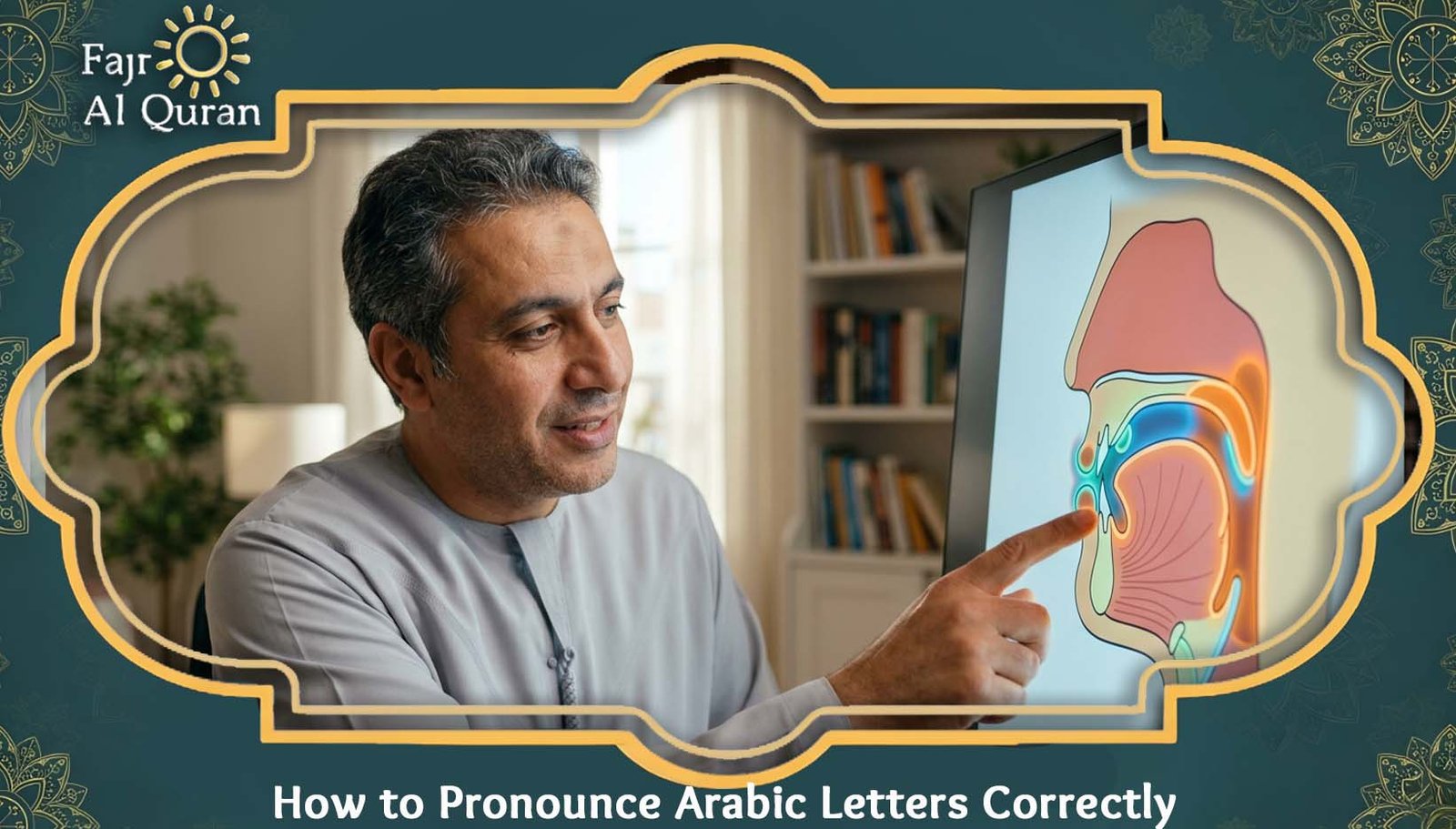
How to Pronounce Arabic Letters Correctly
Correct pronunciation is one of the most important parts of learning the Arabic Alphabet. Knowing what a letter looks like is only the beginning. Learners also need to understand where and how each sound is produced.
Some Arabic sounds have close equivalents in English. Others do not. This is why using an English letter as a permanent substitute can create pronunciation problems.
For example, the Arabic letters ح, خ, ع, غ, ص, ض, ط, and ظ can be challenging for English speakers. Their sounds require movements that may not exist in ordinary English pronunciation.
Muslims studying Quran reading should pay special attention to Makharij al-Huruf, the articulation points of Arabic letters. Correct articulation helps protect the accuracy of Quranic recitation and supports proper Tajweed development.
A qualified teacher can demonstrate the position of the tongue, throat, lips, and teeth. This is much more effective than trying to learn difficult sounds only from English transliterations.
For beginners, pronunciation practice should include:
- Listening carefully to a qualified teacher.
- Repeating each sound slowly.
- Comparing similar letters.
- Practicing difficult sounds regularly.
- Reading letters inside simple words.
- Recording yourself and checking your pronunciation.
English translations can explain meaning, but translation does not teach pronunciation. Likewise, transliteration can provide a temporary guide, but learners should gradually read the original Arabic form directly.
At Fajr Al-Quran Academy, students can receive guided instruction from experienced tutors who can correct pronunciation as they learn. This personal feedback can save beginners from developing habits that become difficult to change later.
Learn Arabic Short Vowels: Fatha, Kasra, and Damma
After learning the basic Arabic Alphabet, beginners should understand short vowels. These marks are essential because they change how many Arabic letters are pronounced.
The three basic short vowels are Fatha, Kasra, and Damma.
Fatha (َ) generally produces a short “a” sound.
Kasra (ِ) generally produces a short “i” sound.
Damma (ُ) generally produces a short “u” sound.
For example, placing different vowel marks on the same consonant creates different readings:
بَ — ba
بِ — bi
بُ — bu
This is a simple but important concept. A learner may recognize the letter Baa perfectly but still misread a word if the vowel mark is ignored.
Students also encounter Sukoon (ْ), which indicates that a consonant does not carry a short vowel, and Shaddah (ّ), which indicates consonant doubling. These marks become increasingly important when learners move into Quran reading and Tajweed.
Arabic also has long vowel sounds. Alif, Waaw, and Yaa can function in patterns that produce longer vowel sounds depending on the surrounding letters and vowel markings.
Beginners should avoid trying to memorize every rule in one lesson. Start with the three short vowels, practice them with familiar letters, and then gradually introduce additional signs.
For Muslim students, this stage connects naturally with Noorani Qaida lessons. A structured Qaida course can help learners move from isolated letters to joined sounds and then to Quranic words.
Understanding vowels also makes Arabic reading more predictable. Once students recognize both letters and their vowel signs, they can begin sounding out unfamiliar words with greater confidence.
How Arabic Letters Connect in Words
Arabic is written from right to left, and many letters connect when they appear in words. This is one of the biggest changes for learners who are accustomed to the English alphabet.
The direction itself becomes easier with practice. The more important challenge is learning how letters change their shape when connected.
Consider a simple sequence containing Baa:
ب
When the letter is connected to other letters, its appearance can change. Students therefore need to learn both the individual character and its connected forms.
This is why simply memorizing the letters in the Arabic alphabet is not enough. Reading requires recognition of characters in different positions.
Some letters connect to the next letter, while others stop the connection. These rules affect the visual structure of words.
Beginners should practice connection gradually. Start with two-letter combinations. Then move to three-letter combinations and simple words.
Writing practice is especially useful here. When students physically write Arabic, they begin to understand how letters flow from one character to another.
Digital typing can also help. Arabic keyboards allow learners to practice recognizing characters on a screen, while Arabic fonts expose them to different styles. However, handwriting should not be ignored.
Students may also encounter Arabic chat, Franco Arabic, or Arabizi, where Arabic words are represented using Latin characters and numbers. These systems are common in informal online communication, but they are not a replacement for learning the actual Arabic script.
For serious Arabic learning or Quran study, learners should focus on the original script and develop the ability to read Arabic directly.
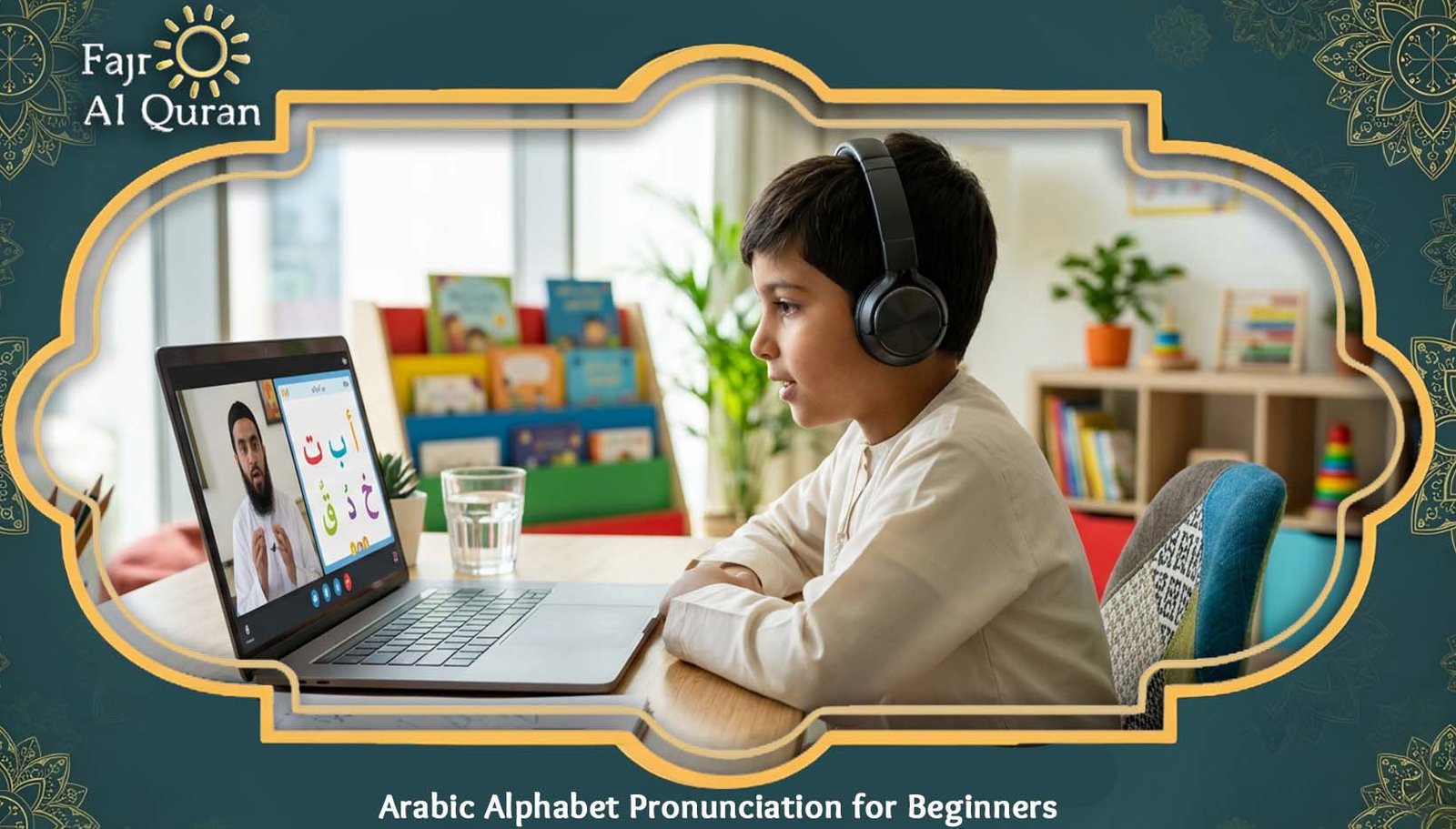
Arabic Alphabet Pronunciation for Beginners
For many learners, pronunciation is the stage where the Arabic Alphabet becomes truly practical. Instead of simply identifying a character, students begin connecting visual recognition with sound.
English-speaking beginners often search for an “Arabic alphabet in English” or Arabic letters with English equivalents. Such resources can be useful when starting, but there is an important limitation: English does not contain an exact equivalent for every Arabic sound.
Transliteration systems attempt to represent Arabic using Latin characters. Different systems may use different symbols. This can make transliterations confusing if learners rely on them too heavily.
For example, a single Arabic letter may be represented in several ways depending on the transliteration system. Arabic chat can make this even more varied because users sometimes represent difficult sounds with numbers.
The best long-term goal is direct recognition:
Arabic character → Arabic sound → Arabic word
rather than:
Arabic character → English letter → transliteration → sound
The second process takes longer and can encourage inaccurate pronunciation.
A good beginner pronunciation lesson should include listening, repetition, correction, and reading. Students should hear a qualified speaker and imitate the sound rather than guessing from Roman letters.
Pronunciation is especially important for Muslims learning to read the Quran. Small sound differences can affect a word’s pronunciation and, in some cases, its meaning.
A native or highly qualified Arabic tutor can explain difficult sounds in a way that English-speaking learners understand. At Fajr Al-Quran Academy, structured online lessons can help children and adults develop these skills from home.
With regular practice, learners can move beyond memorizing alphabet letters and begin reading real Arabic words with confidence.
Arabic Alphabet for Kids with Fun Ways to Learn
Children can learn the Arabic Alphabet successfully when lessons are interactive, short, and consistent. Young learners usually respond better to activities than to long explanations.
Parents should not expect children to memorize all 28 letters in a few days. Recognition develops gradually. A better approach is to introduce a small number of letters, review them often, and celebrate progress.
Games can make alphabet practice more enjoyable. Parents and teachers can use matching cards, letter tracing, picture associations, simple quizzes, songs, and digital activities.
Useful activities include:
- Matching Arabic letters with their names.
- Tracing letters with a finger or pencil.
- Finding a target letter in a short Arabic word.
- Listening and identifying the correct sound.
- Building simple words from letter cards.
- Practicing one short lesson each day.
Visual repetition is particularly helpful for children. A letter should appear in isolation and then in connected forms so that children learn to recognize it in real reading situations.
Parents in the US, UK, Canada, and Australia may also face the challenge of balancing schoolwork with Islamic education. Online lessons can provide a practical solution because children can learn from home without adding travel time to a busy family schedule.
For Muslim children, alphabet lessons can eventually lead to Quran reading, Noorani Qaida, Tajweed, and broader Arabic studies.
Fajr Al-Quran Academy provides a supportive online learning environment for children and adults who want structured Arabic and Quran education. Individual attention can help teachers adapt lessons to a child’s age, learning speed, and existing knowledge.
The most important goal is to make learning positive. When children associate Arabic with encouragement and achievement, they are more likely to continue practicing.
FAQs About the Arabic Alphabet
How many letters are in the Arabic Alphabet?
The standard Arabic Alphabet has 28 basic letters. Learners also encounter additional signs and characters, such as Hamza and vowel marks, as they progress.
Is the Arabic Alphabet difficult for English speakers?
The Arabic Alphabet may look unfamiliar at first, but it becomes manageable with regular practice. Learning letter groups, connected forms, and pronunciation step by step can make the process much easier.
Can I learn the Arabic Alphabet online?
Yes, beginners can learn the Arabic Alphabet through structured online lessons. A qualified tutor can teach letter recognition, pronunciation, writing, vowels, and reading while correcting mistakes in real time.
Is learning the Arabic Alphabet useful for reading the Quran?
Absolutely. Learning Arabic letters is the foundation for Quran reading. Students can then progress to Noorani Qaida, Tajweed, proper pronunciation, and fluent Quranic recitation.
Conclusion: Start Learning the Arabic Alphabet with Confidence
The Arabic Alphabet is the foundation for reading and writing Arabic. It is also the first major step for Muslims who want to improve their Quran reading and understand more of the language of the Quran.
You do not need to master everything at once. Begin with the 28 letters, learn their sounds, practice their different forms, understand short vowels, and gradually read connected words.
Consistent practice is more valuable than rushing. With the right teacher and a clear learning plan, both children and adults can make steady progress.
If you are ready to learn from home, book a free trial lesson with a native Arabic teacher at Fajr Al-Quran Academy. Start with the basics, receive personal guidance, and build the confidence you need to read Arabic correctly.