Learn Easy Tajweed Rules for Beginners and Master Quran Pronunciation Correctly with Our Step-by-Step Guide for Beginners to Master Quranic Arabic. Discover essential tajweed rules, makharij, madd, qalqalah, and practical tips to improve recitation beautifully with expert guidance from the leading platform, Fajr Al-Quran Academy.
Learning how to recite the Qur’an correctly is one of the most rewarding journeys in Islamic studies. Every Muslim, whether a child or an adult, desires to read the Quran beautifully, with proper pronunciation and confidence. However, many beginners feel overwhelmed when they first hear about tajweed rules, makharij, madd, qalqalah, and other specific rules. The good news is that Tajweed Rules for Beginners can be learned in a simple, structured, and practical way. With the right step-by-step guide for beginners, anyone can master Quranic Arabic and improve their recitation, ultimately achieving fluency.
At the Leading platform Fajr Al-Quran Academy, students of all ages are guided by expert teachers, a friendly learning environment, and comprehensive lessons delivered online. Through a simple learning guide for kids and adults, learners build confidence and accuracy while perfecting their Quran recitation and tajweed skills.
This article provides a complete and easy explanation of tajweed rules for beginners, helping you understand, practice, and master Quranic pronunciation correctly.
What Are Tajweed Rules for Beginners?
Tajweed refers to the set of rules governing how the Qur’an should be recited. The word “tajweed” linguistically means “to improve” or “to make better.” In the context of Quran recitation, tajweed means giving every letter its proper rights and characteristics, ensuring accurate pronunciation and beautiful delivery. Tajweed rules for beginners focus on understanding how each Arabic letter is pronounced from its correct articulation point, how vowels affect sounds, and how certain letters interact with one another.
For beginners, understanding tajweed may seem complicated at first, but it is essentially about learning the proper way to pronounce Arabic letters as they were revealed. The Quran was revealed in Arabic, and its recitation, tajweed, preserves the original pronunciation. Without tajweed, the meaning of words can change due to mispronunciation. Therefore, tajweed for beginners starts with the basics: recognizing letters, understanding short vowels, and applying simple rules step by step.
A structured path to learning Tajweed rules for beginners usually begins with Noorani Qaida with Tajweed, which introduces the Arabic alphabet and basic pronunciation. This foundational book is widely used in academies and online classes because it simplifies learning for beginners. Through consistent practice and expert guidance, learners gradually move from recognizing letters to reading complete verses with fluency.
Tajweed rules for beginners are not only about technical rules; it is about reading the Quran correctly and beautifully. When beginners understand the importance of each letter’s sound, they begin to appreciate the deep beauty of Quranic recitation. Using a rules color-coded edition or Musahaf Tajweed helps learners visually identify different tajweed rules, making the learning process more user-friendly and practical.
Importance of Tajweed Rules for Beginners
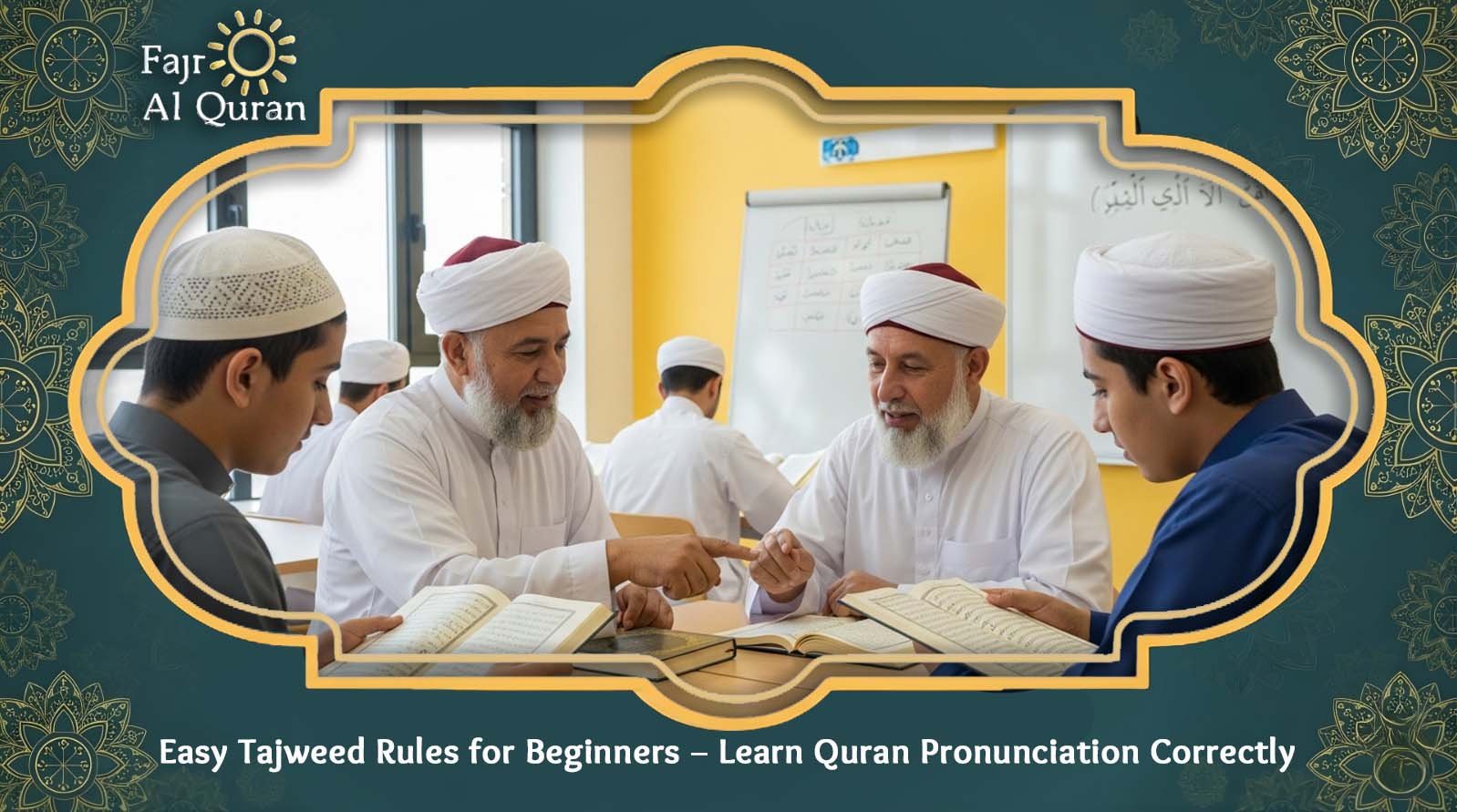
The importance of tajweed rules for beginners cannot be overstated. Reciting the Quran without proper tajweed can lead to mistakes that alter meanings. Arabic is a precise language, and even a small change in pronunciation can result in a completely different word. Therefore, learning essential tajweed rules ensures accuracy and preserves the divine message of the Quran.
Tajweed rules for beginners, learning tajweed builds confidence. Many new learners feel shy or hesitant when reciting in front of others. However, when they understand the rules and practice consistently, their fluency improves, and they recite with clarity. This confidence encourages them to continue their Quranic journey with enthusiasm.
Tajweed also enhances spiritual connection. When a person recites the Quran correctly, with proper pronunciation and rhythm, the recitation becomes more beautiful and impactful. The heart feels more connected to the words of Allah. Reciting beautifully is not about having a melodious voice; it is about applying tajweed correctly and sincerely.
In modern times, Online Tajweed Classes have made learning more accessible. The Leading platform, Fajr Al-Quran Academy, provides expert teachers who address common mistakes and guide students step by step. Their comprehensive Islamic studies programs include tajweed rules for beginners, advanced recitation, and structured lessons tailored for kids and adults.
Another important aspect is that tajweed protects the Quran from distortion. Since the time of revelation, Muslims have preserved the Quran through accurate recitation. By learning the tajweed rules for beginners, each learner becomes part of this noble tradition of preservation.
Basic Tajweed Rules for Beginners You Must Know
There are several basic tajweed rules that every beginner should know. These rules form the foundation of correct Quran recitation. Understanding these essential tajweed rules makes reading easier and more accurate.
One of the first tajweed rules for beginners concerns proper letter pronunciation. Arabic letters have unique sounds that do not always exist in English. For example, letters like “ع” and “ح” require specific throat articulation. Beginners must practice these sounds repeatedly under expert guidance.
Short vowels, known as harakat, are also fundamental. Fatha, kasra, and damma determine how a letter is pronounced. Mastering these short sounds is the first step toward fluent reading. Beginners often start with Noorani Qaida, where they learn how letters combine with vowels.
Another important rule involves sukoon and shaddah. Sukoon indicates that a letter has no vowel, while shaddah doubles the letter’s sound. Misreading these can lead to incorrect pronunciation.
Understanding the term ‘madd,’ which refers to elongation, is also essential. Madd determines how long a vowel sound should be stretched. Some madd are short, while others are extended for specific counts. Learning these specific rules ensures proper rhythm in recitation.
Using a rules color-coded edition or Musahaf Tajweed can greatly help beginners. In these editions, different colors represent different tajweed rules, making it easier to identify and apply them while reading.
With structured Tajweed Lessons Online and consistent practice, beginners gradually move from basic letter recognition to confident Quran recitation. At Fajr Al-Quran Academy, teachers provide clear examples and practical exercises to help learners master the tajweed rules for beginners step by step.
Understanding Makharij (Articulation Points) in Tajweed
Makharij refers to the articulation points from which Arabic letters are pronounced. There are specific areas in the mouth and throat where each letter originates. Understanding makharij is essential for proper pronunciation and accurate recitation of tajweed.
The Arabic letters come from five main areas: the throat, tongue, lips, nasal passage, and oral cavity. Each area produces distinct sounds. For example, some letters originate from the deepest part of the throat, while others are pronounced using the tip of the tongue.
Beginners often struggle with similar-sounding letters. For instance, “س” and “ص” may sound alike to non-native speakers, but they have different articulation points and characteristics. Learning makharij helps learners distinguish between such letters.
Practicing makharij requires patience and repetition. Teachers often demonstrate how each letter is pronounced and correct students’ mistakes immediately. This expert guidance is crucial for building accuracy and fluency.
By focusing on makharij early in the learning journey, beginners develop a strong foundation. Correct articulation prevents future errors and ensures that Quranic words are pronounced properly and beautifully.
Rules of Noon Saakin and Tanween Explained Simply
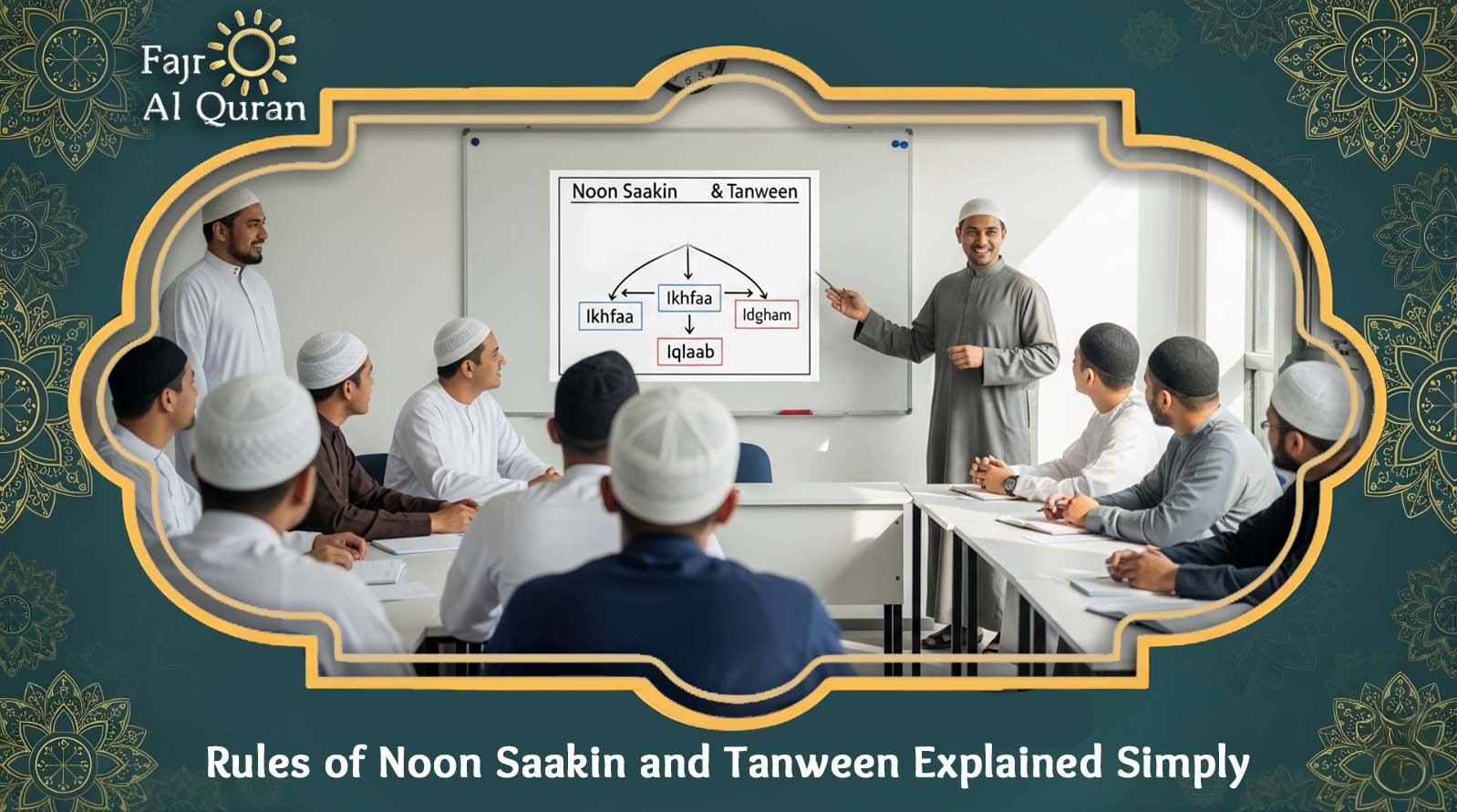
Noon Saakin and Tanween are among the most important tajweed rules for beginners. Noon Saakin refers to the letter “ن” with sukoon, while Tanween refers to double vowels that produce an “n” sound at the end of a word.
There are four main rules related to Noon Saakin and Tanween: Izhar, Idgham, Iqlab, and Ikhfa. Each rule applies depending on the letter that follows.
Izhar means clear pronunciation. When certain throat letters follow Noon Saakin or Tanween, the “n” sound is pronounced clearly without merging.
Idgham means merging. In this case, the “n” sound merges into the following letter. Some types of Idgham include ghunnah, which involves nasalization.
Iqlab occurs when the letter “ب” follows Noon Saakin or Tanween. The “n” sound changes into an “m” sound with nasalization.
Ikhfa means hiding. The “n” sound is pronounced softly and partially hidden before certain letters.
Understanding these specific rules helps beginners avoid common mistakes. With practice and clear examples, learners gain confidence in applying Tajweed rules for beginners during recitation.
Meem Saakin Rules Made Easy for Beginners
Meem Saakin ( – a silent meem) has three main Tajweed rules based on the following letter: Ikhfa Shafawi (hiding with ghunnah before Baa), Idgham Shafawi (merging with ghunnah before another Meem), and Izhar Shafawi (clear pronunciation before all other 26 letters). These rules ensure proper nasalization and clarity, enhancing Quranic recitation.
Ikhfa Shafawi occurs when a “ب” follows Meem Saakin. The meem sound is hidden slightly with nasalization.
Idgham Shafawi happens when another “م” follows Meem Saakin. The two letters merge with ghunnah.
Izhar Shafawi applies when any other letter follows Meem Saakin. The meem is pronounced clearly without nasalization.
These rules are simple once understood properly. Beginners benefit from structured lessons where teachers provide repeated practice and correction.
Qalqalah, Madd, and Ghunnah Rules in Simple Words
Qalqalah refers to a slight echoing sound produced when certain letters have sukoon. The letters of qalqalah are ق, ط, ب, ج, and د. When pronounced correctly, they create a bouncing sound.
Madd, or elongation, determines how long a vowel sound should be extended. Some madd are two counts, while others are longer. Beginners should learn to count properly to maintain rhythm.
Ghunnah is a nasal sound produced when pronouncing certain letters, especially in Idgham and Ikhfa. It adds beauty and accuracy to recitation.
Understanding these essential Tajweed rules for beginners improves fluency and helps learners recite beautifully.
Step-by-Step Guide to Practice Tajweed Rules for Beginners at Home
A step-by-step guide for beginners to master Quranic Arabic begins with setting clear goals. Start by learning the Arabic alphabet with proper pronunciation. Use Noorani Qaida with tajweed rules to build a strong foundation.
Next, practice short vowels and simple words daily. Consistency is key. Even short daily sessions can lead to significant improvement.
Listening to expert reciters helps develop understanding. Repeat after them and compare your pronunciation.
Use a Musahaf Tajweed or rules color-coded edition to visually identify rules while reading.
Join online classes at the Leading platform, Fajr Al-Quran Academy, for structured lessons and expert guidance. Their friendly environment and comprehensive curriculum make learning effective and enjoyable.
Practice regularly, review mistakes, and seek feedback from qualified teachers. Over time, your recitation will improve in accuracy and confidence.
Tips to Improve Quran Recitation with Proper Tajweed
Improving Quran recitation requires patience and dedication. First, focus on understanding the Tajweed Rules for Beginners rather than rushing. Quality is more important than speed.
Record your recitation and listen carefully to identify mistakes. This practical method increases awareness.
Practice specific rules separately before applying them in full verses. For example, focus on madd in one session and qalqalah in another.
Maintain consistency in your learning journey. Daily practice builds fluency.
Seek expert guidance from qualified teachers. At Fajr Al-Quran Academy, expert instructors provide personalized feedback to help learners improve.
Finally, make dua for ease and sincerity. Tajweed is not only about pronunciation; it is about honoring the words of the Quran.
By following this comprehensive and simple learning guide for kids and adults, beginners can master Quranic pronunciation correctly and beautifully. With dedication, structured lessons, and expert support, every learner can achieve confidence, fluency, and accuracy in Quran recitation and tajweed.
Tajweed Quran Online classes make it easy for beginners and adults to learn correct Quran pronunciation from the comfort of their homes.
With expert teachers and structured lessons, Tajweed Quran Online programs help students recite the Quran accurately and beautifully.
Conclusion: Start learning Tajweed Rules for Beginners on your journey today.
Mastering Tajweed Rules for Beginners is a beautiful and rewarding journey that transforms the way you read and connect with the Quran. When you take the time to understand tajweed, practice proper pronunciation, and apply each rule step by step, your recitation becomes more accurate, confident, and spiritually uplifting. Tajweed is not simply about following technical rules; it is about honoring the words of Allah by reciting them correctly and beautifully.
From learning the basic articulation points and essential tajweed rules to understanding Noon Saakin, Meem Saakin, madd, qalqalah, and ghunnah, every small step brings you closer to fluency. With consistent practice, patience, and expert guidance, even complete beginners can develop strong recitation skills. Using tools like Noorani Qaida with tajweed rules, a rules color-coded edition, or Musahaf Tajweed makes the learning process simple and structured for both kids and adults.
If you truly want to improve your Quran recitation and build confidence, choose a supportive and professional learning environment. The Leading platform, Fajr Al-Quran Academy, provides comprehensive online classes, expert teachers, and a friendly atmosphere designed to help learners of all ages master Quranic pronunciation. With their step-by-step guide for beginners to master Quranic Arabic, you can move from basic reading to smooth and beautiful recitation with accuracy.
Take that first step, practice regularly, and seek expert guidance. With dedication and sincerity, you will not only learn tajweed correctly but also deepen your connection with the Quran, reciting it with clarity, confidence, and beauty for a lifetime.