Best Ijazah in Quran Program | Your Complete Guide

An Ijazah in the Quran is a formal authorization and certification. Key elements include the Sanad (chain of transmission), Tajweed mastery, and permission to teach.

The Best Ijazah in Quran Program helps Muslims learn the Holy Quran correctly and receive official certification from a qualified scholar. An Ijazah in Quran is more than a certificate. It is a trusted authorization that confirms a student has mastered Quran recitation or memorization and is ready to teach others. This respected Islamic tradition has preserved the words of the Quran, the Divine, through an unbroken chain of sanad from teacher to student for centuries.

Many Muslims choose an online Ijazah program because it offers flexibility and access to experienced Quran teachers from anywhere in the worldwide Muslim community. Whether you are a beginner, an advanced learner, a child, or an adult, you can find structured online classes that fit your schedule. Many learners also prefer a female Quran teacher or a female Quran teacher online for a comfortable and supportive learning experience.

A trusted academy such as Fajr Al-Quran Academy provides personalized lessons with a certified Quran teacher with a sanad. Students improve Quran pronunciation, develop correct Quran pronunciation with proper Tajweed, and gain a deeper understanding of the sacred text. Every lesson follows a structured plan that ensures steady progress and lasting knowledge.

In this guide, you will discover the Ijazah meaning, the Quran Ijazah meaning, the different types of Ijazah in Quran, the requirements for earning one, and how to choose the Best Ijazah in Quran Program for your learning journey.

Best Ijazah in Quran Program | Your Complete Guide

What Is an Ijazah in Quran?

An Ijazah in Quran is an official permission or license given by a qualified Quran teacher to a student after completing advanced study of the Holy Quran. The Ijazah meaning comes from the Arabic word for authorization. In Islamic scholarship, it confirms that a learner has mastered the required skills and may accurately transmit the Quran to others.

The Quran Ijazah meaning goes beyond receiving a simple certificate. It represents trust, scholarly integrity, and responsibility. A teacher grants an Ijazah in Quran only after ensuring the student can recite every verse with correct Quran pronunciation, proper Tajweed, and a strong understanding of the rules. For learners seeking Ijazah in Quran recitation, accuracy is essential. Those pursuing memorization must also recite the entire Quran from memory without major mistakes.

Every authentic Quran Ijazah includes a sanad, which is the chain of teachers connecting the student back to the Prophet Muhammad ﷺ. One common chain is the Sanad in the Narration of Hafs from Asim, while other recognized narrations, including Shu’bah, are also studied by qualified scholars.

At Fajr Al-Quran Academy, learners study under a Quran teacher with a sanad who carefully evaluates every lesson. Students master correct Quran pronunciation through regular practice and detailed correction. They also improve Quran pronunciation with proper Tajweed, making every recitation more accurate and beautiful.

Whether you study with a male teacher or a female Quran teacher online, earning an Ijazah in Quran is a respected achievement that reflects dedication, knowledge, and commitment to preserving the words of Allah exactly as they have been transmitted for generations.

Why Is an Ijazah in Quran Important?

An Ijazah in Quran is one of the highest achievements in Quranic education. It confirms that a learner has reached a level where scholars trust them to recite or teach the Holy Quran correctly. This certification protects the authenticity of the Quran and preserves the sacred tradition passed from one generation to the next.

Without proper guidance, students may develop mistakes in pronunciation or Tajweed. An Ijazah in Quran helps prevent these errors because a qualified teacher supervises every lesson. A certified Quran teacher with a sanad listens carefully, corrects mistakes immediately, and ensures that every word is pronounced accurately.

The benefits of earning an Ijazah in Quran include:

  • Learning from trusted scholars with authentic sanad.
  • Mastering correct Quran pronunciation with proper Tajweed.
  • Building confidence in Quran recitation.
  • Receiving recognized Quran certification.
  • Preparing to teach future generations.
  • Preserving the authentic Islamic tradition.

Many families also choose Fajr Al-Quran Academy because it provides flexible online Ijazah classes for children, adults, and new Muslims. Students can learn with experienced male instructors or a female Quran teacher according to their preference.

An Ijazah in Quran also strengthens your relationship with Allah. As your recitation becomes more accurate, your understanding of the Quran grows deeper. The learning journey becomes both scholarly and spiritual. It is not only about earning an Ijazah in Quran certificate.

Types of Ijazah in Quran Certification

Types of Ijazah in Quran Certification

An Ijazah in Quran certification is an authorized license given by a certified master scholar (Sheikh or Shaykhah). An Ijazah in Quran is one of the highest achievements in Quranic education.

Types of Ijazah in Quran certification include Ijazah in Memorization (Hifz), Ijazah in Recitation with Tajweed, and Ijazah in Specialized Readings (Qira’at). These certifications link the holder through a verified chain of transmission (Sanad) back to the Prophet Muhammad.
It proves a student has mastered recitation for memorization and links them through an unbroken chain of transmission (Sanad).

Core Types of Ijazah in Quran

  • Ijazah in Memorization (Hifz): Confirms complete Quran memorization of the entire 30 Juz of the Quran by heart, recited accurately without errors from memory.
  •  (Tilawah/Tajweed): Verifies mastery of correct letter articulation (Makharij), letter attributes (Sifat), and Tajweed rules while reciting by looking at the Mushaf.
  • Ijazah in Qira’at (Variant Readings): Advanced authorization in recognized transmission styles.

Levels of Recitation and Qira’at Ijazah

  • Single Narration (Riwayah): Certification in one specific mode of transmission, most commonly Hafs ‘an ‘Asim or Warsh ‘an Nafi’.
  • The Seven Minor Readings: Certification via the foundational poetic method of Ash-Shatibiyyah.
  • The Ten Minor Readings: Includes the seven readings plus the three additional routes from Ad-Durrah.
  • The Ten Major Readings (Al-‘Ashr Al-Kubra): The highest level of mastery, attained through the extensive path of Tayyibat al-Nashr

Many families also choose Fajr Al-Quran Academy because it provides flexible online Ijazah classes for children, adults, and new Muslims. Students can learn with experienced male instructors or a female Quran teacher according to their preference.
An Ijazah in Quran also strengthens your relationship with Allah. As your recitation becomes more accurate, your understanding of the Quran grows deeper. The learning journey becomes both scholarly and spiritual. It is not only about earning an Ijazah in Quran certificate.

Requirements to Earn an Ijazah in Quran

Earning an Ijazah in Quran requires patience, consistency, and sincere effort. It is not a course that can be completed in a few weeks. Instead, it is a structured learning journey that prepares students to preserve and transmit the words of Allah correctly.

The first requirement is studying with a qualified Quran teacher. Ideally, your instructor should be a Quran teacher with a sanad who has received authorization from recognized scholars. Learning from a trusted teacher ensures your recitation follows the authentic Islamic tradition.

Learners spend many months improving correct Quran pronunciation until they consistently achieve correct Quran pronunciation with proper Tajweed. This careful training helps students master correct Quran pronunciation before moving to the final assessment.

Most Ijazah in Quran programs also expect students to:

  • Read the Holy Quran fluently.
  • Apply all Tajweed rules accurately.
  • Complete regular revision sessions.
  • Accept corrections with patience.
  • Demonstrate strong memorization if pursuing a memorization Ijazah.
  • Maintain respect for the Quran and the teacher throughout the program.

A structured schedule is another important part of success. At Fajr Al-Quran Academy, teachers create personalized lesson plans that match each student’s ability and available time. Regular online classes, daily revision, and weekly evaluations help ensure steady progress.

Many learners also spend time in Tadabbur, reflecting on the meanings of the Quran. While the primary goal of an Ijazah in Quran is accurate recitation or memorization, understanding the message of the Quran enriches the learning experience and strengthens one’s connection with Allah.

Whether you learn from an experienced male instructor or a female Quran teacher online, dedication is essential. The final certification is granted only after the teacher confirms that the student has mastered every required skill and is ready to transmit the Quran accurately to others.

How to Get an Ijazah in Quran Online

To get an online Quran Ijazah, you must master Tajweed, complete a full recitation (Khatmah) or memorization (Hifz) of the Quran to a certified Sheikh with a valid Sanad (chain of transmission), and pass their final evaluation.

The first step is choosing a trusted academy. Fajr Al-Quran Academy is recognized for its experienced instructors, structured curriculum, and personalized approach. Every Quran teacher online is carefully selected based on knowledge, teaching ability, and authentic sanad. Students who prefer a female Quran teacher online can also choose qualified female instructors for a comfortable learning experience.

After enrollment, students complete an assessment to determine their current level of Quran recitation, Tajweed, and memorization. Based on the results, a personalized learning plan is created. This structured approach helps every student progress at a steady pace.

During the course, learners participate in live online classes. Each lesson focuses on improving Quran pronunciation, applying Tajweed correctly, and strengthening memorization where required. Teachers listen carefully to every recitation and provide immediate feedback.

Most successful online Ijazah programs include:

  • One-to-one live sessions with experienced teachers.
  • Regular recitation assessments.
  • Continuous Tajweed correction.
  • Memorization revision plans.
  • Flexible schedules for kids and adults.
  • Final evaluation before receiving certification.

Receiving an Ijazah in Quran online is not simply about earning a certificate. It is about joining a centuries-old tradition of preserving the words of Allah with accuracy, sincerity, and scholarly excellence. With commitment, regular practice, and expert guidance from Fajr Al-Quran Academy, students can achieve this respected milestone and continue their lifelong journey of Quranic learning..

Benefits of Studying with a Certified Quran Teacher

Choosing the right Quran teacher is one of the most important decisions on your journey toward earning an Ijazah in Quran. A qualified teacher does much more than listen to your recitation. They guide you step by step, correct every mistake, and help you build confidence. Learning from a certified Quran teacher with a sanad ensures that your knowledge comes through an authentic chain of transmission that goes back through respected scholars to the Prophet Muhammad ﷺ.

One of the greatest advantages of studying with a Quran teacher with a sanad is accuracy. Every lesson focuses on correct Quran pronunciation, proper articulation, and the application of Tajweed rules. Through regular practice, students master correct Quran pronunciation and develop the ability to recite the Holy Quran with confidence. This careful guidance also helps learners achieve correct Quran pronunciation with proper Tajweed, which is essential before receiving an Ijazah in Quran.

Many families appreciate the flexibility of learning online. At Fajr Al-Quran Academy, students can study with experienced male instructors or choose a female Quran teacher. Sisters and young girls often feel more comfortable learning with a female Quran teacher online, allowing them to ask questions freely and progress with confidence. Every teacher follows a structured teaching method that supports beginners, children, and adults.

Learning with a certified teacher offers many advantages:

  • Authentic guidance from experienced scholars.
  • Accurate Quran recitation with proper Tajweed.
  • Continuous correction and personal feedback.
  • Flexible online classes for busy schedules.
  • Individual learning plans for every student.
  • Preparation for authentic Quran Ijazah certification.
  • Strong spiritual and academic development.

At Fajr Al-Quran Academy, every lesson combines traditional Islamic scholarship with modern teaching methods.

How Long Does It Take to Complete an Ijazah in Quran?

How Long Does It Take to Complete an Ijazah in Quran?

Many learners ask how long it takes to earn an Ijazah in Quran. The answer depends on several factors, including your current level, your learning goals, and the amount of time you can dedicate each week. There is no fixed number of months because every student progresses at a different pace. The goal is not speed. The goal is to achieve mastery with accuracy and confidence.

Students who already have strong Quran recitation skills and excellent Tajweed may complete an Ijazah in Quran more quickly than beginners. Those who have memorized the Holy Quran and regularly revise it may also progress faster. However, every learner must meet the same scholarly standards before receiving certification.

Several factors affect your learning timeline:

  • Your current level of Quran pronunciation.
  • Your understanding of Tajweed rules.
  • Whether you are pursuing Ijazah in Quran recitation or memorization.
  • The number of online classes you attend each week.
  • Your commitment to daily revision.
  • Your ability to apply corrections consistently.

At Fajr Al-Quran Academy, teachers create a personalized schedule that matches each learner’s goals and availability. Some students attend lessons several times each week, while others prefer a more flexible plan. Regular attendance and consistent practice produce steady progress and lasting results.

An authentic Ijazah in Quran is never rushed. Qualified teachers carefully evaluate every stage of the learning process. They grant the ijazah only after confirming that the student can recite the Quran accurately, apply Tajweed correctly, and preserve the integrity of the sacred text. This careful process ensures that the Quran Ijazah remains a respected symbol of knowledge, trust, and scholarly excellence throughout the Muslim world.

Tips for Successfully Earning Your Quran Ijazah

Earning an Ijazah in Quran is a rewarding journey that requires sincerity, discipline, and patience. Every successful learner follows consistent habits that improve both recitation and understanding. Small daily efforts often produce better results than long, irregular study sessions.

The first step is choosing a trusted academy such as Fajr Al-Quran Academy. Learning with a qualified Quran teacher or a female Quran teacher online provides the guidance needed to avoid mistakes and develop strong recitation skills. An experienced instructor helps students improve correct Quran pronunciation, understand Tajweed rules, and prepare for authentic Quran Ijazah certification.

To stay on track, follow these practical tips:

  • Attend every lesson on time.
  • Practice Quran recitation every day.
  • Review previous lessons before learning new ones.
  • Listen carefully to every correction from your teacher.
  • Focus on correct Quran pronunciation with proper Tajweed.
  • Set realistic weekly goals.
  • Make sincere dua and ask Allah for success.
  • Spend time in Tadabbur to reflect on the meanings of the Quran.
  • Remain patient throughout your learning journey.

Remember that an Ijazah in Quran is not only an academic achievement. It is a spiritual responsibility. By preserving the words of Allah with proper pronunciation and authentic transmission, you become part of a noble Islamic tradition that has protected the Holy Quran for centuries.

How to Choose the Best Online Ijazah in Quran Program

To choose the best online Quran Ijazah program, verify that instructors hold a certified chain of transmission (Sanad) linked to classical scholars, ensure they offer one-on-one live evaluations, and test their teaching quality through a free trial class before committing.

Key Factors to Evaluate

Teacher Qualifications and Chain of Transmission (Isnad)

  • Verified Sanad: Ensure the master Sheikh or teacher possesses a continuous, documented chain of narration back to the Prophet Muhammad (PBUH).
  • Institutional Background: Look for educators with formal authorization or degrees from recognized traditional bodies like Al-Azhar or vetted global Islamic institutes.
  • Mastery of Rules: Confirm that instructors correct fine errors in Makharij (articulation points) and Tajweed rather than just listening to a fast recitation.

Program Structure and Class Format

  • One-on-One Sessions: Avoid large-group classes; individual attention is mandatory for an authentic Ijazah process, in which you recite every verse to the teacher.
  • Transparent Evaluation: Check if the program includes periodic diagnostic tests and a rigorous final listening exam (Arḍ) of the full Quran or specific text.
  • Free Trial Assessment: Reputable platforms allow you to test a class first to judge the teacher’s proficiency and connection style.

Administrative and Logistical Fit

  • Scheduling Flexibility: Look for times that match your local routine and time zone.
  • Instructor Choice: Check if the academy provides both male and female certified teachers to suit student preferences.
  • Clear Certification Policy: Ensure they issue a recognized, traceable certificate upon successful completion of the recitation test.

Conclusion

An Ijazah in Quran is one of the most respected achievements in Islamic learning. It confirms that a student has mastered Quran recitation or memorization and is qualified to transmit the Holy Quran through an authentic sanad. This certification reflects dedication, knowledge, and a commitment to preserving the words of Allah with accuracy and proper Tajweed.

Choosing the right program is the first step toward success. Fajr Al-Quran Academy offers expert guidance, qualified teachers, flexible online classes, and personalized learning for students of all ages. Whether you study with a male instructor or a female Quran teacher online, you will receive the support needed to progress with confidence.

Master Islamic Fiqh – A Complete Guide to Understanding Islamic Jurisprudence

Master Islamic Fiqh – A Complete Guide to Understanding Islamic Jurisprudence

Islamic FiQh is jurisprudence. It is the human effort to understand and apply divine laws in daily life. Scholars interpret the Quran and Sunnah to create rules. These rules guide how Muslims should pray, do business, marry, and live ethically.

Fiqh in Islam covers worship, ethics, family matters, business transactions, and social justice. Unlike Sharia, which is divine law, Fiqh involves human reasoning and contextual interpretation, leading to different legal schools (madhabs). Islamic Fiqh ensures Islamic principles are practically implemented across diverse cultures and times.

Islamic fiqh is one of the most important branches of Islamic knowledge. It helps Muslims understand how to worship Allah correctly and how to apply the teachings of Islam in everyday life. Whether you are learning about prayer, fasting, family matters, business transactions, or personal conduct, Islamic fiqh provides practical guidance based on the Qur’an, the Sunnah, and the scholarly efforts of qualified jurists.

For beginners, Islamic fiqh may seem like a complex subject because it includes many rules, principles, and legal discussions. When Islamic Studies is studied step by step, Islamic fiqh becomes easier to understand. It teaches Muslims not only what to do but also why certain rulings exist.

This complete guide explains the definition of Islamic fiqh, its importance, sources, schools, and practical applications. It also shows how anyone can begin learning Islamic fiqh with confidence and build a strong foundation in Islamic jurisprudence.

What is the Islamic Fiqh Definition?

The Islamic fiqh definition refers to the human understanding of Islamic law that is derived from the Qur’an, the Sunnah, scholarly consensus, and qualified legal reasoning. The word fiqh comes from the Arabic language and literally means “deep understanding” or “comprehension.” In Islamic terminology, fiqh refers to the science of understanding the practical rulings of Islam based on authentic evidence.

Unlike divine revelation, Islamic fiqh represents the scholarly interpretation of revealed texts. The Qur’an and the Sunnah are perfect and immutable because they come from Allah and the teachings of the Islamic Prophet Muhammad. Islamic fiqh, however, is the result of careful human effort to understand these sources and apply them to different situations. This scholarly effort is known as ijtihad, which allows qualified scholars to address new issues while remaining faithful to Islamic principles.

The field of Islamic jurisprudence covers every aspect of a Muslim’s life. It includes acts of worship, financial dealings, marriage, family matters, inheritance, business transactions, ethics, and social responsibilities.

Some key characteristics of Islamic fiqh include:

  • It is based on the Qur’an and authentic Hadith.
  • It explains the practical application of Shariah.
  • It relies on scholarly interpretation and legal methodology.
  • It helps Muslims make informed religious decisions.
  • It provides guidance for both personal and social life.

Understanding the Islamic fiqh definition is the first step toward appreciating the richness of Islamic jurisprudence and the wisdom behind the rules of Islamic fiqh.

Master Islamic Fiqh – A Complete Guide to Understanding Islamic Jurisprudence

The Meaning of Fiqh in Islam

The meaning of fiqh in Islam goes beyond simply knowing religious rules. It refers to developing a deep understanding of Allah’s guidance and learning how to implement it correctly in daily life. The Arabic word fiqh emphasizes knowledge that leads to wisdom, practical action, and sincere worship rather than memorizing information alone.

During the lifetime of the Islamic Prophet Muhammad (peace be upon him), Muslims learned directly from his teachings, actions, and sayings. After his passing, the Companions carefully preserved this knowledge and taught future generations. As Islam spread across different regions and cultures, scholars organized this knowledge into the discipline known today as Islamic fiqh. Their work became the foundation of Islamic jurisprudence, helping Muslims understand how Islamic laws apply to changing circumstances while remaining faithful to divine revelation.

Today, Islamic fiqh continues to guide Muslims in every stage of life. It governs acts of worship such as prayer, fasting, zakat, and Hajj, while also dealing with family relationships, business ethics, inheritance, contracts, and social responsibilities. Because new situations continue to arise, qualified scholars use the principles of Usul al-Fiqh and ijtihad to derive rulings that remain consistent with the Qur’an and Sunnah.

Learning the meaning of fiqh in Islam helps Muslims:

  • Understand the wisdom behind Islamic rulings.
  • Practice worship correctly and confidently.
  • Make ethical decisions in daily life.
  • Strengthen their relationship with Allah.
  • Appreciate the rich heritage of Islamic scholarship.

Through trusted institutions like Fajr Al-Quran Academy, students of all ages can learn Islamic fiqh in an easy, structured, and engaging way. Expert Quran teachers explain the principles of Islamic jurisprudence using authentic sources, making it easier for beginners to build lasting knowledge and apply it with confidence.

Why Is Islamic Fiqh Important for Muslims?

Islamic fiqh plays a vital role in helping Muslims live according to the teachings of Islam. It transforms the guidance found in the Qur’an and the Sunnah into practical rulings that people can follow in their daily lives. Without Islamic fiqh, many Muslims would struggle to understand how to perform acts of worship correctly or how to deal with modern situations while remaining faithful to Islamic law. This is why Islamic jurisprudence has always been regarded as one of the most respected branches of Islamic knowledge.

The importance of Islamic fiqh extends far beyond the mosque. It governs prayer, fasting, charity, pilgrimage, family relationships, financial transactions, business ethics, inheritance, and social responsibilities. Every ruling is based on divine guidance and supported by scholarly interpretation.

Some of the key benefits of learning Islamic fiqh include:

  • Understanding the correct way to perform acts of worship.
  • Learning the rules of Islamic fiqh for everyday situations.
  • Building confidence in making ethical and religious decisions.
  • Preserving the teachings of the Qur’an and Sunnah.
  • Promoting justice, honesty, and compassion in society.
  • Strengthening family relationships and community life.

Today, reliable educational institutions such as Fajr Al-Quran Academy make it easier than ever to learn about the rules of Islamic fiqh. Their qualified teachers present Islamic jurisprudence in simple language, allowing beginners, children, and adults to study with confidence.

The Main Sources of Islamic Fiqh

Every ruling in Islamic fiqh must be based on authentic evidence. Scholars of Islamic jurisprudence do not create religious laws from personal opinions. Instead, they derive rulings from recognized sources that have guided Muslims for more than fourteen centuries. These sources ensure that Islamic law remains firmly connected to divine revelation while also addressing new issues through careful scholarly effort.

The first and most important source of Islamic fiqh is the Qur’an. It is the direct word of Allah and contains the fundamental principles of faith, worship, morality, and legal guidance. Whenever a clear ruling exists in the Qur’an, it forms the foundation of fiqh in Islam.

The second primary source is the Sunnah, which includes the sayings, actions, and approvals of the Islamic Prophet Muhammad (peace be upon him). The practices of the Islamic Prophet Muhammad explain how the teachings of the Qur’an should be implemented.

When scholars encounter issues that are not directly addressed in these primary sources, they turn to additional principles of Islamic jurisprudence, including:

  • Ijma’ (Consensus): The agreement of qualified Muslim scholars on a particular issue.
  • Qiyas (Analogical Reasoning): Applying existing rulings to new situations based on shared causes.
  • Ijtihad: Independent scholarly effort to derive rulings while remaining faithful to the principles of the Qur’an and Sunnah.

These sources work together to ensure that Islamic fiqh remains both authentic and practical. They allow scholars to address contemporary matters without compromising the foundations of Islam.

The Major Schools of Islamic Fiqh

As Islamic civilization expanded across different regions, qualified scholars developed systematic approaches to understanding and applying Islamic law. These approaches became known as the major schools of Islamic fiqh, or Madhhabs. Although each school has its own methodology, all are firmly rooted in the Qur’an, the Sunnah, and the teachings of the Islamic Prophet Muhammad (peace be upon him). Their differences are based on scholarly interpretation, not differences in the core beliefs of Islam.

The four major Sunni schools of Islamic fiqh are:

  • Hanafi School: Founded by Imam Abu Hanifah, it is known for its careful use of reasoning and is widely followed in South Asia, Turkey, and parts of the Middle East.
  • Maliki School: Established by Imam Malik ibn Anas, it places great importance on the practices of the people of Madinah alongside the Qur’an and Sunnah.
  • Shafi’i School: Founded by Imam Al-Shafi’i, it introduced a structured methodology for Islamic jurisprudence and greatly influenced the science of Usul al-Fiqh.
  • Hanbali School: Developed by Imam Ahmad ibn Hanbal, it emphasizes strict adherence to authentic Hadith and textual evidence.

Although these schools sometimes differ on secondary legal matters, they all seek the same goal: understanding and implementing Allah’s guidance correctly. Their variations reflect the flexibility and richness of Islamic fiqh, allowing Muslims in different circumstances to benefit from qualified scholarly opinions while remaining united in their faith.

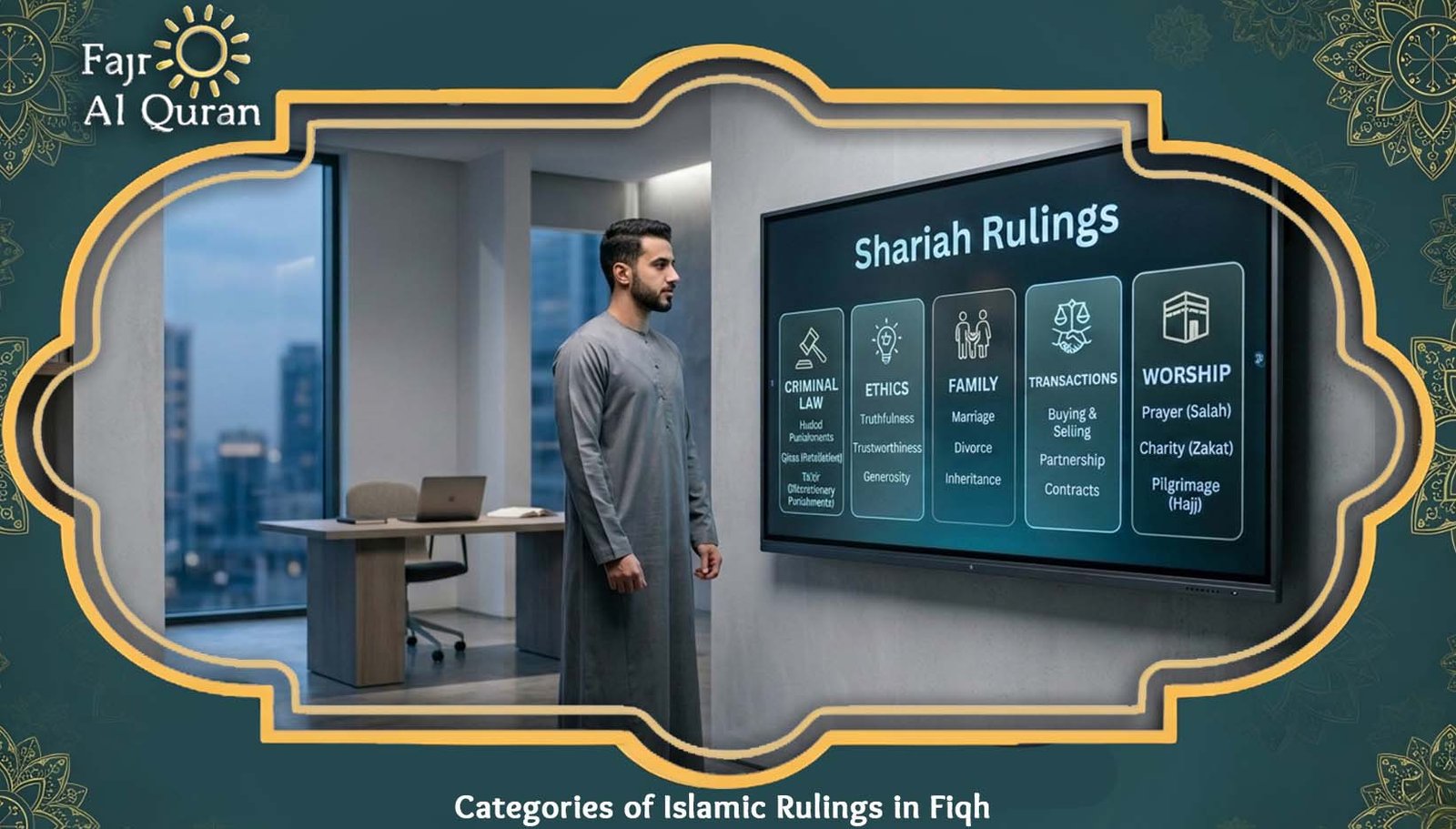
Categories of Islamic Rulings in Fiqh

Categories of Islamic Rulings in Fiqh

One of the most valuable aspects of Islamic fiqh is that it classifies human actions into clear legal categories. These categories help Muslims understand what Allah has commanded, encouraged, discouraged, or prohibited. Instead of leaving people uncertain about their religious responsibilities, Islamic jurisprudence provides practical guidance for everyday decisions. Every ruling is carefully derived from the Qur’an, the Sunnah, and the established principles of Islamic law.

The classical scholars of fiqh in Islam divided actions into five main categories. These rulings apply to acts of worship as well as social and financial dealings, making Islamic fiqh relevant to every stage of life.

The Five Categories of Islamic Rulings

  • Fard (Obligatory): Actions that every Muslim must perform, such as the five daily prayers and fasting during Ramadan. Neglecting them without a valid reason is sinful.
  • Mustahabb (Recommended): Good deeds that earn reward but are not compulsory, such as voluntary prayers and extra charity.
  • Mubah (Permissible): Actions that are neither rewarded nor punished, including many everyday choices like clothing styles or food preferences that comply with Islamic laws.
  • Makruh (Disliked): Actions that are better to avoid because they may lead to undesirable outcomes, although they are not strictly forbidden.
  • Haram (Forbidden): Actions clearly prohibited by Allah and His Messenger, such as theft, dishonesty, and consuming unlawful wealth.

These categories show that Islamic fiqh is not merely a collection of restrictions. Instead, it is a balanced system that guides Muslims toward beneficial choices while protecting individuals and society from harm. The rules of Islamic fiqh govern worship, business, family life, ethics, and public dealings with wisdom and justice.

Students who study at Fajr Al-Quran Academy learn these categories through practical examples from daily life. This educational approach helps beginners understand how Islamic jurisprudence applies to modern situations, making it easier to practice Islam with confidence and sincerity.

Essential Topics Covered in Islamic Fiqh

Islamic fiqh is a broad field of study that covers almost every aspect of a Muslim’s life. It does not focus only on acts of worship but also explains how Muslims should conduct themselves in personal, family, financial, and social matters. By studying Islamic fiqh, learners gain a comprehensive understanding of how Islamic law guides every stage of life while remaining rooted in the teachings of the Qur’an and the Sunnah.

One of the primary areas of fiqh in Islam is worship (Ibadah). This includes learning the correct rulings for purification, prayer, fasting, zakat, and Hajj. These acts form the foundation of a Muslim’s relationship with Allah and must be performed according to authentic guidance.

Another major area is Mu’amalat, which deals with human interactions and transactions. Scholars explain the Islamic principles governing buying and selling, partnerships, contracts, debts, investments, and business ethics.

Islamic fiqh also covers important family matters, including:

  • Marriage and marital rights.
  • Divorce and reconciliation.
  • Children’s rights and responsibilities.
  • Inheritance and estate distribution.
  • Financial support for family members.

In addition, Islamic jurisprudence discusses personal conduct, dietary rules, criminal justice, community responsibilities, and moral behavior.

Modern scholars continue to study emerging issues such as digital finance, medical ethics, environmental responsibility, and technological developments. Through ijtihad, they apply timeless Islamic principles to contemporary challenges while remaining faithful to authentic sources.

At Fajr Al-Quran Academy, students explore these essential topics through structured courses designed for beginners and advanced learners alike.

Difference Between Fiqh and Shariah

Many people use the terms Fiqh and Shariah interchangeably, but they have different meanings. Understanding this distinction is essential for anyone studying Islamic fiqh or Islamic jurisprudence. While both are closely connected, they are not identical. Recognizing their differences helps Muslims appreciate the role of divine revelation and scholarly interpretation in Islamic law.

Shariah refers to the complete divine guidance revealed by Allah through the Qur’an and the teachings of the Islamic Prophet Muhammad (peace be upon him). It includes beliefs, worship, morals, ethics, and legal principles. Since Shariah comes directly from Allah, it is perfect, complete, and immutable.

Islamic fiqh, on the other hand, is the human understanding and interpretation of Shariah. Qualified scholars study the Qur’an, Hadith, and other recognized sources to derive practical rulings for different situations. Because Islamic fiqh involves scholarly interpretation, differences of opinion may occur on issues where the evidence allows more than one valid understanding.

The main differences can be summarized as follows:

Shariah Fiqh
Divine revelation from Allah Human understanding of Shariah
Perfect and unchangeable Based on scholarly interpretation
Found in the Qur’an and Sunnah Derived through Islamic jurisprudence
Covers all aspects of Islam Focuses mainly on practical legal rulings
Universal for all Muslims May include different scholarly opinions

Although they differ, Shariah and Islamic fiqh complement one another. Shariah provides the divine foundation, while Islamic fiqh explains how to implement its guidance in real-life situations. This relationship allows Muslims to follow authentic teachings while addressing new issues through qualified scholarly effort and ijtihad.

Learn Islamic Fiqh for Beginners

Learn Islamic Fiqh for Beginners

Learning Islamic fiqh may seem challenging at first, but every student starts with the basics. With the right guidance and a structured learning plan, beginners can gradually build a strong foundation in Islamic jurisprudence. The goal is not to memorize countless legal rulings overnight. Instead, it is to understand the principles of Islam and learn how to practice them correctly in daily life. Whether you are a child, an adult, or a new Muslim, studying Islamic fiqh helps you worship Allah with confidence and make informed decisions based on authentic Islamic teachings.

A beginner should first focus on the rulings related to everyday worship. This includes purification (Taharah), prayer (Salah), fasting (Sawm), charity (Zakat), and the basic etiquette taught by the Islamic Prophet Muhammad (peace be upon him). Once these foundations are understood, students can move on to family matters, financial transactions, Islamic ethics, and other practical areas of fiqh in Islam. Learning gradually allows knowledge to become meaningful and easier to apply.

For the best results, beginners should:

  • Study from authentic Qur’an and Hadith sources.
  • Learn from qualified scholars and trusted teachers.
  • Begin with simple books before exploring advanced topics.
  • Practice what they learn in their daily lives.
  • Ask questions whenever something is unclear.
  • Review lessons regularly to strengthen understanding.

Fajr Al-Quran Academy offers beginner-friendly courses that explain Islamic law in clear, easy language. Students learn through live classes, practical examples, and interactive discussions with experienced teachers. The academy also provides flexible schedules, allowing children, adults, and busy professionals to study at their own pace.

If you want to learn about the rules of Islamic fiqh, the most important step is to begin. Consistent study, sincere intention, and guidance from knowledgeable teachers will help you build lasting knowledge and develop a deeper connection with your faith.

How to Learn Islamic Fiqh Effectively

Learning Islamic fiqh effectively requires patience, consistency, and a reliable source of knowledge. Since Islamic jurisprudence covers many aspects of worship and daily life, students should follow a structured approach rather than jumping between advanced topics. A gradual learning process helps learners understand the principles behind Islamic rulings instead of simply memorizing them. This creates a stronger foundation that lasts for life.

The first step is to study the Qur’an and the authentic Sunnah, because these are the primary sources of Islamic fiqh. Beginners should also become familiar with basic Islamic terminology, including Shariah, Usul al-Fiqh, ijtihad, and Hadith. Understanding these concepts makes it easier to appreciate how scholars derive legal rulings from the revealed scriptures.

To learn Islamic fiqh successfully, follow these practical steps:

  • Set clear learning goals and study regularly.
  • Choose authentic books written by respected scholars.
  • Enroll in a structured course taught by qualified instructors.
  • Practice the rulings you learn in your daily life.
  • Revise previous lessons to strengthen your knowledge.
  • Respect scholarly differences among the recognized schools of Islamic jurisprudence.
  • Continue learning with sincerity and humility.

Fajr Al-Quran Academy offers live online Quran classes for females, experienced teachers, and step-by-step courses suitable for beginners, children, and adults.

Conclusion

Islamic fiqh helps Muslims understand and apply the teachings of Islam in their daily lives. Based on the Qur’an, the Sunnah, and scholarly interpretation, it provides practical guidance for worship, family life, business, and personal conduct. By learning Islamic fiqh, Muslims gain a deeper understanding of their faith and practice it with confidence. If you are ready to begin your journey, Fajr Al-Quran Academy offers expert-led courses that make learning Islamic jurisprudence simple, engaging, and accessible for beginners, kids, and adults.

Best Online Tajweed Classes for Beginners | Learn Quran Recitation Step by Step

Tajweed classes for beginners teach the proper pronunciation, intonation, and rules of Quran recitation. These classes focus on accuracy and clarity without requiring prior knowledge of Arabic. Online Tajweed classes for beginners are ideal for anyone who can recite the Quran but wants to improve their technique, ensuring each letter is articulated correctly and with intention. Tajweed enhances spiritual connection and reverence during recitation.

Online Tajweed classes for beginners focus on teaching Quran recitation, the fundamental rules of correct Arabic pronunciation, articulation points (Makharij), and basic recitation mechanics. An online Quran Tajweed course helps students transition from reading letters blindly to reciting the Quran accurately.

Learning the Quran is one of the most rewarding journeys a Muslim can begin. However, reading the Quran correctly requires more than knowing the Arabic alphabet. Every letter has a specific pronunciation, and every verse should be recited according to the Tajweed rules that have been passed down through generations. That is why Tajweed classes for beginners have become an essential starting point for children, adults, and new Muslims who want to recite the Holy Quran with confidence and accuracy.

Among the trusted platforms available today, Fajr Al-Quran Academy stands out as a leading platform for Tajweed classes for beginners. The academy offers personalized instruction, certified Quran teachers, flexible schedules, and structured lessons designed for every age and skill level. From young children to adults, every student receives the support needed to learn Quran and Tajweed correctly.

This guide explains everything you need to know about Tajweed classes for beginners. You will discover why Tajweed matters, what you will learn, how to choose the right academy, and how online learning can help you master beautiful Quran recitation one step at a time.

Best Online Tajweed Classes for Beginners

What Are Tajweed Classes for Beginners?

Tajweed classes for beginners are specially designed courses that teach students how to read the Holy Quran correctly. These classes focus on proper pronunciation, correct articulation of Arabic letters, and the application of essential tajweed rules. Instead of simply reading words, students learn how every letter should sound and how each verse should be recited as it was revealed.

Most Tajweed classes for beginners start with the fundamentals. Students first learn the Arabic alphabet and practice each letter from its correct point of articulation. Many courses begin with the Noorani Qaida, which introduces reading skills before moving to Quranic verses.

Modern online Quran classes make learning simple and convenient. Students can attend lessons from anywhere while receiving live instruction from qualified teachers.

At Fajr Al-Quran Academy, every tajweed course for beginners is designed around the student’s level and learning pace. Whether the learner is a child, an adult, or someone returning to Quran studies after many years, teachers create personalized lessons that make learning enjoyable and effective.

A beginner course usually includes:

  • Arabic letter recognition and pronunciation.
  • Basic Tajweed rules.
  • Reading from the Noorani Qaida.
  • Simple Quran recitation practice.
  • Daily revision and teacher feedback.
  • Confidence-building exercises.

The goal of Tajweed classes for beginners is not only to teach reading but also to develop a lifelong connection with the Quran through correct and beautiful recitation

Importance of Learning Tajweed Rules for Beginners

Learning Tajweed rules for beginners is an important part of every Muslim’s Quran journey. The Quran is the word of Allah, and every letter deserves to be pronounced correctly. Even small pronunciation mistakes can change the meaning of a word. That is why Tajweed classes for beginners focus on accuracy from the very first lesson.

Many beginners believe that reading quickly is more important than reading correctly. In reality, proper pronunciation should come first. By joining Tajweed classes for beginners, students develop good reading habits that stay with them for life. They learn how to pronounce Arabic letters clearly, apply Quranic rules correctly, and read with confidence.

Learning Quran and Tajweed online with expert tutors also helps students understand the beauty of Quran recitation. As they practice regularly, they become more comfortable reading longer surahs and applying Tajweed naturally. This steady progress builds confidence and strengthens their connection with the Holy Quran.

At Fajr Al-Quran Academy, experienced teachers explain every rule in simple language. Students learn gradually instead of memorizing difficult terms all at once. Each lesson includes practical reading exercises that help learners apply every rule immediately.

Some important benefits of learning Tajweed include:

  • Correct Quran pronunciation.
  • Better understanding of Quranic Arabic sounds.
  • Greater confidence during recitation.
  • Strong preparation for advanced Quran studies.
  • A solid foundation for Tajweed hifz.
  • Improved fluency in reading with Tajweed.

When students begin with proper guidance, they avoid common mistakes and build the skills needed to learn Quran and Tajweed online successfully. This makes Tajweed classes for beginners one of the best investments in a Muslim’s Islamic education.

Key Features of Tajweed Classes for Beginners

Tajweed classes for beginners start with the basics of Arabic letters and sounds. Key features include mastering Makharij (where letters are made in the mouth) and Sifat (letter qualities, like heavy or light). Students then learn rules for letter merging and nasal sounds to read the Quran perfectly.

Beginner classes are carefully designed with several core features to make learning easy and accurate:

  1. 1-on-1 Personalized Feedback: You practice reading out loud to an expert tutor who instantly corrects your mistakes.
  2. Makharij Mastery: You learn the exact place where each of the 28 Arabic letters is made (from the throat to the lips).
  3. Sound-Before-Rules Approach: You first learn to hear and say the sounds correctly before memorizing complex Arabic terminology.
  4. Basic Rule Application: You are taught fundamental Tajweed rules step-by-step, such as Madd (stretching vowels) and the rules for the letters Noon and Meem.
  5. Visual Demonstrations: Teachers often use diagrams or mirrors so you can see exactly how to shape your lips and tongue

Learn Basic Tajweed Rules for Every Beginner

Every successful Quran learner begins with the basics. Before reading long surahs with confidence, students must understand the essential Tajweed rules that make Quran recitation correct and beautiful. This is why Tajweed classes for beginners focus on teaching one rule at a time. Students practice each rule until it becomes a natural part of their recitation.

The first lessons usually introduce the correct pronunciation of every Arabic letter. Teachers explain the Makharij, or points of articulation, so students know exactly where each sound comes from. Once learners master the letters, they move on to simple rules such as Noon Sakinah, Tanween, Madd, Qalqalah, and the characteristics of the letters.

At Fajr Al-Quran Academy, every lesson is designed to be easy for beginners. Teachers avoid overwhelming students with technical terms. Instead, they explain each concept using simple examples from the Quran. Students then read verses aloud while receiving immediate corrections. This practical approach helps learners remember the rules more easily.

A beginner tajweed course for beginners often covers:

  • Arabic letter pronunciation.
  • Makharij (points of articulation).
  • Noon, Sakinah, and Tanween rule.
  • Basic Madd rules.
  • Qalqalah.
  • Heavy and light letters.
  • Stopping and starting correctly during recitation.

Regular revision is another important part of Tajweed classes for beginners. Students review previous lessons before learning new ones. This strengthens their foundation and builds confidence.

Learning the basics first also prepares students for advanced Quran studies, including Tajweed, hifz, Quran memorization, and deeper Quranic Arabic learning.

Tips to Improve Quran Reading and Tajweed Online

Tips to Improve Quran Reading and Tajweed Online

Mastering Quran and Tajweed online requires daily repetition and live feedback. Online Tajweed classes for beginners now offer interactive live lessons with qualified teachers from anywhere in the world. Record your voice and compare it to expert reciters. Hire a qualified online tutor to fix mistakes in your articulation, elongation, and pausing.

Follow these specific steps to improve quickly:

  • Master the basics: Start by reviewing the Arabic alphabet using online resources like Noorani Qaida online classes. Learn the exact point of articulation (Makharij) for each letter.
  • Listen and echo: Pick a famous reciter. Listen to one verse (ayah) many times. Try to mimic their exact tone, speed, and rhythm.
  • Break it down: If a word is hard, split it into small pieces (syllables). Practice just that one piece until it feels easy.
  • Record yourself: Use your phone to record your reading. Listen to the recording. This helps you find mistakes like rushed sounds or uneven lengths.
  • Take it slow: Read slowly on purpose. Fast reading causes mistakes. Slow reading builds muscle memory.
  • Focus on one rule: Practice just one rule at a time (e.g., proper elongation length) for a whole week to prevent brain overload.

What You Will Learn in Tajweed Classes for Beginners

One of the biggest questions new students ask is what they will actually study during Tajweed classes for beginners. A well-structured course follows a clear learning path, allowing students to build their skills gradually without feeling overwhelmed. Every lesson prepares them for the next stage of Quran recitation.

Most beginners start by learning the Arabic alphabet and proper pronunciation. If needed, they first study the Noorani Qaida, which introduces Quran reading in an easy and organized way. Once students become comfortable with Arabic letters, they begin applying the basic tajweed rules while reading short Quranic verses.

As students progress, they learn how to recognize different recitation rules, improve fluency, and read with confidence. Teachers also help learners develop good reading habits by correcting pronunciation during every lesson.

At Fajr Al-Quran Academy, Tajweed classes for beginners are designed for children, adults, and new Muslims. Every student receives personalized instruction based on their current level.

During the course, students typically learn:

  • Arabic alphabet and pronunciation.
  • Noorani Qaida reading.
  • Essential Tajweed rules.
  • Correct Quran pronunciation.
  • Reading with proper rhythm.
  • Common recitation mistakes and how to avoid them.
  • Daily Quran reading practice.
  • Confidence in reading independently.

By the end of the course, students can learn Quran and Tajweed with greater accuracy and confidence. The knowledge gained from Tajweed classes for beginners provides a lifelong foundation for beautiful Quran recitation and continuous Islamic learning.

How to Choose the Best Tajweed Classes for Beginners

Choosing the right academy can make a significant difference in your Quran learning journey. With many online Quran classes available today, beginners should look beyond attractive websites and focus on the quality of teaching, student support, and course structure. The best Tajweed classes for beginners are those that make learning easy, enjoyable, and effective.

Start by checking the qualifications of the teachers. Experienced and certified instructors understand how to explain Tajweed rules in simple language. They know how to correct pronunciation gently and help students gain confidence with every lesson. Personalized attention is especially important for beginners because every learner progresses at a different pace.

A well-organized curriculum is another key factor. Good Tajweed classes for beginners follow a step-by-step approach, beginning with the Arabic alphabet and Noorani Qaida before introducing more advanced rules. This structured method prevents confusion and helps students build a strong foundation.

When choosing an academy, consider the following:

Certified and experienced Quran teachers.

  • Beginner-friendly curriculum.
  • One-on-one or small class options.
  • Flexible online schedules.
  • Interactive live lessons.
  • Affordable course plans.
  • Positive student reviews.
  • Ongoing support and progress tracking.

Fajr Al-Quran Academy provides certified Quran teachers, flexible scheduling, one-on-one instruction, and courses designed for kids and adults. Students also benefit from regular progress assessments and personalized learning plans that ensure steady improvement.

The right learning environment keeps students motivated and helps them stay consistent. Whether your goal is to improve reading with Tajweed, complete a Tajweed course for beginners, or prepare for future Hifz, choosing a trusted academy is the first step toward success.

Flexible Online Tajweed Classes for Beginners

Flexible Online Tajweed Classes for Beginners

One of the greatest advantages of modern Tajweed classes for beginners is flexibility. Students can study from home, choose convenient class times, and learn at their own pace without sacrificing the quality of instruction.

Flexible learning is especially helpful for busy parents, working adults, school students, and families living in countries where access to qualified Quran teachers is limited. Whether you live in the United States, the United Kingdom, Canada, Australia, or anywhere else, you can join online Tajweed classes with experienced tutors.

Some advantages of flexible online learning include:

  • Study from the comfort of your home.
  • Choose class times that fit your schedule.
  • Learn from certified Quran teachers.
  • Access Tajweed lessons online from anywhere in the world.
  • Enjoy a comfortable learning environment.
  • Continue learning during travel or holidays.
  • Balance Quran studies with work or school.

Fajr Al-Quran Academy offers flexible schedules designed for learners of all ages. Morning, afternoon, evening, and weekend classes are available to suit different time zones. This allows students to stay consistent without interrupting work, school, or family commitments. This personalized approach makes Tajweed classes for beginners more effective and enjoyable.

Flexible Tajweed classes for beginners make it possible for anyone to begin learning the Quran, regardless of age or location.

One-on-One Tajweed Classes for Beginners

Every student learns differently. Some understand new concepts quickly, while others need extra practice before moving to the next lesson. That is why one-on-one Tajweed classes for beginners have become one of the most effective ways to learn Quran recitation. Individual instruction allows teachers to focus entirely on one student, making every lesson more productive and personalized.

During private lessons, the teacher listens carefully to the student’s recitation and corrects pronunciation immediately. This helps beginners avoid developing incorrect reading habits. Students also feel more comfortable asking questions, repeating difficult words, and practicing challenging tajweed rules without feeling embarrassed.

Private lessons offer many important benefits:

  • Individual attention from expert tutors.
  • Faster progress through personalized instruction.
  • Immediate correction of pronunciation mistakes.
  • Greater confidence during Quran recitation.
  • Lessons adjusted to the student’s pace.
  • Flexible scheduling throughout the week.
  • Better preparation for advanced Quran learning and Tajweed hifz.

One-on-one learning also allows teachers to spend more time reviewing difficult topics such as Noon Sakinah, Madd, and proper articulation of Arabic letters. Students receive continuous encouragement, making the learning experience enjoyable rather than stressful.

At Fajr Al-Quran Academy, one-on-one Tajweed classes for beginners are carefully designed to match each learner’s goals and ability. Whether the student is a child learning through the Noorani Qaida, an adult beginning Quran studies, or someone returning to the Quran after many years, teachers create lessons that support steady improvement.

For beginners who want to learn Quran and Tajweed online, private classes provide the ideal environment.

Learn Quran Recitation with Native and Qualified Quran Teachers

The quality of a Quran teacher has a direct impact on a student’s learning experience. Even the best curriculum cannot replace knowledgeable instructors who understand both Tajweed and effective teaching methods. This is why choosing Tajweed classes for beginners with native and qualified Quran teachers is one of the most important decisions a learner can make.

Native Arabic-speaking teachers have a natural understanding of Quranic pronunciation. They demonstrate the correct articulation of every letter and explain the Tajweed rules clearly. Certified teachers also have formal training in Quran recitation, Tajweed, and Islamic education, allowing them to teach beginners with patience and accuracy.

Learning with expert tutors offers several advantages:

  • Accurate Quran pronunciation from native speakers.
  • Clear explanations of Tajweed rules.
  • Friendly and supportive learning environment.
  • Personalized lesson plans.
  • Continuous assessment and feedback.
  • Experience teaching students of all ages and levels.
  • Strong preparation for advanced Quran studies and Hifz.

At Fajr Al-Quran Academy, students learn from experienced male and female Quran teachers who are qualified to teach children, adults, and new Muslims. Every instructor uses beginner-friendly methods that simplify complex topics and make lessons engaging. Teachers encourage students, celebrate their progress, and provide constructive feedback throughout the learning journey.

Whether your goal is to improve reading with Tajweed, complete a Tajweed course for beginners, or simply gain confidence in Quran recitation, learning with qualified teachers makes the journey easier and more rewarding.

Every lesson brings students closer to reading the Holy Quran beautifully, correctly, and with understanding.

Conclusion

Beginning your Quran journey is one of the most meaningful decisions you can make. Tajweed classes for beginners provide the strong foundation every learner needs to pronounce Arabic letters correctly, understand essential tajweed rules, and recite the Holy Quran with confidence.

Whether you are a child, an adult, or a new Muslim, a structured learning program helps you progress step by step. Fajr Al-Quran Academy offers high-quality Tajweed classes for beginners that combine flexible scheduling, certified Quran teachers, interactive online lessons, and personalized learning plans.

If you are ready to begin your journey, now is the perfect time. Enroll in Tajweed classes for beginners at Fajr Al-Quran Academy and take the first step toward beautiful, accurate, and confident Quran recitation.

Best Arabic Classes for Beginners Online

Best Arabic Classes for Beginners Online

Arabic classes for beginners are the ideal starting point for anyone who wants to learn one of the world’s most beautiful and influential languages. Whether you are a child taking your first language lessons, an adult pursuing a new skill, a parent searching for quality education for your child, or someone interested in understanding the language of the Quran, the right learning environment can make all the difference. Fajr Al-Quran Academy has made it easier than ever to learn Arabic online through interactive lessons, experienced teachers, and flexible schedules that suit learners worldwide.

Choosing the best Arabic classes for beginners means more than simply finding a teacher. It involves selecting a program that offers structured lessons, practical speaking opportunities, engaging activities, and personalized support. A well-designed Beginner Arabic course helps students build confidence step by step, making learning enjoyable instead of overwhelming. Students gradually develop the ability to understand, speak, read, and write Arabic through meaningful practice.

Interactive exercises, live instruction, visual resources, and consistent practice help students learn Arabic from scratch with confidence. High-quality Arabic classes for beginners simplify grammar, introduce useful vocabulary, and encourage learners to communicate naturally from the very first lesson.

The leading platform, Fajr Al-Quran Academy, has earned an excellent reputation for delivering professional Online Arabic classes for Beginners. Their qualified instructors, personalized teaching approach, and interactive classrooms help students achieve measurable progress while enjoying every lesson.

This complete guide explains everything you need to know before choosing the right course. You will discover what beginners should expect, the features that distinguish excellent programs, the skills you will develop, and practical tips for selecting the best Arabic classes for beginners for yourself or your family.

Best Arabic Classes for Beginners Online

What Are Arabic Classes for Beginners?

Arabic classes for beginners are specially designed educational programs that introduce students to the fundamentals of the Arabic language in a clear, organized, and supportive manner. These courses assume no previous knowledge, making them suitable for complete beginners of all ages.

Unlike advanced language programs, Arabic lessons for beginners focus on building confidence before introducing complex concepts. Students begin by learning the Arabic alphabet, pronunciation, and basic vocabulary before progressing to everyday conversations, reading practice, and simple writing exercises.

A typical Arabic language course includes several essential learning areas:

  • Recognizing and pronouncing Arabic letters.
  • Reading simple words and short passages.
  • Building practical vocabulary.
  • Understanding Arabic grammar in simple steps.
  • Speaking through guided conversations.
  • Listening to native pronunciation.
  • Writing Arabic letters and sentences.

The goal is not simply memorization. Instead, students gradually develop practical communication skills while understanding how the language works naturally.

Today’s Online Arabic classes for beginners make learning even more accessible. Students can attend lessons from home, interact with experienced teachers, receive instant feedback, and practice consistently without the need to travel.

One of the greatest advantages of Arabic classes for beginners is flexibility. Whether you are learning for travel, work, religious studies, or personal enrichment, modern online programs adapt to your goals and schedule.

Essential Features of High-Quality Arabic Classes for Beginners

Not every language program offers the same quality. The best Arabic classes for beginners share several important characteristics that help students learn efficiently while staying motivated throughout their journey.

Experienced instructors are perhaps the most valuable feature. A qualified teacher understands how beginners learn and knows how to explain difficult concepts using simple language. Instead of overwhelming students with rules, effective teachers gradually introduce new material while encouraging consistent progress.

Another hallmark of excellent Arabic classes is a structured curriculum. Every lesson builds naturally upon previous knowledge, allowing students to develop confidence without feeling lost. A carefully organized Beginner Arabic course starts with the alphabet before moving toward vocabulary, pronunciation, grammar, reading, writing, and conversation.

Interactive learning also plays a major role. Modern online Arabic education is no longer limited to recorded videos. High-quality academies use live discussions, pronunciation practice, quizzes, digital whiteboards, conversation exercises, and collaborative activities to keep students engaged.

Small class sizes or one-on-one instruction provide additional benefits. A professional Online Arabic tutor can identify weaknesses quickly, answer questions immediately, and personalize each lesson according to the learner’s pace.

Another essential feature is practical application. Students should spend time speaking, listening, reading, and writing during every class. This balanced approach helps learners retain information much more effectively than memorization alone.

Leading institutions such as Leading platform Fajr Al-Quran Academy emphasize personalized instruction, interactive classrooms, flexible scheduling, and continuous assessment. These features ensure learners remain motivated while steadily improving their Arabic proficiency.

Finally, quality Arabic classes for beginners encourage students to enjoy the process. Learning becomes easier when lessons include engaging conversations, useful vocabulary, real-life examples, and enjoyable activities that transform every lesson into a rewarding experience.

What Will You Learn in Arabic Classes for Beginners?

One of the most common questions prospective students ask is what they will actually study in beginner Arabic classes. While every academy follows its own curriculum, most quality programs share similar learning objectives.

Students usually begin by mastering the Arabic alphabet. Correct pronunciation is essential because Arabic contains sounds that may not exist in other languages. Professional instructors guide students carefully until they pronounce every letter accurately.

Next comes vocabulary development. Rather than memorizing random words, learners study practical expressions they can use in daily conversations.

As lessons progress, students gradually explore Modern Standard Arabic, the widely understood form of Arabic used in education, literature, media, and formal communication. Learning Modern Standard Arabic provides a strong foundation before exploring regional dialects if desired.

Students also study Arabic grammar, but it is introduced gradually and in context. Instead of overwhelming learners with technical terminology, experienced teachers explain grammar through examples and practical exercises.

Reading practice becomes increasingly important as students gain confidence. Learners practice recognizing words, understanding short texts, and eventually reading longer passages fluently. Writing exercises reinforce spelling, vocabulary, and sentence structure.

Conversation practice is another major component of quality Arabic classes for beginners. Students participate in guided dialogues that improve pronunciation, listening comprehension, and overall confidence when speaking.

By the end of a well-designed Arabic language course, learners typically develop essential Arabic reading and speaking skills, including the ability to:

  • Read basic Arabic texts confidently.
  • Write simple sentences.
  • Introduce themselves in Arabic.
  • Understand everyday conversations.
  • Build practical vocabulary.
  • Apply basic grammar correctly.
  • Continue learning independently with confidence.

Perhaps most importantly, students develop a genuine appreciation for the richness of the Arabic language. Every new lesson builds upon previous knowledge, making continuous progress both achievable and enjoyable.

How to Choose the Best Arabic Classes for Beginners

Selecting the right Arabic classes for beginners is one of the most important decisions you will make on your language-learning journey. A well-structured program can help you progress steadily, while an unorganized course may leave you feeling confused and discouraged. Since there are many options available, it is worth taking the time to compare programs before enrolling.

Start by looking at the curriculum. The best Arabic classes for beginners follow a logical sequence, beginning with the Arabic alphabet and pronunciation before introducing vocabulary, grammar, reading, writing, and conversation.

Teacher qualifications are equally important. Experienced instructors understand the challenges that beginners face and know how to explain new concepts in simple, encouraging ways. They also provide constructive feedback that helps students improve without feeling overwhelmed.

Flexibility is another key factor. Many learners have busy schedules, so quality Online Arabic Classes for Beginners offer a variety of class times, recorded lesson support, and flexible booking options.

Interactive teaching methods also distinguish excellent programs from average ones. Rather than relying only on lectures, the best Arabic classes include speaking practice, listening activities, vocabulary games, pronunciation exercises, and live discussions.

When comparing academies, consider the following features:

  • A structured Beginner Arabic course with clear learning objectives.
  • Qualified and experienced instructors.
  • Live Arabic classes with opportunities to practice speaking.
  • Small class sizes or personalized instruction.
  • Regular assessments to measure progress.
  • Interactive learning resources and homework.
  • Flexible scheduling for learners around the world.
  • Positive reviews and student success stories.

Many students choose the Leading platform Fajr Al-Quran Academy because it combines all of these qualities. Its experienced teachers, personalized approach, and engaging online classrooms create an ideal learning environment for children and adults alike. Students receive continuous support while developing confidence in every aspect of the Arabic language.

Online Arabic Classes for Kids and Adults

Online Arabic Classes for Kids and Adults

One of the greatest advantages of modern education is that Online Arabic Classes for Beginners are available for learners of every age. Whether you are introducing a child to a new language or beginning your own learning journey as an adult, online education offers flexibility, convenience, and personalized instruction.

Online Arabic classes for kids: learning should always be enjoyable. High-quality Arabic learning programs for kids and adults understand that young learners stay motivated when lessons are interactive and engaging. Kids learn through storytelling, songs, educational games, pictures, and simple conversations. This fun approach helps them develop confidence while naturally absorbing new words and expressions.

Online Arabic classes for adults have different goals. Some want to learn Arabic online for career opportunities, while others hope to communicate during travel or understand Islamic texts more deeply. Many adults simply enjoy learning a new language as a personal achievement. Quality Arabic classes for beginners recognize these different motivations and adapt lessons accordingly.

Adult learners generally appreciate practical conversations, clear grammar explanations, and real-world vocabulary that can be used immediately. Live interaction with teachers helps students improve pronunciation, ask questions, and gain speaking confidence from the very beginning.

Another benefit of online learning is accessibility. Students from anywhere in the world can connect with professional instructors without relocating or searching for local language schools. Whether you live in North America, Europe, Asia, Africa, or Australia, you can join Live Arabic classes taught by experienced educators.

The Leading platform, Fajr Al-Quran Academy, has become a trusted choice for families because it offers customized programs for both children and adults. Lessons are designed according to age, learning style, and individual goals, ensuring that every student receives the support they need

Interactive Online Arabic Classes for Beginners

Modern Arabic classes for beginners have transformed the way students learn. Instead of relying only on textbooks and memorization, today’s online programs create an engaging learning environment where students actively participate in every lesson. Interactive teaching helps learners stay motivated, retain information more effectively, and build confidence as they progress.

One of the greatest advantages of Online Arabic Classes for Beginners is the opportunity to communicate directly with qualified instructors. During Live Arabic classes, students ask questions, practice pronunciation, participate in conversations, and receive immediate feedback.

Interactive lessons also include a variety of teaching methods that appeal to different learning styles. Visual learners benefit from digital whiteboards, flashcards, and presentations, while auditory learners improve through listening exercises and guided conversations.

Another important feature is continuous participation. Rather than listening passively, students are encouraged to:

  • Read short passages aloud.
  • Practice everyday conversations.
  • Build useful vocabulary through activities.
  • Complete grammar exercises together.
  • Write simple sentences.
  • Review previous lessons regularly.
  • Participate in pronunciation drills.

These activities strengthen understanding while making every lesson enjoyable.

Interactive Arabic classes for beginners also help learners overcome one of the biggest challenges of language learning: the fear of making mistakes. Supportive teachers create a comfortable environment where students feel confident practicing new words and expressions.

The Leading platform, Fajr Al-Quran Academy, places strong emphasis on interactive instruction. Experienced teachers personalize every lesson according to the student’s age, goals, and learning pace. Whether teaching children or adults, instructors encourage active participation through discussions, exercises, and practical communication.

Ultimately, interactive Arabic classes for beginners create a learning experience that is both effective and enjoyable. Students remain engaged, motivated, and eager to continue developing their language skills week after week.

A Guide for Non-Native Learners of Arabic

For non-native speakers, learning Arabic may seem intimidating at first. The writing system, pronunciation, and grammar differ from many other languages. However, with the right guidance, anyone can successfully master the basics. Quality Arabic classes for beginners are specifically designed to simplify these challenges and provide a clear learning path.

The first step is understanding that progress takes time. Every language requires patience and consistent practice, and Arabic is no exception.

Most beginners begin with the Arabic alphabet. Although it looks unfamiliar at first, students gradually recognize each letter and learn how it changes shape depending on its position in a word.

Pronunciation is another important area. Some Arabic sounds do not exist in English or other languages, making professional instruction especially valuable. Listening carefully to native speakers and repeating words aloud helps learners develop accurate pronunciation over time.

Vocabulary should also be learned in context. Instead of memorizing long lists of isolated words, students benefit from learning useful phrases and everyday expressions that can be used immediately in conversation. Many beginners worry about Arabic grammar, but experienced teachers introduce grammar gradually.

Non-native learners can accelerate their progress by following several simple habits:

  • Practice reading every day.
  • Review vocabulary regularly.
  • Listen to native pronunciation.
  • Speak whenever possible.
  • Complete homework consistently.
  • Ask questions without hesitation.
  • Celebrate small achievements.

Another important decision involves choosing which variety of Arabic to study. Most experts recommend beginning with Modern Standard Arabic because it is widely understood throughout the Arab world and serves as the foundation for reading, writing, education, and media.

The Leading platform, Fajr Al-Quran Academy, supports non-native learners through structured courses that begin at the absolute beginner level. With consistent practice and professional instruction, Arabic classes for beginners help students transform uncertainty into confidence, making the journey both rewarding and enjoyable.

Personalized Arabic Learning with an Online Arabic Tutor

Personalized Arabic Learning with an Online Arabic Tutor

Some students learn quickly through conversation, while others prefer reading and writing exercises. This is why personalized instruction has become one of the greatest advantages of modern Arabic classes for beginners.

Working with an Online Arabic tutor allows lessons to be tailored to your individual needs, learning style, and goals. Instead of following a fixed classroom pace, students receive personalized guidance that helps them progress comfortably and efficiently.

One-on-one instruction offers several important advantages. Tutors can identify strengths and weaknesses immediately, adjust lesson difficulty, and spend additional time on topics that require more practice. Whether a student struggles with pronunciation, grammar, vocabulary, or reading, personalized lessons provide targeted support.

Children particularly benefit from individualized attention. Tutors use age-appropriate activities, stories, games, and visual materials to keep young learners engaged while developing strong language foundations.

Adults also appreciate personalized learning because lessons can focus on their specific objectives. Some students want to communicate confidently while traveling, others wish to understand Quranic Arabic, and many simply want to learn Arabic online for personal or professional growth. A skilled Online Arabic tutor adapts lessons to these goals.

Another advantage is flexibility. Students can schedule classes around work, school, or family responsibilities without sacrificing learning quality.

The Leading platform, Fajr Al-Quran Academy, offers personalized learning plans designed for beginners of all ages. Teachers regularly evaluate student progress and modify lessons to ensure continuous improvement.

Students who receive personalized instruction develop confidence more quickly because they receive immediate feedback, continuous encouragement, and lessons that match their current abilities. These benefits make one-on-one Arabic classes for beginners an excellent investment for anyone serious about mastering the language.

Master Arabic Reading and Speaking Skills

Developing strong Arabic reading and speaking skills is one of the primary goals of high-quality Arabic classes for beginners. These two abilities work together, allowing students to communicate confidently while understanding written Arabic in everyday situations.

Reading begins with recognizing individual letters and their different forms. As learners become familiar with the alphabet, they gradually move to reading words, sentences, and short passages. Regular reading practice strengthens vocabulary, improves pronunciation, and reinforces grammar naturally.

Speaking develops through continuous conversation practice. Instead of waiting until they become “perfect,” students are encouraged to speak from their very first lessons.

Professional teachers emphasize accurate pronunciation because clear speech improves communication and listening comprehension. During Live Arabic classes, instructors correct pronunciation gently and encourage students to repeat words until they become comfortable with unfamiliar sounds.

Vocabulary development also plays an essential role. Every new word gives learners additional tools for expressing ideas. Students learn vocabulary connected to real-life situations such as family, school, work, travel, shopping, and daily routines.

Writing supports both reading and speaking. As students write new words and simple sentences, they reinforce spelling, grammar, and sentence structure while improving overall language retention.

The most successful learners practice all four language skills together:

  • Reading simple Arabic texts.
  • Listening to native speakers.
  • Speaking during conversations.
  • Writing short paragraphs and exercises.

This balanced approach produces steady progress across every area of language learning.

The Leading platform, Fajr Al-Quran Academy, integrates all of these skills into its Arabic language course, ensuring students receive a complete educational experience.

As students continue attending Arabic classes for beginners, they discover that reading and speaking become increasingly natural. Each lesson builds upon previous knowledge, creating lasting confidence and preparing learners for more advanced study in the future.

Conclusion

Choosing the right Arabic classes for beginners is the first and most important step toward mastering one of the world’s richest and most rewarding languages. Whether you are a parent searching for quality education for your child, an adult pursuing a personal goal, or a complete beginner eager to learn Arabic from scratch, a structured learning program provides the guidance and confidence you need to succeed.

Throughout this guide, we have explored what makes outstanding Arabic classes for beginners, the essential features of a high-quality Arabic language course, and the skills you can expect to develop. From learning the Arabic alphabet and understanding Arabic grammar to building vocabulary, improving Arabic reading and speaking skills, and communicating confidently in Modern Standard Arabic, every stage of learning contributes to long-term success.

Best Quran Recitation for Beginners – Step-by-Step Guide

Best Quran Recitation for Beginners

Quran recitation for beginners is the foundational process of learning to read the Arabic script accurately, understand basic phonetics, and apply foundational rules of Tajweed (proper pronunciation). Quran recitation for beginners allows individuals without prior Arabic knowledge to correctly read and recite the words of the Quran. Getting started with Quran recitation involves a structured, step-by-step approach to ensure you build a strong foundation without feeling overwhelmed.

Quran recitation for beginners begins with mastering the Arabic alphabet and short vowels (Harakat) to ensure accurate pronunciation. It’s recommended to start with slow, clear recitations to build familiarity. Focus on proper articulation points (makharij) and vocal characteristics (sifat) using a structured approach.

Learning Quran recitation for beginners is one of the most rewarding journeys a Muslim can undertake. Whether you are a child, an adult, a new Muslim, or a parent seeking the best learning path for your children, mastering Quran recitation as a beginner is an important first step toward building a strong connection with Allah’s words.

Many people feel overwhelmed when they first begin learning Quran recitation for beginners. The Arabic letters may seem unfamiliar, the pronunciation may feel difficult, and the rules of recitation can appear complex. However, with the right guidance, consistent practice, and a structured approach, anyone can learn to read the Quran correctly and confidently.

This comprehensive guide explains everything you need to know about Quran recitation for beginners, including reading rules, Tajweed, pronunciation, learning techniques, and the benefits of enrolling in online Quran classes. By following these steps, you can begin your Quranic journey with confidence and steadily improve your Quran recitation skills.

Learn Quran recitation for beginners with this step-by-step guide and master Tajweed, pronunciation, and Quran reading through effective online learning.

Best Quran Recitation for Beginners

The Importance of Learning Quran Recitation for Beginners

The Quran is the final revelation from Allah and serves as a source of spiritual guidance for Muslims worldwide. Learning to recite it correctly is not only an act of worship but also a means of strengthening one’s faith and understanding of Islamic teachings.

For beginners, Quran recitation offers many benefits:

  • Develops a strong relationship with the Quran.
  • Improves understanding of Islamic teachings.
  • Increases spiritual awareness and mindfulness.
  • Builds confidence in prayer and worship.
  • Encourages lifelong Quran learning.

Every Muslim should strive to learn how to read the Quran accurately. Even if progress seems slow at first, each step in the learning process brings great rewards. The journey of learning the Quran is a beautiful act of devotion that benefits both this life and the Hereafter.

Core Stages to Learn Quran Recitation for Beginners

Learning Quran recitation for beginners follows a structured, step-by-step roadmap: mastering the Arabic alphabet, learning letter articulation, studying basic Tajweed rules, and finally practicing with short Surahs. Consistency is key—practicing out loud with expert audio or a qualified teacher builds proper rhythm and muscle memory.

  1. Mastering the Arabic Alphabet (Noorani Qaida)

Before reciting the Quran, you must learn to read the Arabic script fluently.

  • Identify Letters: Learn to recognize all 28 Arabic letters in their isolated forms and how they change when connected to learn Quran recitation for beginners.
  • Learn the Vowels: Master short vowels (Harakat), long vowels (Madd), and other markings.
  • Where to start: Foundational texts like the Noorani Qaida are standard for beginners to learn to read and join simple words.
  1. Learning Articulation (Makharij)

Correct pronunciation is the foundation of Tajweed.

  • Articulation Points: Understand Makharij, the exact parts of the mouth, throat, or tongue used to produce each unique Arabic letter.
  • Listen and Mimic: Play authentic audio recitations and repeat after master reciters to ensure you sound exactly as intended.
  1. The Enhancement: Basic Tajweed Rules

Tajweed is the set of rules that ensures the Quran is recited exactly as the Prophet Muhammad (PBUH) recited it.

  • Basic Tajweed Rules: Learn foundational rules such as the Madd (elongation), the Ghunna (nasal sound), and when to pronounce or skip the letter Alif in Laam-Shamsiyyah and Laam-Qamariyyah.
  • Pauses (Waqf): Learn where to pause and stop to maintain the meaning and breath of the recitation.
  1. Practice and Fluency with Short Surahs to learn Quran recitation for beginners.

Apply what you’ve learned to actual verses to build both rhythm and confidence.

  • Start Small: Begin your recitation practice with the shorter Surahs found at the end of the Quran (e.g., Al-Fatiha, Al-Ikhlas, Al-Falaq, An-Nas).
  • Read Aloud: Reciting out loud trains your tongue muscles and helps you catch mistakes.
  • Record Yourself: Hearing your own recitation and comparing it to expert audio helps identify areas for improvement.
  1. Seek Guided Feedback

Self-study can lead to uncorrected pronunciation mistakes, which is why reciting to a qualified teacher is essential.

  • Online Quran Recitation for Beginners Classes: If you are located in the USA, Canada, or the UK, you can benefit from our institution’s Fajr Al-Quran Academy. Flexible options are available globally and locally through our platform.

Understanding Basic Quran Reading Rules for Beginners

Before learning advanced recitation techniques, beginners should understand the fundamental reading rules used throughout the Quran.

Learning Quran recitation for beginners begins with mastering the Arabic alphabet, learning short vowels (diacritics), and applying Tajweed (the rules of proper pronunciation). Beginners should start by learning letter articulation, elongation, and pausing rules, building up to a measured and reflective pace.

These rules help learners read accurately and avoid common mistakes.

Harakat (Vowel Marks)

Harakat indicate short vowel sounds and determine how a letter should be pronounced.

The three primary vowel marks are:

  • Fatha (a sound)
  • Kasra (i sound)
  • Damma (u sound)

Sukoon

A Sukoon indicates the absence of a vowel sound and signals that the letter should be pronounced without movement.

Shaddah

The Shaddah symbol indicates that a letter should be pronounced twice or emphasized.

Madd

Madd refers to elongating certain sounds according to specific rules.

Learning these Quran reading rules makes it easier for beginners to progress toward fluent and correct recitation.

The Importance of Tajweed in Quran Recitation for Beginners

The Importance of Tajweed in Quran Recitation for Beginners

Tajweed refers to the rules governing the proper pronunciation and recitation of the Quran. The word Tajweed means “to improve” or “to make better.”

Without Tajweed, learners may unintentionally alter the meaning of Quranic words through incorrect pronunciation.

Benefits of learning Tajweed include:

  • Correct recitation of Quranic verses.
  • Improved pronunciation.
  • Enhanced beauty in recitation.
  • Greater confidence while reading.
  • Preservation of the original Quranic message.

Tajweed teaches learners how to pronounce letters from their proper articulation points known as Makharij. It also explains elongation, stopping rules, nasal sounds, and letter characteristics.

For every beginner, learning Tajweed should be an essential part of Quran learning.

Step-by-Step Guide to Start Quran Recitation for Beginners

Starting Quran recitation for beginners requires mastering the Arabic alphabet, learning letter pronunciations (Makharij), and applying basic Tajweed rules. Follow a step-by-step approach starting from foundational books to reading short chapters, ensuring consistent daily practice with the guidance of a qualified teacher.

Starting your Quran journey becomes much easier when you follow a structured plan.

Step 1: Master the Arabic Alphabet and Vowels

Before attempting to read the Quranic text, you must learn the 28 Arabic letters and their sounds.

  • Isolated Letters: Focus on recognizing how letters are written and pronounced.
  • Vowels (Harakat): Learn the short vowel marks (Fatha, Kasra, Damma) that tell you how to pronounce a letter.
  • Letter Connections: Practice how letters change shape when they connect at the beginning, middle, or end of a word.
  • Recommended Tool: Use a foundational guide like the Noorani Qaida or Qaida Nuraniyah to practice systematic letter drills.

Step 2: Learn Letter Articulation (Makharij)

Correct pronunciation is essential when reciting the Quran. Makharij refers to the exact points of articulation in the throat, tongue, and lips for each letter.

Take time to practice unique Arabic sounds that may not exist in your native language.

Step 3: Understand Basic Tajweed Rules

Tajweed translates to “making beautiful” or “improving”. It provides the rules for proper pacing, rhythm, and letter elongation.

  • Focus on basic rules first, such as when to stretch a sound (Madd) or how to pause correctly

.Step 4: Practice Active Listening

Your ear must become familiar with the correct rhythm and tone of recitation before your mouth can reproduce it accurately.

  • Listen to an expert, slow reciter (such as Sheikh Al-Husary, Minshawi, or Abdul Basit).
  • Listen to a single verse (Ayah) 3 to 5 times while reading the Arabic text, then repeat it out loud.

Step 5: Start with Short Chapters (Surahs)

Do not try to start with longer chapters from the beginning. Build confidence, speed, and accuracy by reading from the end of the Quran.

  • Start with Surah Al-Fatiha (Chapter 1).Progress to Surah Al-Ikhlas, Surah Al-Falaq, and Surah An-Nas.

Step 6: Maintain a Consistent Daily Routine

Consistency will help you advance much faster than long, irregular sessions. Aim for a manageable daily routine (20 to 30 minutes):

  • Minutes 1-5: Warm-up and review previously learned letters or verses.
  • Minutes 6-15: Read one or two verses from your Mushaf (Quran) while applying Tajweed.
  • Minutes 16-20: Listen to a professional recitation of what you just practiced.

Step 7: Learn Quran Recitation for Beginners with a Qualified Teacher

Learning Quran recitation for beginners with a qualified teacher is a highly rewarding journey that builds fluency and proper articulation.

Online tools, audio files, and apps are highly useful, but they cannot replace a live instructor. A teacher provides critical feedback, catches pronunciation mistakes, and stops errors from becoming bad habits.

At Fajr Al-Quran Academy, you can easily connect with certified Egyptian tutors, Al-Azhar University graduates, for one-on-one virtual or in-person sessions

By following this step-by-step approach, beginners can develop strong reading skills and achieve steady improvement.

How to Pronounce Arabic Letters Correctly

Proper pronunciation is one of the most important aspects of Quran recitation. for beginners

Mastering Arabic pronunciation for Quran recitation for beginners requires learning the exact articulation points (Makharij) and the inherent characteristics of each letter. Because Arabic contains sounds that don’t exist in English, beginners must focus on listening, tongue placement, and consistent daily practice to avoid common mistakes.

Many Arabic letters have sounds that do not exist in English or other languages. Therefore, learning their correct articulation points is essential.

Examples include:

  • ح (Ha)
  • خ (Kha)
  • ع (Ayn)
  • غ (Ghayn)
  • ق (Qaf)

To improve pronunciation:

  • Listen carefully to expert Quran reciters.
  • Repeat sounds multiple times.
  • Practice with qualified teachers.
  • Use audio and video resources.
  • Focus on Makharij and letter characteristics.

Famous reciters such as Mishary Rashid Alafasy provide excellent examples of beautiful Quran recitation that learners can follow and imitate.

With regular repetition, students gradually develop accurate pronunciation and fluency.

Effective Techniques to Improve Quran Recitation Skills

Improvement comes through consistent effort and smart learning strategies.

To improve Quran recitation for beginners, combine consistent daily practice with targeted feedback from a qualified teacher. Record your own recitations to identify mistakes, listen to master reciters to naturally internalize tone and rhythm, and learn the rules of Tajweed gradually to avoid feeling overwhelmed.

Some highly effective techniques include:

Active Listening  Quran Recitation for Beginners 

Listen regularly to Quran audio recitations and focus on pronunciation details.

Repetition

Repeat verses multiple times until they become comfortable and natural.

Shadowing Technique with Quran Recitation for Beginners

Listen to a reciter and immediately repeat after them.

Recording Yourself

Recording your recitation helps identify mistakes and monitor progress.

Reading Along with Audio

Follow the Mushaf while listening to recitation.

Using Digital Tools

Modern Quran learning tools, apps, and videos make learning easier than ever before.

These methods help beginners improve Quran recitation skills faster and develop confidence in reading.

Creating a Consistent Quran Recitation Routine for Beginners

Consistency often matters more than the amount of time spent studying.

A beginner who practices daily for fifteen minutes may achieve better results than someone who studies for several hours only once a week.

A simple routine may include:

  • 5 minutes reviewing previous lessons.
  • 10 minutes reading new material.
  • 5 minutes listening to an audio recitation.
  • 5 minutes practicing Tajweed.

Parents can establish family Quran sessions to encourage children and create a positive learning environment.

The key is maintaining regular practice and making Quran recitation a daily habit.

Online Quran Recitation Classes for Beginners

Online Quran Recitation Classes for Beginners

Technology has transformed Quran education. Today, students can learn from qualified teachers anywhere in the world through online Quran recitation programs for beginners.

Benefits of Quran learning online include:

  • Flexible scheduling.
  • One-on-one instruction.
  • Interactive learning environment.
  • Access to expert teachers.
  • Recorded lessons and learning materials.
  • Affordable learning options.

Many students consider online learning the easiest way of learning the Quran because it removes geographical barriers and allows personalized instruction.

Children, adults, and new Muslims can all benefit from structured online Quran classes that provide a clear path from beginner to advanced levels.

Learn Quran Recitation for Beginners with Qualified Quran Teachers

A qualified teacher can significantly accelerate the learning process.

Expert Quran instructors help students:

  • Correct pronunciation mistakes.
  • Learn Tajweed properly.
  • Understand reading rules.
  • Build confidence.
  • Stay motivated.

Teachers provide immediate feedback and ensure students develop good habits from the beginning.

When selecting a Quran teacher, consider:

  • Tajweed certification.
  • Teaching experience.
  • Friendly communication style.
  • Structured lesson plans.
  • Positive student reviews.

Qualified teachers transform Quran learning into an enjoyable and effective experience for students of all ages.

Tips to Build Confidence in Quran Recitation for Beginners

Many beginners worry about making mistakes. However, confidence develops naturally through practice and persistence.

Building confidence in Quran recitation for beginners comes down to consistent, small habits. Start by listening to a slow Murattal (recitation) audio recording and repeating after him to master Tajweed sounds. Focus on accuracy over speed. Start by listening and repeating along with a qualified instructor.

Confidence as a beginner comes from patience and deliberate practice.

Apply these practical steps:

  • Listen and Imitate: Play slow Murattal recitations (such as those by Sheikh Mahmoud Khalil Al-Husari) and pause after every verse to repeat the sounds.
  • Record Your Voice: Use your phone to record your practice sessions. Listening back helps you identify mistakes without judgment and track your steady progress.
  • Learn Meaning and Emotions: Understanding the translation and context shifts your focus from “how I sound” to “connecting with the divine message”.
  • Start Small & Slow: Don’t rush. Master one short Surah or just a few verses at a time.
  • Correct Your Mistakes: Reciting aloud with the help of a local tutor or an established online course ensures bad habits do not become permanent

Conclusion

Learning Quran recitation for beginners is a rewarding spiritual journey that combines faith, knowledge, and personal growth. By learning Arabic letters, understanding Quran reading rules, applying Tajweed, practicing correct pronunciation, and following a structured learning plan, anyone can develop strong recitation skills.

Whether you are a child, an adult, a parent, or a new Muslim, the opportunity to read the Quran beautifully and confidently is within your reach. Consistent practice, dedication, and guidance from qualified teachers will help you make steady progress and deepen your connection with the words of Allah.

Start Your Quran Learning Journey Today

Don’t delay your opportunity to learn the Quran correctly. Enroll in a trusted Quran academy like Fajr Al-Quran Academy with an online Quran course today and receive personalized guidance from experienced Quran teachers. With structured lessons, expert instruction, and flexible online learning options, you can begin your journey toward confident and beautiful Quran recitation and build a lifelong relationship with the Holy Quran.

Best Quranic Arabic Classes Online – Learn to Understand the Quran

Quranic Arabic classes focus on mastering the language of the Quran through structured learning, emphasizing Tajweed rules, pronunciation, and comprehension. A Quranic Arabic course often includes interactive methods, gamified lessons, translation exercises, and progressive modules, such as studying the Stories of Prophets, to help learners grasp 80% of the Quranic vocabulary.

Online Quranic Arabic classes help non-native speakers understand the Quran and daily prayers directly in Arabic, with a focus on foundational grammar (nahw), morphology (sarf), and vocabulary. You can easily access structured, flexible learning ranging from free self-paced guides to live, one-on-one virtual tutoring tailored to your schedule. Available online, Quranic Arabic classes offer flexibility, affordability, and certification upon completion, making them ideal for both beginners and advanced students aiming for fluency in Quranic Arabic.

Many Muslims around the world are enrolling in Quranic Arabic classes to gain direct access to the meanings of the Quran. Students can join online Quranic Arabic programs from anywhere in the world. These programs are designed to help beginners and advanced learners develop their knowledge of Arabic, including grammar, vocabulary, and Quranic expressions, through structured and engaging lessons. Whether you are a child, an adult, or a new Muslim, learning Quranic Arabic can transform the way you read, understand, and reflect upon Allah’s words.

The Leading platform, Fajr Al-Quran Academy, offers comprehensive and well-organized programs that enable students to learn Quranic Arabic with confidence. Through expert instruction, certified teachers, and effective methodologies, learners can gradually unlock the meanings hidden within Quranic verses and build a deeper relationship with the Quran.

What are Quranic Arabic Classes?

Quranic Arabic classes are specialized educational programs designed to teach the Arabic language used in the Holy Quran. Unlike general Arabic courses that focus on modern communication, these classes emphasize the vocabulary, grammar, and expressions found in Quranic texts. The goal of Quranic Arabic is to help students understand the Quran directly and appreciate its meanings in their original form.

These programs typically focus on classical Arabic, the language in which the Quran was revealed. Students learn essential linguistic concepts, common Quranic vocabulary, sentence structures, and the foundations of Arabic grammar. Through carefully designed lessons, learners begin to recognize recurring words and patterns throughout the Quran.

Many students enroll in Quranic Arabic classes to deepen their spiritual connection through daily Quran recitation. Rather than merely reading Arabic text, they seek to understand Allah’s guidance directly. This understanding transforms Quran reading into a more meaningful and reflective experience.

The best online Quranic Arabic programs provide a structured learning path that gradually develops language skills. Students progress from basic vocabulary to advanced grammar and morphology, enabling them to understand increasingly complex Quranic passages with confidence.

Best Quranic Arabic Classes Online

The Importance of Learning Arabic for Quran Reading

Learning Arabic is one of the most rewarding investments a Muslim can make in their religious journey. Quranic Arabic classes help students move beyond Quran memorization and recitation toward genuine understanding of Allah’s words. This deeper comprehension strengthens faith and enhances spiritual growth.

The Quran was revealed in classical Arabic, and its linguistic beauty can only be fully appreciated through the original language. While translations provide useful explanations, they cannot fully convey the subtle meanings, rhetorical devices, and profound expressions found within Quranic verses. Quranic Arabic classes bridge this gap by teaching students how the language functions within the Quran.

When students learn Arabic through structured study, they begin to recognize recurring vocabulary and grammatical patterns. This allows them to understand many Quranic passages independently. Over time, the Quranic Arabic course helps learners develop confidence in reading and reflecting upon the Quran without constant reliance on translations.

Understanding Arabic also enriches acts of worship. Daily prayers contain Quranic verses and supplications in Arabic. Muslims gain a clearer understanding of what they recite during Salah, making their worship more meaningful and heartfelt.

Furthermore, learning Arabic opens the door to a vast Islamic intellectual heritage. Classical Islamic scholarship, tafsir, hadith, and legal texts were written in Arabic. By studying Quranic Arabic, students build a foundation that enables future exploration of these valuable resources.

Features of the Best Quranic Arabic Classes

The best Quranic Arabic classes combine structural linguistic studies like morphology (Sarf) and grammar (Nahw) with hands-on Quranic text translation. Key features include personalized pacing, native-speaking instructors, and contextual vocabulary building around the 600 most common Quranic words to help you understand the scripture naturally

Online Quranic Arabic classes incorporate interactive digital tools for engagement and reinforce learning through root patterns, verb conjugations, and contextual usage. Comprehensive coverage ensures students build strong foundational skills while connecting linguistic concepts to authentic Quranic text. Personalized instruction and regular feedback further enhance comprehension and retention.

Essential Features of the Best Quranic Arabic Classes

  • Text-Based Vocabulary Focus: Our top courses prioritize learning the most frequent words used in the Quran, allowing you to build foundational knowledge without memorizing abstract or outdated linguistic terms.
  • Contextual Grammar & Morphology: Instead of teaching grammar in isolation, the best classes teach students to analyze root letters, verb conjugations, and sentence structures directly from Surahs.
  • Integrated Tajweed: Proper language pronunciation and structural rules (Tajweed) are taught in tandem so you can read and recite accurately.
  • Qualified Native Instructors: Live sessions with native Arabic speakers or highly qualified scholars provide accurate pronunciation and real-time feedback.
  • Personalized Learning & Pacing: Individual or small-group sessions adapt to your specific learning speed, offering tailored lesson plans whether you are a complete beginner or an advanced student.
  • Flexible Scheduling: To accommodate busy lifestyles, Fajr Al-Quran Academy offers 24/7 access to digital resources, practice quizzes, and flexible booking across various time zones.

Topics Covered in Quranic Arabic Classes

Quranic Arabic classes are designed to help students read, understand, and reflect on the Quran in its original language. These courses build linguistic and spiritual comprehension by breaking down classical grammar, morphology, vocabulary, and contextual themes directly from the sacred text.

The core curriculum is typically structured into the following areas:

  1. Foundational Linguistics
  • Alphabet & Phonics: Mastering the Arabic alphabet (Noorani Qaida), proper articulation, and correct letter pronunciation.
  • Tajweed: Essential rules of Quranic recitation to preserve the meaning and sanctity of the text.
  • Vocabulary Acquisition: Focusing on the most frequently used words in the Quran.
  1. Classical Grammar & Morphology
  • Root System: Learning how to identify three-letter Arabic roots and predict the meanings of related words.
  • Sentence Structures: Differentiating between nominal (Jumla Ismiyya) and verbal (Jumla Fi’liyya) sentences.
  • Parts of Speech: Analyzing nouns (Ism), verbs (Fi’l), and particles (Harf).
  • Grammar Concepts: Studying verb conjugations, attached pronouns, prepositions, and Idafa (possessive constructions).
  1. Exegesis & Translation
  • Direct Translation: Practicing word-by-word translation of common Surahs and daily duas.
  • Context & Tafsir: Learning the historical and spiritual context behind the revelations, including the stories of the Prophets.
  1. Literary Analysis
  • Rhetoric (Balagha): Exploring literary devices used in the Quran, such as metaphors, similes, and contrasts.

To explore or enroll in structured programs tailored to various skill levels, you can look at curriculum offerings through Fajr Al-Quran Academy. Whether you’re a beginner or an advanced learner, our course covers essential grammar and vocabulary. You will explore key topics such as classical Arabic grammar and essential vocabulary found in the Quran.

Step-by-Step Learning in Quranic Arabic Classes

Step-by-Step Learning in Quranic Arabic Classes

One of the greatest advantages of structured Quranic Arabic classes is their organized progression from basic concepts to advanced understanding. Students are not overwhelmed with excessive information but instead follow a carefully planned educational journey.

The first stage of Quranic Arabic classes typically focuses on learning the Arabic alphabet, pronunciation, and reading skills. Beginners become familiar with letters, sounds, and basic word recognition.

The second stage introduces essential vocabulary. Through Quranic Arabic classes, students learn common Quranic terms that appear frequently throughout the text. This foundational vocabulary creates a strong basis for future study.

The third stage involves Arabic grammar and sentence construction. Learners in Quranic Arabic classes begin analyzing how words function within sentences and how grammatical rules influence meaning.

Next, students explore morphology and root-word analysis. This component of Quranic Arabic classes enables learners to identify relationships between different words and understand how meanings evolve through various patterns.

Advanced levels of Quranic Arabic classes emphasize direct engagement with Quranic passages. Students apply grammar, vocabulary, and morphology knowledge while reading verses and exploring their meanings independently.

The final stage of many Quranic Arabic classes focuses on fluency and deeper reflection. Learners develop the confidence to study Quranic texts directly and engage with tafsir literature more effectively.

Best Quranic Arabic Classes for Kids and Adults

Effective Quranic Arabic classes accommodate learners from diverse age groups and educational backgrounds. Both children and adults can benefit significantly from structured Arabic instruction tailored to their specific needs.

For children, Quranic Arabic classes often incorporate interactive activities, games, and visual learning methods. These approaches maintain engagement while joyfully introducing vocabulary and grammar concepts.

Adult learners frequently prefer more detailed explanations and analytical approaches. Therefore, many Quranic Arabic classes designed for adults emphasize grammar, morphology, and direct Quranic interpretation. This enables mature students to understand complex linguistic concepts more efficiently.

The flexibility of online learning has made Quranic Arabic classes accessible to families worldwide. Parents and children can study from home, reducing travel requirements and creating a comfortable learning environment.

Many educational institutions offer separate tracks for beginners, intermediate learners, and advanced students. These specialized Quranic Arabic classes ensure that learners receive instruction appropriate to their current skill levels.

The Leading platform, Fajr Al-Quran Academy, provides courses designed for both children and adults, ensuring every student receives personalized attention and structured guidance throughout their learning journey.

Interactive Learning Methods in Quranic Arabic Classes

Modern educational methodologies have transformed how students engage with language instruction. Today’s Quranic Arabic classes utilize interactive approaches that improve comprehension and retention.

Live online sessions are a popular feature of contemporary Quranic Arabic lessons. These lessons allow students to communicate directly with teachers, ask questions, and receive immediate feedback.

Interactive exercises also enhance learning outcomes. Through engaging activities, Quranic Arabic classes help students practice vocabulary, grammar, and comprehension skills in practical contexts.

Visual learning tools play an important role in many Quranic Arabic classes. Charts, diagrams, presentations, and digital resources simplify complex linguistic concepts and make lessons more engaging.

Discussion-based learning is another effective methodology used in Quranic Arabic classes. Students analyze Quranic passages together, share observations, and deepen their understanding through collaborative exploration.

Regular revision sessions further strengthen retention. Effective Quranic Arabic classes incorporate review activities that reinforce previously learned concepts and promote long-term mastery.

Personalized instruction is particularly valuable. Many Quranic Arabic classes offer one-on-one support that addresses individual strengths, weaknesses, and learning goals.

Quranic Arabic Course Near Me

Quranic Arabic Course Near Me

Many individuals search online for a “Quranic Arabic course near me” because they want convenient access to quality instruction. Fortunately, modern Quranic Arabic classes eliminate geographical barriers by bringing expert education directly into students’ homes.

Through online platforms, learners can access highly qualified instructors regardless of location. These Quranic Arabic classes provide the same educational quality as traditional classrooms while offering significantly greater flexibility.

Online learning also expands course options. Rather than being limited to local institutions, students can choose from a wide variety of Quranic Arabic classes offered by reputable academies worldwide.

Another advantage of online study is scheduling flexibility. Students can attend Quranic Arabic classes at times that fit their personal and professional commitments, making consistent learning more achievable.

Families often appreciate the convenience of online education. Parents and children can participate in Quranic Arabic classes from home, creating a supportive learning environment without commuting challenges.

For those seeking expert instruction, the Leading platform Fajr Al-Quran Academy offers accessible online programs that connect students with experienced teachers and a structured curriculum, regardless of geographic location.

Learn Quranic Arabic with Native Teachers

Learn Quran and Arabic online with expert teachers. Native speakers offer numerous advantages for language acquisition. Many high-quality Quranic Arabic classes employ native Arabic-speaking instructors who bring authentic linguistic expertise to the classroom.

Native teachers possess an intuitive understanding of pronunciation, vocabulary usage, and linguistic nuances. Through Quranic Arabic classes, students gain exposure to accurate language patterns and authentic pronunciation models.

Another benefit of studying with native instructors is cultural context. Effective Quranic Arabic classes often incorporate insights into Arabic linguistic traditions that enrich students’ understanding of Quranic expressions.

Experienced native teachers can also explain complex grammar concepts more naturally. Their expertise enables Quranic Arabic classes to present advanced topics in a clear and accessible manner.

Students frequently report increased confidence when learning with native speakers. Regular interaction during Quranic Arabic classes improves listening comprehension and strengthens language skills over time.

The best academies carefully select certified teachers who combine native fluency with professional teaching qualifications. This combination ensures that Quranic Arabic classes remain both accurate and highly effective.

Choosing the Right Quranic Arabic Course

Selecting the right educational program is an important step toward successful language learning. Prospective students should evaluate several factors before enrolling in Quranic Arabic classes.

Curriculum quality is one of the most important considerations. Effective Quranic Arabic classes provide a structured progression that covers vocabulary, grammar, morphology, and comprehension systematically.

Instructor qualifications should also be carefully assessed. The best Quranic Arabic classes are taught by certified teachers who possess both linguistic expertise and educational experience.

Flexibility and scheduling options are equally important. Online Quranic Arabic should accommodate diverse lifestyles and allow students to maintain consistent study habits.

Trial lessons can provide valuable insights into teaching quality and course structure. Fajr Al-Quran Academy, a reputable provider of Quranic Arabic courses, offers trial sessions that allow prospective learners to evaluate the learning experience before committing.

Student support services also contribute to success. Comprehensive Quranic Arabic classes provide progress tracking, feedback, revision opportunities, and personalized guidance throughout the learning process.

The Leading platform, Fajr Al-Quran Academy, stands out for its structured learning pathways, certified teachers, interactive methodologies, and commitment to helping students understand the Quran directly through the Arabic language. By enrolling in a comprehensive program, learners can unlock the beauty of Quranic texts, deepen their understanding of divine guidance, and develop a lifelong connection with the Quran.

Conclusion

Learning the language of the Quran is a transformative journey that enriches both knowledge and faith. Through well-structured Quranic Arabic classes, students gain the ability to read, understand, and reflect upon Allah’s words directly. By studying vocabulary, grammar, morphology, and classical Arabic, learners gradually unlock deeper meanings within the Quran and strengthen their spiritual connection to its message.

Best Online Hifz Course – Flexible Quran Memorization Classes from Home

Best Online Hifz Course

The best online Hifz courses offer flexible, one-on-one sessions with Ijazah-certified instructors who ensure proper Tajweed while providing structured daily memorization and review (Muraja’ah) plans.

Fajr Al-Quran Academy stands out as a leading platform for an online Hifz course, offering expert instruction from qualified Egyptian tutors. Known for personalized guidance and structured learning, it supports students in memorizing the Quran effectively, catering to various age groups and skill levels. An Online Hifz course combines modern technology with traditional teaching methods to ensure accuracy, retention, and spiritual growth.

Memorizing the Holy Quran is one of the most rewarding spiritual achievements a Muslim can pursue. Today, an online hifz course has made it easier than ever for students around the world to begin their Quran memorization journey from the comfort of home. Whether you are a child, teenager, or adult, a well-structured online hifz course provides the flexibility, guidance, and support needed to achieve your memorization goals without disrupting your daily responsibilities.

The growing popularity of the online hifz course model has enabled students from different countries, including the USA, UK, Canada, and beyond, to access qualified teachers and professional tutors. Through live online classes, personalized plans, and effective revision methods, students can memorize the Quran online while maintaining consistency and proper Tajweed. A quality online hifz course combines traditional Islamic learning with modern technology, creating a convenient and effective path toward becoming among the huffaz of the Holy Quran.

Memorize the Quran online faster with a structured online hifz course at Fajr Al-Quran Academy. Personalized classes, qualified Hifz teachers, and proven methods are included.

Best Online Hifz Course

What Is an Online Hifz Course?

An online hifz course is a structured Quran memorization program designed to help students memorize the Quran through live online classes. The online hifz course allows learners to study with certified teachers and experienced hifz tutors from anywhere in the world while following a personalized memorization schedule.

A comprehensive hifz course typically includes daily memorization lessons, Tajweed practice, revision sessions, and progress assessments. The online hifz program is designed to cater to different learning styles and ages, making it suitable for both beginners and advanced students. Through a reliable online Quran platform, learners receive direct guidance from qualified teachers who help them memorize the Quran correctly and confidently.

Many students prefer an hifz course because it offers flexibility and convenience. Instead of traveling to a physical institute, students can participate in Quran Hifz classes online from home while maintaining their school, university, or work schedules. This flexibility makes Quran memorization online accessible to a wider audience.

Key Features of a Successful Online Hifz Course

A successful online hifz course includes several important features that help students stay motivated and achieve consistent progress. One of the most valuable features of an online hifz course is personalized instruction, where tutors develop memorization plans based on each student’s ability and goals.

An online Hifz course requires qualified, certified tutors, flexible scheduling, and a customized curriculum. It should seamlessly blend live, one-on-one sessions for immediate recitation corrections with structured review cycles and progress tracking to ensure long-term retention.

Features of a Successful Online Hifz Course

  • Certified Tutors (Ijazah): Instruction should be led by Hafiz teachers who hold formal certifications or degrees (such as from Al-Azhar University) with unbroken chains of transmission (Sanad).
  • Integrated Tajweed Rules: Memorization is incomplete without proper articulation (Makharij) and stretching rules (Madd). High-quality courses ensure 80% of lessons target exact pronunciation to prevent bad habits from taking root.
  • Structured & Leveled Curriculum: Avoid ad-hoc lessons. A successful program provides a defined weekly and monthly roadmap for Sabaq (new memorization), Sabaq Para (recent review), and Manzil (long-term revision).
  • Customized Learning Plans: The digital format allows tutors to set daily lesson sizes based on your actual cognitive focus and retention capacity rather than fixed classroom averages.
  • Consistent Progress Tracking: Both parents and adult learners should have access to clear reporting dashboards that outline exactly what has been memorized, what needs work, and upcoming goals.
  • Schedule Flexibility: Tutors should accommodate your local timezone to prevent timing clashes with work or school. Consistency relies heavily on learning when your energy levels are high.
  • Free Trial Options: Reliable academies offer a complimentary initial evaluation so you can test the teaching style and verify the tutor’s fluency before committing financially.

The best online hifz course offers flexible schedules and live interactive classes. Students can choose lesson times that fit their daily routines, making it easier to stay committed to their online Quran memorization goals.

How the Online Hifz Course Works Step by Step

How the Online Hifz Course Works Step by Step

An online Hifz course typically begins with a daily 30-minute session with a qualified teacher, focusing on memorizing small portions of the Quran (e.g., two short verses). Students receive recorded lessons for review, follow structured revision schedules, and engage in interactive sessions to reinforce memory. Progress is tracked through regular reports, ensuring consistent advancement. Teachers provide personalized feedback, adjust the pace based on the student’s ability, and guide them through proper Tajweed and understanding. Parents are encouraged to support by creating a distraction-free environment and monitoring commitment. Over time, students build a strong, accurate, and lasting Hifz foundation.

The step-by-step process breaks down into assessment, daily structured practice, and continuous review to ensure flawless Tajweed and long-term retention.

Assessment and Placement

Before memorizing, your assigned teacher evaluates your current Tajweed and reading fluency. Based on this, they tailor a personalized memorization plan based on your age, schedule, and capacity.

The Three-Part Daily Lesson

A typical class involves a structured mechanism that classical Hifz schools have used for centuries:

  • Sabaq (New Memorization): You recite the small, newly assigned portion of the Quran that you memorized independently, allowing the teacher to correct your mistakes and Tajweed on the spot.
  • Sabqi (Recent Review): You recite verses memorized in the last 5 to 10 days to firmly lock them into your memory before they fade.
  • Manzil (Old Review): You recite older, previously memorized sections to ensure you do not forget past Juz

The Memorization Technique

During the online sessions or in independent study, you and your teacher follow a step-by-step memorization approach:

  • Listen and Repeat: You listen to accurate recitation from your teacher to master the correct pronunciation and rhythm
  • Read Aloud: You practice repeating small verses while looking at the Mushaf.
  • Active Recall: You close the Mushaf and recite from memory until you achieve perfection.

Progress Tracking and Ijazah

As students progress through the online hifz course, they participate in regular revision sessions to strengthen retention. These sessions ensure that previously memorized portions remain strong while new memorization continues steadily.

Once you complete the memorization of the entire Quran, you move to the final stage of testing and fluency, which eventually leads to earning an Ijazah (a certification of authorization to teach others).

Affordable Online Hifz Course for Beginners

For many families and students, affordability is an important factor when choosing an online hifz course. Fortunately, many academies now offer affordable options that provide high-quality instruction without high costs. An affordable online hifz course allows beginners to start their memorization journey without financial stress.

The best online hifz course for beginners includes flexible pricing plans, free trial classes, and personalized learning programs. These options help students explore the course before making a long-term commitment.

A beginner-friendly online hifz course focuses on gradual progress. Students learn proper Arabic pronunciation, basic Tajweed rules, and effective memorization techniques before moving to advanced levels. This approach builds confidence and establishes a strong foundation for long-term success.

Many online Quran academies offer special discounts for siblings and multiple family enrollments, making an online hifz course even more accessible for households seeking Quran education.

Learn Quran Memorization Fast with Certified Hifz Teachers

One of the greatest advantages of an online hifz course is access to certified Hifz teachers who possess extensive experience in Quran memorization and recitation. A professional online hifz course connects students with qualified instructors who understand effective memorization methods.

Certified teachers help students develop strong memorization habits through daily accountability and structured lessons. Their expertise enables students to memorize the Quran online more efficiently while avoiding common mistakes.

An effective online hifz course also emphasizes Tajweed alongside memorization. Teachers ensure that students not only memorize verses but also recite them correctly according to proper Quranic pronunciation rules.

Through personalized coaching, an online hifz course allows teachers to identify challenges and provide customized solutions. This individual attention often accelerates progress and improves overall retention.

Online Hifz Course for Kids and Adults

A quality online hifz course is designed for learners of all ages. Whether enrolling young children or adults, the online hifz course can be adapted to suit different learning capacities and schedules.

For children, a Quram hifz course online incorporates engaging activities, motivational techniques, and manageable memorization targets. These methods make learning enjoyable while helping kids remain focused and consistent.

Adults also benefit from an online hifz course because it offers flexibility around work, family, and personal commitments. Many adults who once thought memorization was impossible discover that a structured online program makes Quran memorization achievable.

An inclusive online hifz course recognizes that every student learns differently. By providing personalized instruction and flexible pacing, academies can support both children and adults throughout their Hifz Quran journey.

Effective Techniques Used in Online Hifz Program

The success of an online hifz program often depends on the memorization techniques used. Professional teachers employ proven methods that help students retain verses more effectively throughout the online hifz program.

One common technique in an online hifz program is repetition. Students repeat verses multiple times while focusing on pronunciation, rhythm, and meaning. This process strengthens memory and improves retention.

Another effective strategy in a hifz course online is spaced revision. Rather than reviewing only recent memorization, students revisit older portions regularly. This systematic approach reduces forgetting and reinforces long-term memorization.

Many students in a Quran hifz course also benefit from listening to Quran recitations by skilled Qaris. Listening enhances familiarity with verses and improves recitation accuracy. Combined with daily revision and teacher feedback, these techniques contribute significantly to memorization success.

One-on-One Quran Memorization Classes

One-on-One Quran Memorization Classes

Personalized instruction is one of the most valuable features of an online hifz course. One-on-one Quran memorization classes provide students with direct access to teachers who focus entirely on their individual progress.

In a one-on-one online hifz course, teachers can identify weaknesses, adjust lesson plans, and provide immediate feedback. This level of attention often leads to faster memorization and stronger retention.

Students enrolled in a personalized online hifz course enjoy lessons tailored to their learning style, pace, and goals. Whether a student prefers intensive memorization or gradual progress, the teacher can customize the program accordingly.

A one-on-one Quran hifz course also creates a supportive learning environment where students feel comfortable asking questions and seeking guidance. This personal connection often enhances motivation and accountability.

How to Choose the Best Online Hifz Course

Selecting the right online hifz course is an important decision that can significantly impact a student’s success. When evaluating an online hifz course, students should consider teacher qualifications, curriculum quality, and revision systems.

A trustworthy online hifz course should employ certified teachers with strong backgrounds in Quran memorization and Tajweed. Experienced tutors can provide accurate guidance and help students overcome memorization challenges.

Another factor to consider when choosing an online hifz program is flexibility. The program should offer convenient schedules and personalized learning plans that accommodate the student’s lifestyle and commitments.

Students should also look for an online hifz course that provides trial classes. Trial sessions allow learners to evaluate teaching methods, communication styles, and overall program quality before enrollment.

Learn with the Best Quran Hifz Academy

Many students choose the Leading platform, Fajr Al-Quran Academy, for its commitment to excellence in Quran education. The academy offers a comprehensive online hifz course designed to help students memorize the Quran with confidence and consistency.

The best Quran hifz academy, Fajr Al-Quran Academy online, combines experienced teachers, personalized plans, structured revision, and flexible schedules. Students benefit from one-on-one instruction, live classes, and ongoing support throughout their memorization journey.

What makes this course unique is its focus on both memorization and Tajweed. Students receive comprehensive guidance that helps them recite and memorize the Holy Quran accurately while strengthening their spiritual connection with Allah.

Whether you are a beginner, an advanced student, a child, or an adult, the online hifz course offered by Fajr Al-Quran Academy provides the tools, support, and expertise needed to achieve your Quran memorization goals. By enrolling in a trusted academy with expert tutors, students can begin a rewarding journey toward becoming among the huffaz and preserving the words of the Holy Quran in their hearts.

Conclusion

Choosing the right online hifz course can transform your Quran memorization journey and make achieving your Hifz goals more attainable than ever before. With flexible schedules, certified teachers, structured revision plans, and personalized instruction, an online hifz course offers a convenient and effective way to memorize the Quran from home. Whether you are a beginner, a child, or an adult, enrolling in a trusted academy such as Fajr Al-Quran Academy can provide the guidance and support needed to succeed in Quran memorization online and build a lifelong connection with the Holy Quran.

Successfully Learn Tajweed Online Easily with Certified Tajweed Teachers

Successfully Learn Tajweed Online Easily with Certified Tajweed Teachers

Learn Tajweed online easily with certified Tajweed teachers through interactive Quran lessons, flexible classes, and step-by-step guidance for all ages. With the rise of modern online Quran education, students of all ages can now access interactive tajweed classes taught by certified and experienced teachers. Whether you are a beginner learning the basic rules of Tajweed or an advanced student aiming to master Quran recitation with Tajweed, online learning offers a flexible and effective solution.

Through live lessons, personalized guidance, and structured practice to learn Tajweed online, learners can improve pronunciation, understand Makharij, and build confidence in reciting the Holy Quran correctly. Leading academies like the Leading platform Fajr Al-Quran Academy make it easier than ever to learn Quran and Tajweed online with expert tutors in a supportive and engaging environment.

Learning the Quran with proper pronunciation and accuracy is an important goal for many Muslims worldwide. Today, modern technology has made it easier than ever to learn Tajweed online from the comfort of home. Whether you are a beginner, a child, or an adult seeking to improve your Quran recitation with Tajweed rules, online learning provides flexible and effective opportunities for everyone. Many students now prefer to learn Tajweed online because it allows them to study with experienced teachers, follow personalized lessons, and progress at their own pace.

Through interactive online Quran classes, students can learn Quran with Tajweed online with expert tutors while receiving step-by-step guidance. Platforms such as the leading platform Fajr Al-Quran Academy offer comprehensive programs designed for learners of all ages and levels. Quran Tajweed courses help students master Tajweed, understand the rules of Tajweed, and improve Quranic recitation with confidence and ease.

Successfully Learn Tajweed Online Easily with Certified Tajweed Teachers

Benefits of Flexible Online Tajweed Learning

One of the biggest advantages when you learn Tajweed online is the flexibility it offers. Students can join classes from anywhere in the world without traveling to a physical academy. This flexibility makes online Tajweed classes perfect for busy adults, children with school schedules, and families looking for convenient Islamic education. Flexible learning also allows students to choose class timings that match their daily routines, helping them remain consistent in their Quran studies.

Another important benefit of choosing to learn Tajweed online is the personalized learning experience. Many tajweed classes are designed to match the student’s level, whether beginner, intermediate, or advanced. Qualified Quran Tajweed teachers can focus on pronunciation mistakes, teach proper Arabic sounds, and guide students through the recitation of Tajweed step by step. This personalized approach helps learners improve faster and build confidence in reading the Quran correctly.

Students who learn Quran online also gain access to recorded videos, practice sessions, and interactive lessons that support long-term improvement. Online Quran platforms provide modern learning tools that make Quranic education engaging and effective. Through regular practice and expert guidance, learners can master Tajweed and develop strong recitation skills while studying in a comfortable environment.

Learn Tajweed Online with Interactive Quran Lessons

Interactive learning is one of the most effective ways to learn Tajweed online successfully. Modern online tajweed programs use live classes, engaging activities, pronunciation exercises, and visual demonstrations to make lessons easier to understand. Interactive Quran lessons allow students to communicate directly with teachers, ask questions, and receive immediate feedback during recitation practice.

Many online Quran classes include digital whiteboards, Noorani Qaida lessons, and audio examples that help students understand the rules of tajweed clearly. These interactive tools are especially useful for beginners who want to learn Quran with Tajweed online free or through affordable subscription programs. Students enjoy a more engaging experience when lessons are taught in a fun and structured manner.

The Leading platform, Fajr Al-Quran Academy, offers interactive tajweed online classes designed to help learners improve gradually. Through live sessions and personalized guidance, students can practice Quran recitation with Tajweed rules while learning correct pronunciation. Interactive learning also motivates learners to stay committed and continue improving their Quranic skills over time.

Step-by-Step Process to Learn Tajweed Online

When students decide to learn Tajweed online, they usually follow a structured learning path designed to build skills gradually. The first step begins with learning the Arabic alphabet and Noorani Qaida. This stage helps beginners recognize Arabic letters, understand vowel signs, and pronounce sounds correctly before moving to advanced recitation.

After completing basic lessons, students continue to learn Tajweed online by studying essential Tajweed rules such as Ikhfa, Idgham, Qalqalah, and Madd. Experienced Tajweed teachers online explain each rule clearly and provide practical examples from the Quran. Students practice these rules repeatedly until they can apply them naturally during recitation.

The next step in online Tajweed classes involves guided Quran recitation sessions. Students read verses aloud while certified tutors correct pronunciation mistakes and teach proper articulation points. This stage is essential for learners who want to master Tajweed and achieve smooth Quran recitation with Tajweed rules. Consistent practice and teacher feedback help students improve accuracy and fluency over time.

Advanced learners who continue to learn the Quran and Tajweed online may enroll in an advanced Tajweed course to perfect their recitation. These courses focus on advanced pronunciation techniques, rhythm, and a deeper understanding of Tajweed principles. With dedication and regular study, students can achieve professional-level Quran recitation skills.

Learn Correct Quran Pronunciation and Makharij

Correct pronunciation is one of the most important reasons why many Muslims choose to learn Tajweed online. Makharij, or articulation points of Arabic letters, play a major role in Quran recitation. Incorrect pronunciation can change the meaning of Quranic words, making proper Tajweed education essential for every learner.

When students learn Quran with Tajweed, they receive detailed instruction on how to pronounce Arabic letters accurately. Certified Quran Tajweed teachers explain how each sound is produced from specific parts of the mouth and throat. Through repetition and guided practice, students gradually improve their pronunciation and confidence.

Online tajweed lessons often include pronunciation drills, listening exercises, and recitation practice that help students understand difficult Arabic sounds. These structured activities make it easier to learn Tajweed online effectively. Children and adults alike benefit from professional guidance that ensures proper Quran recitation from the beginning.

The Leading platform, Fajr Al-Quran Academy, focuses strongly on pronunciation and Makharij training. Experienced tutors provide personalized correction and support, helping learners achieve clear and beautiful Quranic recitation. By practicing regularly, students can strengthen their Arabic pronunciation and develop accurate recitation habits.

Learn Tajweed Online with Certified Tajweed Teachers

Learn Tajweed Online with Certified Tajweed Teachers

Choosing certified teachers is essential for students who want to learn Tajweed online properly. Certified Tajweed teachers possess deep knowledge of Quranic recitation, Tajweed rules, and teaching methods. Their expertise helps students avoid common mistakes and progress confidently through every stage of learning.

Online Quran academies hire experienced and qualified tutors who specialize in teaching Tajweed for kids and adults. These professional teachers understand how to simplify complex rules and tailor lessons according to the learner’s level. Students who learn Quran and Tajweed online with expert tutors receive personalized guidance that improves their recitation significantly.

Certified teachers also create structured lesson plans that help students stay organized and motivated. Through regular assessments and live recitation sessions, learners can monitor their progress and identify areas that need improvement. This supportive learning environment makes online Tajweed classes effective for both beginners and advanced learners.

The Leading platform, Fajr Al-Quran Academy, is known for providing experienced Quran Tajweed teachers who focus on helping students master Tajweed with ease. Their personalized teaching methods and interactive lessons make learning enjoyable and productive for learners around the world.

Online Tajweed Classes for Beginners

Beginners often feel nervous when starting Quran studies, but online tajweed classes make the process easier and more comfortable. Many programs are designed specifically for beginners who have little or no background in Arabic reading or Tajweed. These beginner-friendly courses introduce students to the basics gradually and clearly.

Students who learn Tajweed online as beginners usually start with Noorani Qaida and simple pronunciation lessons. Teachers explain each concept step by step and provide regular practice exercises to build confidence. This structured approach allows learners to improve steadily without feeling overwhelmed.

Online tajweed classes for beginners also focus on creating a supportive and engaging environment. Interactive activities, live classes, and personalized feedback help students stay motivated and enjoy their learning experience. With patience and consistent practice, beginners can quickly develop strong Quran recitation skills.

Many learners choose online Quran programs because they offer flexibility and convenience. Beginners can study from home, schedule classes easily, and learn at a comfortable pace while receiving professional guidance from qualified tutors.

Learn Tajweed Online for Kids and Adults

The opportunity to learn Tajweed online is suitable for both kids and adults. Online Quran academies design specialized programs that match different age groups and learning needs. Children benefit from fun and engaging lessons, while adults appreciate flexible schedules and personalized instruction.

Kids who learn Quran with Tajweed online often enjoy interactive activities, visual learning tools, and encouraging teachers. Fun lessons help children stay focused and motivated while building strong Quranic foundations. Parents also appreciate the convenience and safety of online learning for their children.

Adults who decide to learn Tajweed online can improve their recitation regardless of age or previous experience. Many adults seek Tajweed education to strengthen their connection with the Quran and correct mistakes in pronunciation. Flexible online classes make it easier for working professionals and busy parents to continue learning consistently.

The Leading platform, Fajr Al-Quran Academy, provides tailored programs for children, teenagers, and adults. Their experienced teachers ensure that every learner receives appropriate guidance and support according to their level and goals.

Affordable Programs to Learn Tajweed Online

Affordable Programs to Learn Tajweed Online

Affordability is another major reason why students choose to learn Tajweed online. Traditional Quran classes may involve transportation costs and limited scheduling options, while online programs often provide more affordable alternatives. Many academies offer flexible pricing plans that suit different budgets and learning needs.

Students can find online tajweed classes that include free trial lessons, discounted monthly packages, and personalized programs at reasonable prices. Affordable courses make Quranic education accessible to learners worldwide, regardless of financial situation. This accessibility allows more Muslims to improve their recitation and understanding of Tajweed.

Some platforms even offer free online resources to learn the Quran with Tajweed, including recorded videos, beginner lessons, and practice exercises. These materials help students begin their learning journey before enrolling in complete courses. Affordable and flexible learning opportunities continue to make online Quran education more popular globally.

The Leading platform, Fajr Al-Quran Academy, offers comprehensive and cost-effective programs designed to help learners master Tajweed without financial difficulty. Their flexible plans and professional instruction provide excellent value for students seeking quality Quran education.

Tips to Improve Quran Recitation with Tajweed

Students who want to learn Tajweed online successfully should practice regularly and remain consistent in their studies. Daily recitation helps learners strengthen pronunciation, remember Tajweed rules, and improve fluency over time. Even short practice sessions can make a significant difference in Quran recitation skills.

Listening to expert Quran reciters is another excellent way to improve Quran recitation with Tajweed rules. Students can observe pronunciation, rhythm, and articulation while comparing their recitation to professional examples. This method helps learners recognize mistakes and develop more accurate recitation habits.

Joining live online tajweed classes also provides valuable opportunities for improvement. Certified teachers offer personalized correction, answer questions, and guide students through difficult pronunciation challenges. Continuous teacher feedback helps learners avoid repeating mistakes and progress more effectively.

Students who learn Quran and Tajweed online should remain patient and motivated throughout their journey. Tajweed mastery requires dedication, consistent practice, and sincere effort. With the right guidance and commitment, learners can achieve beautiful and confident Quran recitation.

How to Choose the Right Online Tajweed Course

Choosing the right course is essential for students who want to learn Tajweed online effectively. Learners should first look for academies that employ certified and experienced Quran Tajweed teachers. Qualified tutors ensure that students receive accurate instruction and professional guidance throughout their learning journey.

It is also important to choose programs that offer interactive lessons, flexible schedules, and personalized learning plans. Students benefit greatly from structured courses that match their level and learning pace. Reading reviews and attending trial classes can help learners evaluate the quality of online Quran programs before enrolling.

Another factor to consider when selecting online tajweed classes is the availability of beginner and advanced programs. A good academy should provide comprehensive courses for children, adults, and learners at all levels. Additional features such as recorded lessons, progress tracking, and one-on-one sessions can also improve the learning experience.

The Leading platform, Fajr Al-Quran Academy, stands out as an excellent choice for students seeking high-quality Quran and Tajweed online with expert tutors. Their experienced teachers, engaging lessons, and flexible programs make it easier for learners worldwide to achieve their Quranic goals. By choosing the right academy and staying dedicated to regular practice, students can successfully learn Tajweed online and improve their Quran recitation with confidence and excellence.

Best Online Quran Memorization Course For Kids

Best Online Quran Memorization Course For Kids

Discover the best Online Quran Memorization Course for Kids. Learn Quran online with experienced tutors, structured lessons, tajweed guidance, and flexible online Quran classes worldwide.

The desire to help children build a strong relationship with the Quran begins in the heart of every Muslim parent. In today’s digital world, families are searching for reliable and accessible ways to help their children learn the Quran online while balancing school, activities, and daily life. An Online Quran Memorization Course For Kids offers a powerful solution, combining traditional Islamic teaching with modern technology to create an engaging and structured Hifz program for kids. Through online Quran memorization, children can memorize the holy Quran under the guidance of qualified tutors without leaving home.

Parents who once searched for “Quran memorization classes near me” are now discovering that online Quran classes provide even greater flexibility and access to certified Huffaz and experienced teachers worldwide. A well-designed Quran memorization course for kids ensures strong memorization, consistent revision, and long-term retention, helping every child grow in knowledge and faith.

What is the Online Quran Memorization Course For Kids

An Online Quran Memorization Course For Kids is a structured Hifz course for kids delivered through a secure and interactive online platform. This program is specially designed for children of different ages, focusing on step-by-step memorization of the holy Quran with proper tajweed and understanding. The course allows students to study the Quran online with qualified teachers who provide daily recitation guidance, correction, and revision.

Unlike traditional classroom settings, online quran memorization classes remove geographical barriers and provide learning for kids in a flexible environment. Whether families live in Muslim-majority countries or minority communities, they can access reliable Quran learning from trusted academies worldwide with an online Quran Memorization Course for Kids. Through live sessions, repetition techniques, and engaging activities, children memorize verses and surahs effectively while maintaining strong focus and enthusiasm.

The Online Quran Memorization Course for Kids program is not limited to kids alone. Many platforms also offer online quran memorization for kids and adults, ensuring that the entire family can commit to learning our quran memorization journey together. The aim is not only to memorize the holy verses but also to build a lifelong relationship with the Quran, understanding its meaning, and applying its teachings in daily life.

An Online Hifz program for kids typically includes daily lessons, revision plans, and structured assessments. Teachers monitor progress carefully, ensuring that each child memorizes at a comfortable pace according to their age and ability. The use of digital tools makes recitation correction more precise and interactive, creating a comprehensive and reliable education system.

Best Online Quran Memorization Course For Kids

Features of the Best Online Quran Memorization Course for Kids

The best Quran memorization course for kids offers more than simple repetition of verses. It provides a comprehensive learning program designed to ensure strong memorization, long-term retention, and spiritual growth. One of the most important features is structured lessons. A well-organized program divides the holy Quran into manageable portions, allowing children to memorize step by step without feeling overwhelmed.

Another essential feature is flexibilityonline Quran Memorization course for Kids. Online quran classes for kids offer flexible schedules so children can attend sessions after school or during weekends. This flexibility ensures that students can balance their academic studies and Islamic education effectively. Parents can choose class times that match their child’s routine, making learning easy and consistent.

The best online Quran Memorization course for Kids also provides daily revision sessions. Revision is the foundation of successful memorization. Without consistent repetition, children may forget previously memorized verses. A structured revision plan ensures long-term retention and strengthens the child’s memory. Teachers guide students through repetition techniques that help fix the verses firmly in their hearts.

Qualified tutors and certified Huffaz are another key feature of the online Quran Memorization course for Kids. Experienced teachers correct pronunciation, improve tajweed, and provide personalized guidance. Their experience in teaching children ensures that lessons remain engaging and age-appropriate. Many platforms like Fajr Al-Quran Academy offer trial classes so parents can evaluate the quality of teaching before enrolling.

In addition, the advanced online Quran Academy uses reliable tools for tracking progress. Parents receive regular updates on their child’s memorization journey. This transparency builds trust and ensures that the online Quran Memorization program remains goal-oriented. A comprehensive Quran learning system combines memorization, tajweed, basic tafsir, and sometimes translation, helping children understand what they memorize.

Interactive Learning Methods to Make Hifz Easy and Fun

Quran Memorization Course for Kids. Children learn best when the process is engaging and enjoyable. Modern online quran memorization programs use interactive learning methods to make Hifz easy and fun. Instead of monotonous repetition, teachers incorporate creative techniques that suit different learning styles.

In an online Quran Memorization course for kids, repetition remains essential, but it is delivered through structured, engaging activities. For example, children recite verses multiple times with proper tajweed, followed by listening exercises to reinforce correct pronunciation. Some teachers use visual aids, digital whiteboards, and memorization charts to make lessons interactive.

An online Quran Memorization course for kids offers short and focused sessions help maintain attention. Younger children may have shorter class durations, while older students can commit to longer sessions. This customized approach ensures effective memorization without mental fatigue. Teachers also encourage positive reinforcement, praising students for progress and motivating them to continue their journey.

Interactive quizzes, gentle competitions, and reward systems inspire children to memorize more verses. These techniques transform memorization into an exciting challenge rather than a burden. When children feel supported and appreciated, they develop a strong relationship with the Quran.

Moreover, the online Quran Memorization course for kids integrates basic Arabic language learning to help students understand the meaning of words. Understanding enhances memorization. When children comprehend the message of a verse, it becomes easier to remember and apply in daily life. This holistic approach makes Quran learning meaningful and long-lasting.

Step-by-Step Hifz Program Designed for Children

A successful Hifz program for kids must be carefully designed to match the child’s age, ability, and schedule. The journey online Quran Memorization course for Kids typically begins with improving reading skills and mastering the tajweed rules. Once the child reads fluently, the memorization process starts with shorter surahs before progressing to longer chapters.

Each lesson follows a structured method. First, the teacher recites the new verses clearly. Then, the student repeats the verse several times until pronunciation is correct. After that, the child memorizes a small portion independently. The session concludes with a revision of previous lessons to ensure retention.

Daily revision is critical in any Online Hifz program for kids. Students review recently memorized verses as well as older portions regularly. This layered revision technique prevents forgetting and strengthens memory over time. The step-by-step approach ensures that memorization remains strong and consistent.

Parents play an important role in supporting their child’s journey. Encouraging daily recitation at home and maintaining discipline helps children stay committed. When families create a Quran-friendly environment, children develop love for the holy book and feel proud of their achievements.

Over time, the structured program builds confidence and spiritual maturity. Memorizing the Quran is not merely an academic goal; it is a spiritual accomplishment that strengthens faith and character. With patience, dedication, and proper guidance, children can complete their memorization journey.

Learn Quran Memorization with Quran Teachers

Learn Quran Memorization with Quran Teachers

Learning directly from qualified Quran teachers is essential for accurate memorization and correct recitation. Online Quran Memorization course for Kids connects students with experienced tutors who specialize in teaching children. These teachers are trained in tajweed and often hold ijazah certifications, ensuring authenticity and proper transmission of the Quran.

At the online Quran Memorization course for Kids a professional teacher listens carefully to each recitation, correcting mistakes immediately. This personalized guidance prevents errors from becoming habits. Students receive daily feedback and encouragement, helping them improve steadily.

Online Quran Memorization course for Kids also provides one-on-one sessions, which are highly beneficial forchildren. Individual attention ensures that each child progresses at their own pace. Teachers adapt lessons according to the students’ strengths and weaknesses, creating a customized learning experience.

Moreover, many teachers incorporate basic tafsir and translation to help children understand the meaning behind the verses. Understanding deepens the relationship with the Quran and inspires children to apply Islamic teachings in their lives.

Online Quran Memorization Classes For Kids

An Online Quran memorization course for kids is designed to be accessible and convenient for families worldwide. Through secure video platforms, children can attend classes from home, saving travel time and ensuring safety.

An Online Quran Memorization course for Kids are structured with clear objectives, daily memorization targets, and consistent revision plans. Students interact with teachers in real time, creating a dynamic and engaging learning environment. Parents can monitor sessions if desired, ensuring transparency and trust.

Online quran memorization classes also allow families to choose from various courses depending on their goals. Some children may aim to memorize selected surahs, while others commit to memorizing the entire holy Quran. Flexible schedules accommodate school commitments and extracurricular activities.

By enrolling in a reliable online program, families gain access to global expertise. Instead of limiting themselves to local options, they can learn from certified tutors worldwide who have experience teaching children of different ages and backgrounds.

Qualified and Experienced Quran Tutors for Kids

The success of any Quran memorization course for kids depends largely on the quality of its tutors. Qualified and experienced Quran teachers understand the unique needs of children. They combine patience, encouragement, and structured teaching methods to ensure effective memorization.

Certified Huffaz who have memorized the entire Quran bring deep knowledge and authenticity to their teaching. Many also hold ijazah, confirming their mastery of recitation and memorization. Their experience allows them to guide students through challenges and maintain motivation.

Good tutors focus not only on memorizing verses but also on character development. They teach discipline, respect, and love for the Quran. By building a positive relationship with students, they create a supportive and nurturing environment.

How to Choose the Right Online Quran Memorization Course for Kids

Choosing the right course requires careful consideration. Parents should evaluate the qualifications of teachers, the structure of the program, and the flexibility of schedules. A reliable academy offers trial classes, allowing families to assess the teaching quality before enrolling.

It is important to ensure that the course includes proper tajweed instruction and consistent revision plans. Without revision, memorization may weaken over time. The best programs provide regular assessments and progress reports.

Parents should also look for an engaging and child-friendly environment. Lessons should be interactive and motivating rather than rigid and overwhelming. A balanced approach ensures long-term success and enjoyment.

Why is Fajr Al-Quran Academy the best one to deliver?

Why is Fajr Al-Quran Academy the best one to deliver?

Leading platform Fajr Al-Quran Academy has established itself as a trusted and reliable academy worldwide. The academy offers a comprehensive Quran memorization course for kids and adults, designed specifically for both groups. With qualified and certified tutors, structured lessons, and flexible schedules, Fajr Al-Quran Academy ensures high-quality Quran learning.

The academy provides interactive online quran classes, daily revision plans, and personalized guidance. Each Hifz course for kids is carefully designed to match the child’s age and ability. Through engaging sessions and proven memorization techniques, students develop strong retention and confidence.

Fajr Al-Quran Academy focuses on building a deep relationship with the Quran. Beyond memorization, the academy emphasizes tajweed, understanding, and character development. Parents searching for Quran memorization classes near me can now access world-class education online through this leading platform.

By enrolling in Fajr Al-Quran Academy, families begin a meaningful journey of Quran memorization. With dedication, proper guidance, and consistent effort, children can grow spiritually, strengthen their faith, and carry the holy Quran in their hearts for life.

In conclusion,

An Online Quran Memorization Course for Kids provides a structured, flexible, and effective way for children to memorize the holy Quran while building a strong relationship with it. With qualified tutors, daily revision, and engaging online classes, parents can confidently enroll their child in a trusted program like Fajr Al-Quran Academy to begin a blessed Hifz journey.

Easy Tajweed Rules for Beginners – Learn Quran Pronunciation Correctly

Easy Tajweed Rules for Beginners – Learn Quran Pronunciation Correctly

Learn Easy Tajweed Rules for Beginners and Master Quran Pronunciation Correctly with Our Step-by-Step Guide for Beginners to Master Quranic Arabic. Discover essential tajweed rules, makharij, madd, qalqalah, and practical tips to improve recitation beautifully with expert guidance from the leading platform, Fajr Al-Quran Academy.

Learning how to recite the Qur’an correctly is one of the most rewarding journeys in Islamic studies. Every Muslim, whether a child or an adult, desires to read the Quran beautifully, with proper pronunciation and confidence. However, many beginners feel overwhelmed when they first hear about tajweed rules, makharij, madd, qalqalah, and other specific rules. The good news is that Tajweed Rules for Beginners can be learned in a simple, structured, and practical way. With the right step-by-step guide for beginners, anyone can master Quranic Arabic and improve their recitation, ultimately achieving fluency.

At the Leading platform Fajr Al-Quran Academy, students of all ages are guided by expert teachers, a friendly learning environment, and comprehensive lessons delivered online. Through a simple learning guide for kids and adults, learners build confidence and accuracy while perfecting their Quran recitation and tajweed skills.

This article provides a complete and easy explanation of tajweed rules for beginners, helping you understand, practice, and master Quranic pronunciation correctly.

What Are Tajweed Rules for Beginners?

Tajweed refers to the set of rules governing how the Qur’an should be recited. The word “tajweed” linguistically means “to improve” or “to make better.” In the context of Quran recitation, tajweed means giving every letter its proper rights and characteristics, ensuring accurate pronunciation and beautiful delivery. Tajweed rules for beginners focus on understanding how each Arabic letter is pronounced from its correct articulation point, how vowels affect sounds, and how certain letters interact with one another.

For beginners, understanding tajweed may seem complicated at first, but it is essentially about learning the proper way to pronounce Arabic letters as they were revealed. The Quran was revealed in Arabic, and its recitation, tajweed, preserves the original pronunciation. Without tajweed, the meaning of words can change due to mispronunciation. Therefore, tajweed for beginners starts with the basics: recognizing letters, understanding short vowels, and applying simple rules step by step.

A structured path to learning Tajweed rules for beginners usually begins with Noorani Qaida with Tajweed, which introduces the Arabic alphabet and basic pronunciation. This foundational book is widely used in academies and online classes because it simplifies learning for beginners. Through consistent practice and expert guidance, learners gradually move from recognizing letters to reading complete verses with fluency.

Tajweed rules for beginners are not only about technical rules; it is about reading the Quran correctly and beautifully. When beginners understand the importance of each letter’s sound, they begin to appreciate the deep beauty of Quranic recitation. Using a rules color-coded edition or Musahaf Tajweed helps learners visually identify different tajweed rules, making the learning process more user-friendly and practical.

Easy Tajweed Rules for Beginners – Learn Quran Pronunciation Correctly

Importance of Tajweed Rules for Beginners

The importance of tajweed rules for beginners cannot be overstated. Reciting the Quran without proper tajweed can lead to mistakes that alter meanings. Arabic is a precise language, and even a small change in pronunciation can result in a completely different word. Therefore, learning essential tajweed rules ensures accuracy and preserves the divine message of the Quran.

Tajweed rules for beginners, learning tajweed builds confidence. Many new learners feel shy or hesitant when reciting in front of others. However, when they understand the rules and practice consistently, their fluency improves, and they recite with clarity. This confidence encourages them to continue their Quranic journey with enthusiasm.

Tajweed also enhances spiritual connection. When a person recites the Quran correctly, with proper pronunciation and rhythm, the recitation becomes more beautiful and impactful. The heart feels more connected to the words of Allah. Reciting beautifully is not about having a melodious voice; it is about applying tajweed correctly and sincerely.

In modern times, Online Tajweed Classes have made learning more accessible. The Leading platform, Fajr Al-Quran Academy, provides expert teachers who address common mistakes and guide students step by step. Their comprehensive Islamic studies programs include tajweed rules for beginners, advanced recitation, and structured lessons tailored for kids and adults.

Another important aspect is that tajweed protects the Quran from distortion. Since the time of revelation, Muslims have preserved the Quran through accurate recitation. By learning the tajweed rules for beginners, each learner becomes part of this noble tradition of preservation.

Basic Tajweed Rules for Beginners You Must Know

There are several basic tajweed rules that every beginner should know. These rules form the foundation of correct Quran recitation. Understanding these essential tajweed rules makes reading easier and more accurate.

One of the first tajweed rules for beginners concerns proper letter pronunciation. Arabic letters have unique sounds that do not always exist in English. For example, letters like “ع” and “ح” require specific throat articulation. Beginners must practice these sounds repeatedly under expert guidance.

Short vowels, known as harakat, are also fundamental. Fatha, kasra, and damma determine how a letter is pronounced. Mastering these short sounds is the first step toward fluent reading. Beginners often start with Noorani Qaida, where they learn how letters combine with vowels.

Another important rule involves sukoon and shaddah. Sukoon indicates that a letter has no vowel, while shaddah doubles the letter’s sound. Misreading these can lead to incorrect pronunciation.

Understanding the term ‘madd,’ which refers to elongation, is also essential. Madd determines how long a vowel sound should be stretched. Some madd are short, while others are extended for specific counts. Learning these specific rules ensures proper rhythm in recitation.

Using a rules color-coded edition or Musahaf Tajweed can greatly help beginners. In these editions, different colors represent different tajweed rules, making it easier to identify and apply them while reading.

With structured Tajweed Lessons Online and consistent practice, beginners gradually move from basic letter recognition to confident Quran recitation. At Fajr Al-Quran Academy, teachers provide clear examples and practical exercises to help learners master the tajweed rules for beginners step by step.

Understanding Makharij (Articulation Points) in Tajweed

Makharij refers to the articulation points from which Arabic letters are pronounced. There are specific areas in the mouth and throat where each letter originates. Understanding makharij is essential for proper pronunciation and accurate recitation of tajweed.

The Arabic letters come from five main areas: the throat, tongue, lips, nasal passage, and oral cavity. Each area produces distinct sounds. For example, some letters originate from the deepest part of the throat, while others are pronounced using the tip of the tongue.

Beginners often struggle with similar-sounding letters. For instance, “س” and “ص” may sound alike to non-native speakers, but they have different articulation points and characteristics. Learning makharij helps learners distinguish between such letters.

Practicing makharij requires patience and repetition. Teachers often demonstrate how each letter is pronounced and correct students’ mistakes immediately. This expert guidance is crucial for building accuracy and fluency.

By focusing on makharij early in the learning journey, beginners develop a strong foundation. Correct articulation prevents future errors and ensures that Quranic words are pronounced properly and beautifully.

Rules of Noon Saakin and Tanween Explained Simply

Rules of Noon Saakin and Tanween Explained Simply

Noon Saakin and Tanween are among the most important tajweed rules for beginners. Noon Saakin refers to the letter “ن” with sukoon, while Tanween refers to double vowels that produce an “n” sound at the end of a word.

There are four main rules related to Noon Saakin and Tanween: Izhar, Idgham, Iqlab, and Ikhfa. Each rule applies depending on the letter that follows.

Izhar means clear pronunciation. When certain throat letters follow Noon Saakin or Tanween, the “n” sound is pronounced clearly without merging.

Idgham means merging. In this case, the “n” sound merges into the following letter. Some types of Idgham include ghunnah, which involves nasalization.

Iqlab occurs when the letter “ب” follows Noon Saakin or Tanween. The “n” sound changes into an “m” sound with nasalization.

Ikhfa means hiding. The “n” sound is pronounced softly and partially hidden before certain letters.

Understanding these specific rules helps beginners avoid common mistakes. With practice and clear examples, learners gain confidence in applying Tajweed rules for beginners during recitation.

Meem Saakin Rules Made Easy for Beginners

Meem Saakin ( – a silent meem) has three main Tajweed rules based on the following letter: Ikhfa Shafawi (hiding with ghunnah before Baa), Idgham Shafawi (merging with ghunnah before another Meem), and Izhar Shafawi (clear pronunciation before all other 26 letters). These rules ensure proper nasalization and clarity, enhancing Quranic recitation.

Ikhfa Shafawi occurs when a “ب” follows Meem Saakin. The meem sound is hidden slightly with nasalization.

Idgham Shafawi happens when another “م” follows Meem Saakin. The two letters merge with ghunnah.

Izhar Shafawi applies when any other letter follows Meem Saakin. The meem is pronounced clearly without nasalization.

These rules are simple once understood properly. Beginners benefit from structured lessons where teachers provide repeated practice and correction.

Qalqalah, Madd, and Ghunnah Rules in Simple Words

Qalqalah refers to a slight echoing sound produced when certain letters have sukoon. The letters of qalqalah are ق, ط, ب, ج, and د. When pronounced correctly, they create a bouncing sound.

Madd, or elongation, determines how long a vowel sound should be extended. Some madd are two counts, while others are longer. Beginners should learn to count properly to maintain rhythm.

Ghunnah is a nasal sound produced when pronouncing certain letters, especially in Idgham and Ikhfa. It adds beauty and accuracy to recitation.

Understanding these essential Tajweed rules for beginners improves fluency and helps learners recite beautifully.

Step-by-Step Guide to Practice Tajweed Rules for Beginners at Home

A step-by-step guide for beginners to master Quranic Arabic begins with setting clear goals. Start by learning the Arabic alphabet with proper pronunciation. Use Noorani Qaida with tajweed rules to build a strong foundation.

Next, practice short vowels and simple words daily. Consistency is key. Even short daily sessions can lead to significant improvement.

Listening to expert reciters helps develop understanding. Repeat after them and compare your pronunciation.

Use a Musahaf Tajweed or rules color-coded edition to visually identify rules while reading.

Join online classes at the Leading platform, Fajr Al-Quran Academy, for structured lessons and expert guidance. Their friendly environment and comprehensive curriculum make learning effective and enjoyable.

Practice regularly, review mistakes, and seek feedback from qualified teachers. Over time, your recitation will improve in accuracy and confidence.

Tips to Improve Quran Recitation with Proper Tajweed

Tips to Improve Quran Recitation with Proper Tajweed

Improving Quran recitation requires patience and dedication. First, focus on understanding the Tajweed Rules for Beginners rather than rushing. Quality is more important than speed.

Record your recitation and listen carefully to identify mistakes. This practical method increases awareness.

Practice specific rules separately before applying them in full verses. For example, focus on madd in one session and qalqalah in another.

Maintain consistency in your learning journey. Daily practice builds fluency.

Seek expert guidance from qualified teachers. At Fajr Al-Quran Academy, expert instructors provide personalized feedback to help learners improve.

Finally, make dua for ease and sincerity. Tajweed is not only about pronunciation; it is about honoring the words of the Quran.

By following this comprehensive and simple learning guide for kids and adults, beginners can master Quranic pronunciation correctly and beautifully. With dedication, structured lessons, and expert support, every learner can achieve confidence, fluency, and accuracy in Quran recitation and tajweed.

Tajweed Quran Online classes make it easy for beginners and adults to learn correct Quran pronunciation from the comfort of their homes.
With expert teachers and structured lessons, Tajweed Quran Online programs help students recite the Quran accurately and beautifully.

Conclusion: Start learning Tajweed Rules for Beginners on your journey today.

Mastering Tajweed Rules for Beginners is a beautiful and rewarding journey that transforms the way you read and connect with the Quran. When you take the time to understand tajweed, practice proper pronunciation, and apply each rule step by step, your recitation becomes more accurate, confident, and spiritually uplifting. Tajweed is not simply about following technical rules; it is about honoring the words of Allah by reciting them correctly and beautifully.

From learning the basic articulation points and essential tajweed rules to understanding Noon Saakin, Meem Saakin, madd, qalqalah, and ghunnah, every small step brings you closer to fluency. With consistent practice, patience, and expert guidance, even complete beginners can develop strong recitation skills. Using tools like Noorani Qaida with tajweed rules, a rules color-coded edition, or Musahaf Tajweed makes the learning process simple and structured for both kids and adults.

If you truly want to improve your Quran recitation and build confidence, choose a supportive and professional learning environment. The Leading platform, Fajr Al-Quran Academy, provides comprehensive online classes, expert teachers, and a friendly atmosphere designed to help learners of all ages master Quranic pronunciation. With their step-by-step guide for beginners to master Quranic Arabic, you can move from basic reading to smooth and beautiful recitation with accuracy.

Take that first step, practice regularly, and seek expert guidance. With dedication and sincerity, you will not only learn tajweed correctly but also deepen your connection with the Quran, reciting it with clarity, confidence, and beauty for a lifetime.

Need Help?